
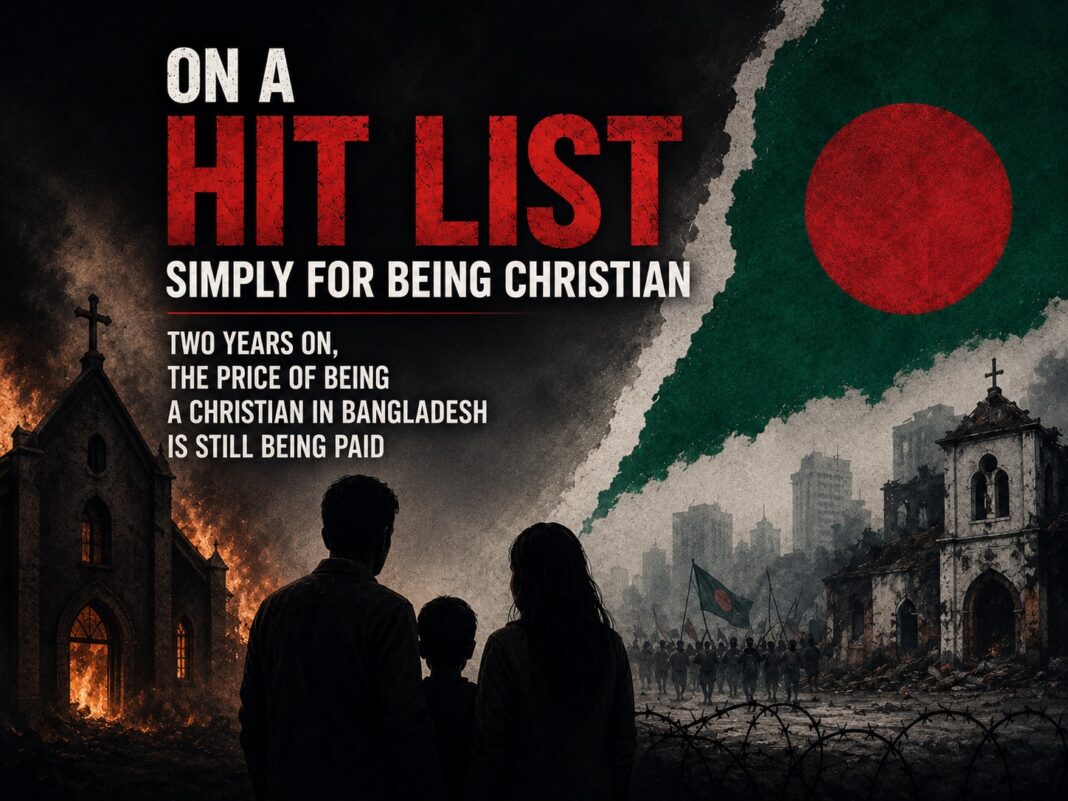

A motorcycle, a helmet, and a hijab. Those three items were all that stood between one Christian man and his wife and certain death.
In August 2024, as power in Bangladesh was being seized—according to the account—through the backing of several foreign states, the support of Islamist militant groups, and the military, his home was set on fire. His only “crime” was being a Christian. His name had already been placed on a hit list solely because of his religious identity. Had a friend from his church not arrived in time with a helmet and helped them escape, there might be no one left today to tell his story.
That man now lives in the United States. He is in his sixties. He believes that when he was in his thirties, Bangladesh was a country where Christians did not face this level of hatred simply because of their faith. But what happened during those months in 2024 changed him forever. Prisoners escaped after jails were broken open, police officers were killed and disappeared from the streets, and, amid the chaos, some groups began hunting down Christians and Hindus. Churches were burned, temples were demolished, and several locally known Hindu leaders lost their lives. These were not isolated incidents but part of a sustained wave of violence that lasted for months, targeting those who were not Muslim. Eventually, he fled to India with almost nothing, survived with the support of the Christian community there, and ultimately found refuge in the United States.
Another Christian tells a different story, but the fear is the same.
He was a school student at the time. His parents kept him confined to their home for months, terrified that something would happen to him if he went outside. At school, classmates beat him because he refused to renounce Christianity and convert to Islam. Now in his twenties, he says that even wearing a cross around his neck or dressing as he chooses—ordinary freedoms for any individual—fills him with quiet anxiety, as though those freedoms could be taken away at any moment.
Jamaat-e-Islami has now become the second-largest party in Parliament, securing several times more seats than it held two decades ago. There was a time when the party was banned from political activity after a court ruled that its registration conflicted with the constitutional principle of secularism. Twelve years later, that ban has been lifted, and the party has emerged as a significant parliamentary force. Its rise has deepened the sense of insecurity among many members of Bangladesh’s Christian community.
Although the political transition has largely settled, attacks against Christians have not ended. In November 2025, homemade bombs exploded outside several Catholic churches in Dhaka. In late April 2026, two men scaled the wall of a church, assaulted a priest, and robbed him. Alongside these incidents, another quieter crisis continues: many Christians have reportedly been burdened with false criminal cases, leaving some imprisoned and others forced into hiding within their own country simply because they are Christians.
Perhaps the most heartbreaking reality is that many Muslims in Bangladesh do not support the persecution of Christians. Yet many remain silent because they fear that speaking out could one day place their own names on similar lists. That silence is perhaps the most alarming sign of all, revealing how deeply fear and anti-Christian hostility have become embedded.
Two years have passed since that bloody summer. Governments have changed, yet for many Christian families in Bangladesh, security remains fragile and uncertain. Simply because they are Christians, many still wake up each morning wondering whether they will make it safely through another day.