
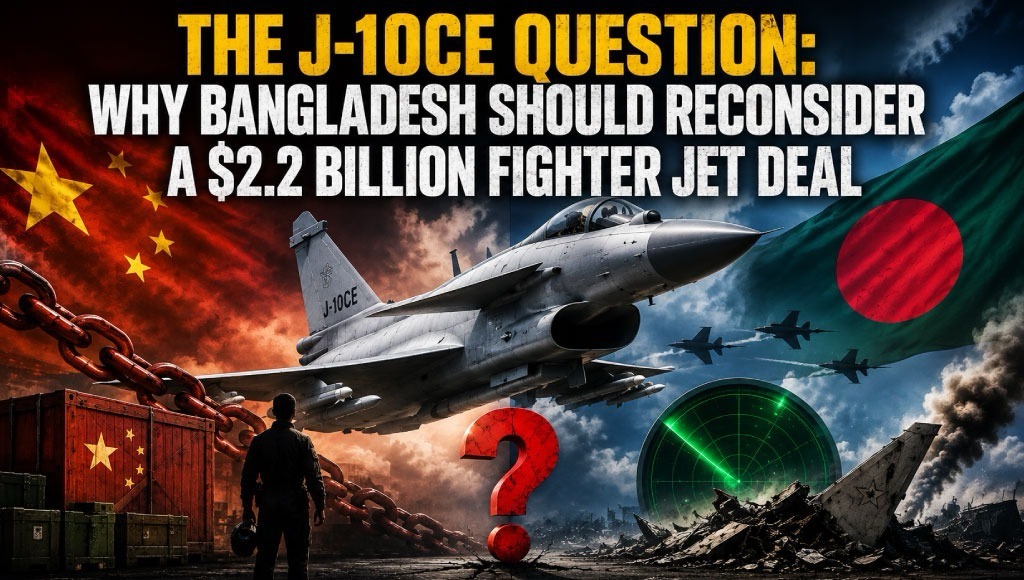

BNP government is moving toward finalizing one of the largest defense procurements in the country’s history: a deal worth roughly $2.2 billion for 20 to 24 Chinese-made J-10C/J-10CE fighter jets, with officials targeting a signing date as early as August.
But as Dhaka accelerates talks during Rahman’s visit to Beijing this week, the deal is drawing scrutiny over a question that goes beyond price or politics: how thoroughly tested the aircraft actually is.
A SINGLE-CUSTOMER TRACK RECORD
The J-10C, manufactured by Chengdu Aircraft Industry Group under the state-run Aviation Industry Corporation of China, has been in service with China’s own air force since 2018. Outside China, however, it has so far had only one foreign operator: Pakistan, which took delivery of its first jets in 2022 and has since acquired 25, with an option for 11 more, according to manufacturer and government statements compiled by aviation trackers.
If the Bangladesh deal closes, Dhaka would become just the second country to fly the aircraft — a fact several regional outlets, including Firstpost and the Times of India, have flagged in their coverage of the talks.
That matters for reasons that go beyond symbolism. Export fighter programs typically build a track record gradually, as multiple operators flying the same airframe under different conditions — climate, basing, maintenance practices, pilot training pipelines — surface problems the manufacturer’s own testing may not catch. With only one foreign customer to date, the J-10C export program lacks that comparative data. Indonesia has more recently signaled interest in the platform, and Serbian state media have reported Belgrade is weighing a purchase, but both remain in early, unconfirmed stages and do not yet provide an operational record Bangladesh could draw on.
ONE ENGAGEMENT, CONTESTED ACCOUNTS
The aircraft’s reputation as “combat-proven” rests almost entirely on a single event: the four-day military clash between India and Pakistan in May 2025, in which Islamabad says its J-10Cs engaged Indian Rafale jets. Pakistani officials and Chinese state media have cited the encounter as evidence of the J-10C’s edge in radar performance and beyond-visual-range engagements; some Chinese-aligned defense outlets have asserted the jets “achieved superior radar lock ranges against Rafale fighters.”
Independent verification of those claims is limited. New Delhi has not corroborated Pakistan’s account of the engagement, and assessments of what actually happened — including aircraft losses on either side — diverge sharply depending on the source. No neutral after-action investigation has been made public.
In other words, the principal evidence being cited for the jet’s battlefield performance comes from a single contested skirmish, relayed primarily through the accounts of the operator and the manufacturer’s own government. Western defense analysts who have written on the J-10C, including Justin Bronk of the UK’s Royal United Services Institute, classify it as a capable 4.5-generation fighter on paper — modern AESA radar, the PL-15 missile, a respectable combat radius — but caution that paper specifications and one disputed engagement are not the same as a multi-decade service record.
WHY THE COMPARISON TO PAKISTAN CUTS BOTH WAYS
Bangladeshi officials have pointed to nearly five decades of defense cooperation with Beijing — including the F-7 fighters and Q-5 attack aircraft that make up the bulk of the Bangladesh Air Force’s aging fleet — as a reason to trust Chinese hardware and an established supply relationship.
But the J-10C and its predecessor J-7 line are not comparable in pedigree. The F-7 is a derivative of the 1960s-era Soviet MiG-21, built and exported for decades, with a service history spanning dozens of air forces. The J-10C is a far more complex, sensor-and-software-dependent 4.5-generation aircraft introduced into Chinese service less than a decade ago, with the kind of network-centric systems — data links, integration with airborne early warning aircraft, electronic warfare suites — whose reliability typically only becomes clear after years of operational use across multiple customers. Trust built on the F-7 relationship does not automatically transfer to a fundamentally different aircraft generation.
THE UNRESOLVED QUESTION
None of this means the J-10C is an unsound aircraft, and Bangladesh’s underlying need to replace a Cold War-era fleet is not in serious dispute among analysts on any side. What is in dispute is whether a procurement of this size and duration — a 10-year financial commitment built around an airframe whose combat record consists of one contested engagement, assessed almost entirely through the accounts of its only existing foreign operator and the manufacturer’s home government — meets the evidentiary bar that decisions of this scale typically require. Bangladesh would not be the first country to buy an unproven platform for sound budgetary reasons. But it would be doing so as one of the first two air forces in the world betting its frontline fighter capability on a jet whose reputation is, for now, built on a single battle.
During the May 2025 India-Pakistan clash, Pakistan touted the J-10CE’s radar and missile performance against Rafales, but those claims were heavily disputed. Independent verification of kill counts and platform performance remains thin, meaning Dhaka would be buying into an unproven narrative rather than a demonstrated combat record. In 2016, a mid-air collision during an Aerobatics Team training flight in Hebei, killed China’s first female J-10 pilot, Yu Xu.
Beyond the contested performance question, the purchase deepens Bangladesh’s reliance on a single supplier for training, spare parts, and logistics, and risks locking the Bangladesh Air Force into a costly, dependency-heavy relationship.