

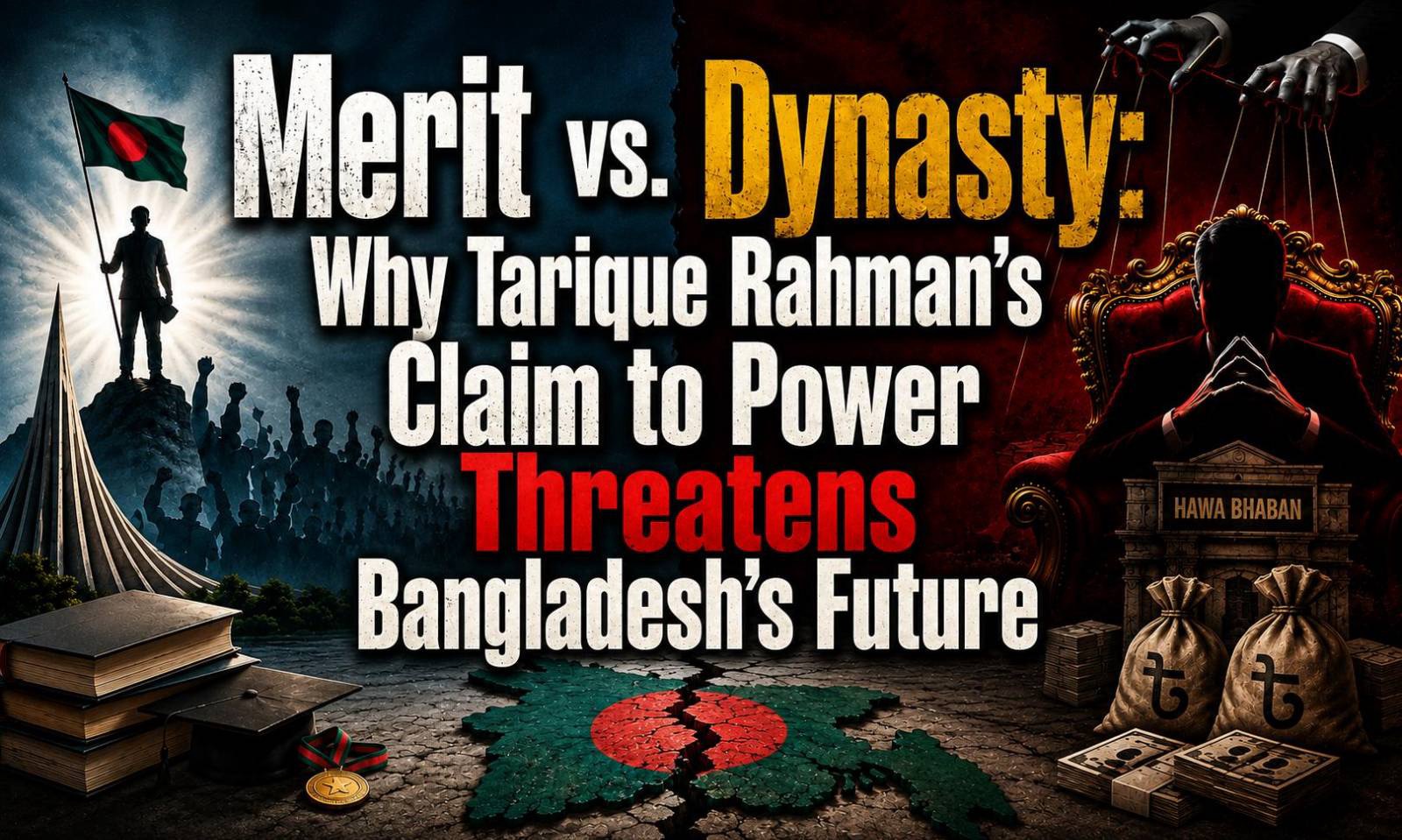
What has Tarique Rahman actually done to deserve the leadership of the Bangladesh Nationalist Party (BNP), let alone the prime ministership of a nation of 170 million people?
To understand why Tarique Rahman’s claim to power faces severe skepticism, one must contrast his path with the figures who defined Bangladesh’s political history.
The nation’s founder, Sheikh Mujibur Rahman, did not inherit a ready-made apparatus; he spent decades in and out of colonial and Pakistani prisons, organizing the grassroots movements that ultimately led to the 1971 Liberation War. His successor in the annals of power, General Ziaur Rahman, Tarique Rahman’s father, rose through the military ranks, fought with distinction in 1971, and navigated the brutal institutional chaos following the 1975 assassinations to eventually build the BNP from scratch on a platform of distinct nationalism.
Even the “dynastic heirs”, Sheikh Hasina of the Awami League and Begum Khaleda Zia of the BNP, who are frequently criticized by international commentators for establishing Bangladesh’s dynastic duopoly, earned their political stripes through intense struggle. Following the vacuums left by their respective family tragedies, both women faced a deeply traditional, conservative, and largely uneducated society. They did not simply inherit titles; they filled structural voids when no one else could hold their fractured parties together.
For nearly two decades, Hasina and Khaleda led street agitations against military dictatorship, survived repeated assassination attempts, faced prolonged imprisonment, and built genuine personal mandates through successive national elections. They possessed flaws, and their tenures were marked by bitter partisan conflict, but their political gravity was earned on the hot asphalt of Dhaka’s streets. Credit must be acknowledged where it is due: they held their organizations together because no one else possessed the institutional capability to do so.
The “Hawa Bhaban” Era: A Legacy of Parallel Governance
During his mother, Khaleda Zia’s government from 2001 to 2006, Tarique Rahman held no official cabinet position. Yet from the BNP office known as Hawa Bhaban, he exercised considerable influence.
Tarique symbol of violent politics
International diplomatic assessments from that era paint a troubled picture. Declassified U.S. embassy cables from Dhaka went so far as to describe him as a symbol of “kleptocratic government,” alleging that his inner circle systematically exacted percentages on state contracts and foreign direct investments. This parallel governance apparatus undermined institutional transparency, directly contributing to Bangladesh consistently ranking at the bottom of Transparency International’s Corruption Perceptions Index during that period.
Hawa Bhaban and the 10% Empire: How Tarique Rahman Turned the State into a Business
This evasion of accountability had real consequences for everyday citizens. Major infrastructure deals, including the highly controversial Niko Resources agreement and various national power grid expansions, became heavily entangled in allegations of institutional bribery and cronyism, severely damaging the nation’s economic credibility with international lenders.
Tarique sold electric poles at higher prices
Bangladesh: Tarique Rahman jailed for money laundering
Institutional Decay and Judicial Outcomes
Beyond economic missteps, the period of Rahman’s ascendance coincided with severe institutional degradation and a steep decline in domestic security. The most damaging blow to his domestic and international standing remains his legal conviction for his role in the August 21, 2004, grenade attack targeting an opposition rally, an incident that killed 24 people, injured hundreds, and permanently altered the country’s political landscape by shattering democratic norms.
Furthermore, during this period, the state struggled to contain or openly ignored the rise of violent extremist cells in the country’s northern regions, severely damaging Bangladesh’s reputation as a moderate, secular democracy.
| Period | Structural Record | Institutional Impact |
| 2001–2006 | Shadow state via Hawa Bhaban | Bottom global corruption rankings; bypassed the civil service |
| August 2004 | Escalating political violence. | Grenade attack convictions deepened polarization. |
| 2008–2025 | Remote control from London | Avoided local accountability; party reliant on family legacy |
For nearly two decades, Rahman has managed the BNP via remote video links from London, having left the country under a judicial bond during the 2007–2008 caretaker government. Apologists frequently argue that his primary achievement is keeping the party apparatus intact during years of intense state pressure. However, local political analysts note that the party’s structural survival relies far more on the lingering goodwill of his mother, Begum Khaleda Zia, and the resilience of grassroots organizers who faced the brunt of law enforcement actions on the ground.
Bangladesh’s Crossroads: Beyond Bloodlines
The 2024 student uprising that toppled Sheikh Hasina exposed a fierce demand for accountability and new leadership. The 2026 elections handed the BNP a strong mandate. Yet one sharp question remains: What has Tarique Rahman actually built or achieved to lead 170 million people through economic turmoil, institutional rot, and youth despair?
Survival in London, exile, and family loyalty are thin credentials for the premiership. In South Asia’s dynastic playground, bloodlines too often recycle the very pathologies, parallel power, cronyism, and eroded trust that plagued Hawa Bhaban.
Bangladesh’s resilient young population deserves better: leaders judged by merit, results, and integrity, not inheritance. The world is watching whether Rahman can escape his past or will drag the nation back into it. The stakes, for governance, stability, and hope, could not be higher.