

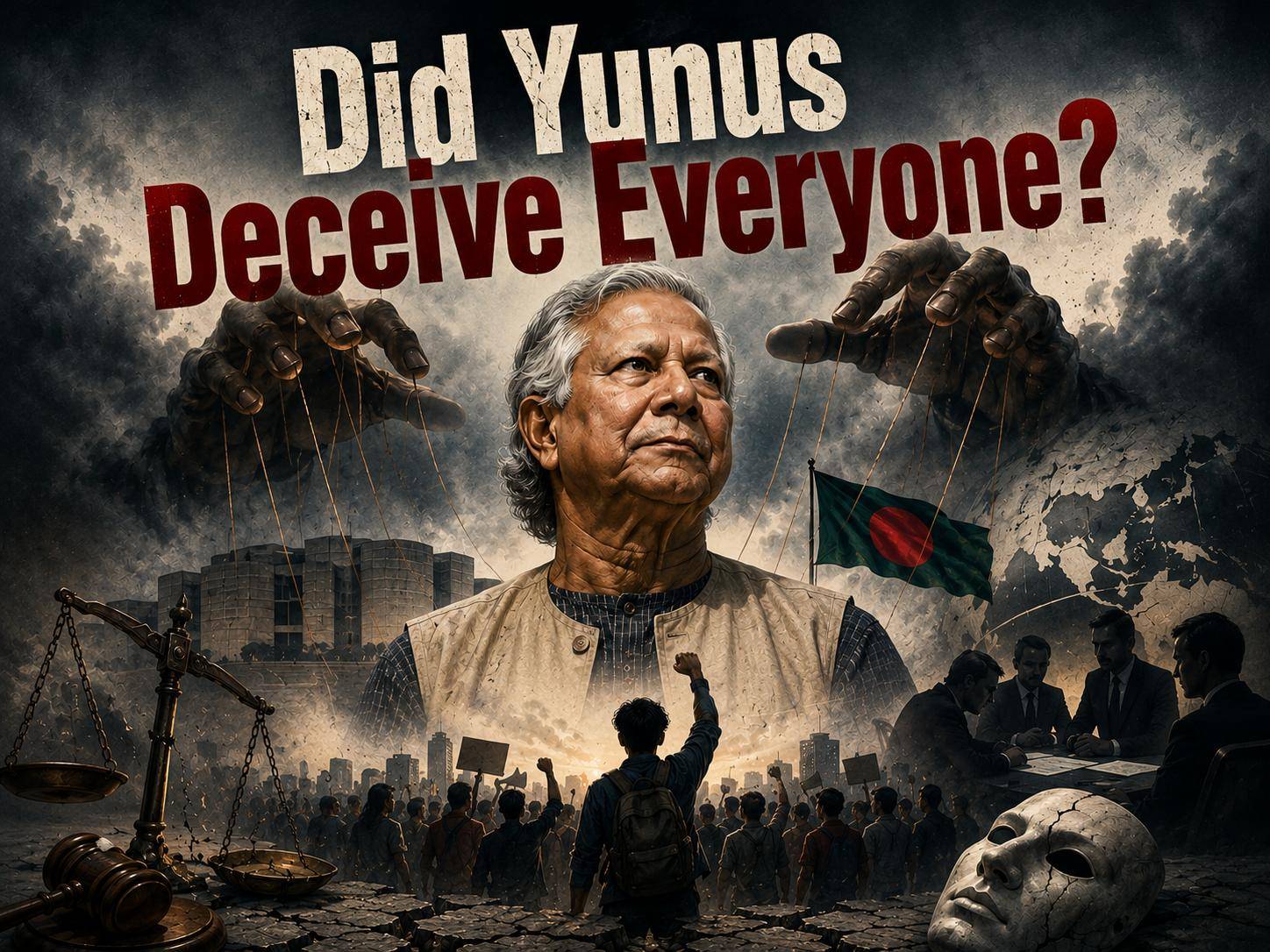
Some people can be fooled for a short time, but no one can fool everyone forever. That truth now seems to be proving itself once again. One after another, the darker chapters of Nobel Peace Prize laureate Dr. Muhammad Yunus’s year-and-a-half in power are being exposed. Promising to transform the country, many critics argue that he not only changed his own fortunes but effectively sold out the nation. More importantly, they claim he betrayed even those who helped place him in power. According to these allegations, Yunus deceived everyone except himself during his rule.
Just three months after handing power over to an elected government, several of his close associates have begun publicly revealing details about his administration. The latest addition is former Foreign Affairs Adviser Touhid Hossain. In a recent interview, he openly disclosed that the “Agreement on Reciprocal Trade” signed with the United States in Washington on February 9 was concluded without any meaningful involvement of the Foreign Ministry. He stated:
“Neither the Foreign Minister nor the Foreign Ministry was involved in this agreement in the slightest. It involved the Commerce Ministry and the National Security Adviser (Dr. Khalilur Rahman). There may have been reasons behind it that forced us into signing. Otherwise, it would have been more appropriate to leave the matter to an elected government.”
Dr. Yunus has not publicly challenged this statement. If true, critics argue it suggests he ignored basic administrative protocol and bypassed standard governmental procedures. Questions have therefore been raised about whether he had the moral or legal authority to sign such an agreement while allegedly keeping other advisers in the dark.
Earlier, one of Yunus’s closest allies and a member of his so-called “kitchen cabinet,” Asif Nazrul, reportedly claimed he was not consulted regarding the agreement. Another adviser, Farida Akhter, stated that she fought against the deal until the very end but failed to stop it.
Taken together, these statements suggest two things to critics. First, they argue Dr. Yunus governed without regard for the opinions of others and acted primarily in the interests of select groups. Second, they say the advisers now criticizing him are themselves responsible, because they remained silent while serving in office. Had they protested publicly at the time, many believe the public would have praised their integrity. Instead, critics argue their silence reflected opportunism and self-interest.
Beyond the trade agreement, allegations regarding the measles-related child deaths have also intensified scrutiny of the Yunus administration. UNICEF reportedly warned the interim government at least five times about a possible vaccine shortage through official letters to the Health Ministry and repeated the warning in ten separate meetings with government officials. According to UNICEF representative Rana Flowers, changes made to the vaccine procurement process during the interim administration delayed vaccine arrivals in Bangladesh.
When Yunus first took office, he claimed the students who led the July movement were effectively his employers. Many believe he encouraged them to form a political party. But critics now argue that he ultimately betrayed the students as well.
Following the July movement, many believed his primary responsibility should have been restoring stability and strengthening the rule of law. Instead, critics allege that Yunus used students to advance his own political agenda, turning them into a political force to suppress opposition through mob pressure and street politics. They argue that instead of guiding students back to education, he drew them deeper into political confrontation.
According to critics, this damaged the image of the anti-discrimination movement’s young leaders. Rather than empowering them academically and politically in a constructive way, they allege he exposed them to corruption, patronage, and power struggles. Less than two years after the July movement, the reputations of many activists have reportedly become deeply controversial. Now, as some of those young leaders face growing political and personal difficulties, critics say Yunus has remained silent. Recently, Nahid Islam, one of the prominent leaders of the NCP and the anti-discrimination movement, publicly called on Yunus to support implementation of the July Charter. Yunus reportedly did not respond.
Some supporters claim Yunus treated the BNP fairly by overseeing the February 12 election. Critics, however, argue he only agreed to hold elections after pressure from powerful international backers who had initially supported his administration. By that point, they say, the country had already been pushed into deep crisis.
According to these critics, Bangladesh’s economy deteriorated severely during the Yunus administration. The private sector weakened, the country’s international reputation suffered, and relations with neighboring countries declined. They claim that education, healthcare, law enforcement, the judiciary, media, and social stability were all left in disorder before the election was finally held.
Meanwhile, critics argue Yunus focused primarily on securing his own interests during his time in power. They allege that legal cases against him were withdrawn, tax burdens reduced, corruption charges cleared, and various institutional and business advantages secured. According to his detractors, everyone suffered except Yunus himself — and Bangladesh suffered the most.
In the words of critics, the Nobel laureate’s ultimate goal appeared to be simple: overturn everything and enrich himself in the process.
— Aditi Karim, Writer and Playwright