
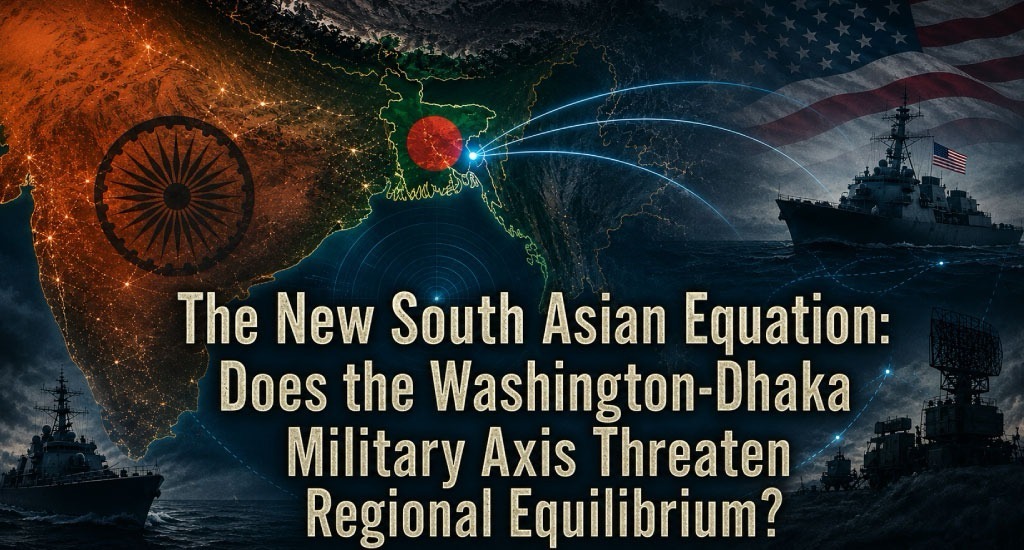

By moving away from its traditional stance of strict neutrality, Bangladesh’s temporary administration has introduced a quiet, unpredictable variable right on India’s eastern flank.
In the volatile waters of the Bay of Bengal, neutrality has long been Bangladesh’s most prized strategic asset. Yet, in a hurried move that has sent ripples across South Asia, Bangladesh’s interim government has rushed into the General Security of Military Information Agreement (GSOMIA) with the United States. Promoted as a technical step toward military modernization, this pact raises profound questions: What has Bangladesh truly gained? And at what cost to its neighbors and its own hard-won independence?
Bangladesh opens port to US warships
Dhaka Must Tread Cautiously on ‘Routine Defense Agreements’ with the US
Critics rightly point out the absence of tangible benefits for Dhaka. No flood of advanced weaponry has materialized to transform the Forces Goal 2030. No ironclad security guarantees against regional threats. Instead, the deal has injected fresh uncertainty into an already delicate geopolitical landscape, alarming key partners like India and China while pulling Bangladesh deeper into great-power competition.
Trump Personally Pushes Tarique Rahman to sign GSOMIA In Exchange for Trade Preferences
The Rush to Sign: Questions of Timing and Transparency
The primary job of an interim government is simple: stabilize the country, keep the economy steady, and steer the nation toward a fair, democratic election. Taking a detour to sign a long-term strategic and military agreement, one that binds state institutions for years to come, feels like a significant stretch of that mandate. Looking closely at the deal, it is hard to find any immediate, practical benefit for Bangladesh. Proponents claim that signing GSOMIA is a necessary step if Dhaka wants to buy advanced American defense hardware. But in the middle of a serious economic crunch, committing to purchase expensive Western weaponry seems like an unnecessary financial strain.
When the global market is full of affordable defense alternatives and development partnerships that do not carry heavy political strings, locking the country into complex American logisticaland tracking frameworks lack practical sense. Instead of gaining strategic leverage, the temporary administration has essentially stepped onto a high-stakes global chessboard as a dependent player, giving up a piece of its autonomy without getting much in return.
Moreover, with China supplying over 70% of Bangladesh’s arms inventory historically and serving as a top economic partner, this shift risks alienating a vital stakeholder.
Security Concerns for Neighbors: A New Flashpoint in the Bay of Bengal
For over fifty years, Bangladesh’s foreign policy has been guided by a very simple, elegant rule: “Friendship to all, malice toward none.” This strict focus on remaining neutral is exactly what kept Dhaka safe from the rivalries of global superpowers. It allowed the country to build deep infrastructure connections with Beijing while simultaneously maintaining a vital, close relationship with New Delhi. It was a delicate balance, but it worked.
Will a U.S. Agreement Harm Bangladesh’s Relations With Other Countries?
By taking this step into the American security orbit, the current administration is breaking away from that historical neutrality. The agreement quietly pulls Dhaka into Washington’s wider Indo-Pacific framework, which is built entirely around containing other regional powers. Opening the door to closer military information sharing and potential logistical coordination near sensitive waters like the Bay of Bengal chips away at Bangladesh’s traditional policy of strategic ambiguity.
New Debate Over U.S. Agreement: Will It Pressure Bangladesh’s Foreign Policy?
It makes the country’s defense setup much more transparent to an outside superpower, and in geopolitics, transparency often equals vulnerability.
By allowing an outside global power to establish a formal foothold in the local neighborhood, the current governance structure risks quietly undermining decades of hard-won bilateral trust and predictability.
U.S. Military Access Agreement in Bangladesh May Raise Security Concerns for China and India
A New Reality on India’s Flank: Multi-Dimensional Strategic Risks
The agreement’s most immediate and troubling impact falls on Bangladesh’s neighbors, particularly India.
For India, a secure and predictable Bangladesh is not just a diplomatic preference; it is a geographic necessity. Bangladesh sits as a vital strategic buffer right next to India’s sensitive northeast corridor and the narrow Siliguri bottleneck. For more than a decade, Dhaka’s previous administration kept a very clear, reliable promise to its neighbor: Bangladeshi soil would never be used by outside global powers to threaten Indian security or upset the balance of the region.
Why US-Bangladesh trade deal poses challenges for India
Under that previous, long-standing leadership, a broad military intelligence pact like this one, which brings an external superpower right into the immediate belly of the subcontinent, would have faced immense resistance and likely never been signed. The former status quo recognized that bringing outside military entities into South Asia’s delicate equation would immediately create tension.
Today, with the political landscape in Dhaka completely changed under a pro-BNP and transitional shift, this new Washington-Dhaka axis introduces an unpredictable variable.
Establishing a formal pipeline for US military information sharing alters the local status quo, creating several critical, concrete security challenges for New Delhi:
- Pressure on the Siliguri Corridor (“Chicken’s Neck”): This narrow land strip connecting mainland India to its northeastern states is already a strategic vulnerability. Enhanced US intelligence-sharing and potential monitoring capabilities from Bangladeshi territory could increase surveillance risks around this critical corridor, complicating India’s ability to secure its eastern flank in any future contingency.
- Challenges to Maritime Dominance in the Bay of Bengal: The Bay is central to India’s Act East Policy and overall maritime security. Greater US logistical access could turn parts of Bangladesh’s coastline into nodes for broader Indo-Pacific operations. This might restrict India’s freedom of maneuver, force resource reallocations, and alter the naval balance that India has worked hard to shape.
- Impact on Northeast Security and Border Management: Historical cross-border connections mean any external intelligence or logistical presence in Bangladesh can indirectly affect stability in India’s northeast. It could complicate counter-insurgency efforts or create new layers of complexity in managing border dynamics with Assam, Tripura, and other states.
- Erosion of Bilateral Trust: Under previous leadership, India and Bangladesh had built defense dialogues, training programs, and some procurement ties. The current trajectory risks stalling or reversing that momentum. India now has to rethink its assumptions about a neighbor it once considered a reliable partner in regional stability.
- The Burden of a “Triple-Front” Dilemma: Rather than optimizing its military forces along its western boundary with Pakistan and northern mountainous borders with China, India is now forced to monitor its eastern flank as an evolving, unpredictable strategic theater. This division of defense resources fractures long-term planning, adding an unnecessary operational and financial burden to New Delhi’s defense budget.
These aren’t abstract worries. Analysts note that infrastructure built for one purpose can easily serve others, and proximity to India’s sensitive areas raises the stakes significantly.
US trade deal: Devil hidden in the fine print
U.S Plans To Deploy Warships In Bangladesh, Closer To India & China
Economic Complexities and Pressure from Beijing
At the same time, this hurried defense alignment is bound to raise red flags in China, Bangladesh’s largest trade partner and a major infrastructure investor. Beijing has always viewed the expansion of US military frameworks in Asia as an attempt at encirclement. Because Bangladesh relies heavily on Chinese raw materials and industrial inputs, the interim government’s sudden pivot into an American defense orbit brings serious risks. These kinds of US agreements often come with quiet, secondary compliance rules.
Dhaka could soon find itself under quiet pressure from Washington to follow specific technology supply-chain rules or trade restrictions aimed at China. Forcing a developing economy to pull away from its main economic engine in East Asia is a dangerous path. On top of that, these defense arrangements often carry long-term commercial expectations, potentially tying Dhaka to
buying expensive American LNG or agricultural products at prices well above the open market, moving the real financial cost directly onto the ordinary citizens.
What Bangladesh Gains, and What It Stands to Lose
Proponents claim GSOMIA unlocks high-end U.S. equipment and intelligence, modernizing forces amid evolving threats. Yet, evidence of concrete deliverables remains thin. Previous U.S. overtures emphasized these pacts as prerequisites, yet Bangladesh’s military modernization proceeded through diverse suppliers without them.
Defence Deal With US Could Result in Bangladesh Surrendering Intelligence Sovereignty
The real calculus appears geopolitical. For Washington, Bangladesh represents prime real estate in the Indo-Pacific chessboard. For Dhaka, short-term diplomatic or economic sweeteners may have proven tempting amid domestic pressures. But long-term, the costs to autonomy and regional relationships could prove prohibitive.
Compare this to the Awami League era: despite its flaws, that government steadfastly protected Bangladesh’s balancing act. Such an agreement, widely seen as tilting against key Indian interests in the Bay of Bengal, would have faced far greater internal scrutiny. Today’s interim framework, and any successor pursuing aggressive alignment, bears responsibility for altering a policy that served national interests for decades. This departure invites precisely the external anxieties now surfacing in New Delhi and Beijing.
Time for Reckoning: Urgency for Course Correction
Bangladesh stands at a critical crossroads. The Bay of Bengal is now a high-stakes theater of major-power competition where every misstep can have lasting consequences. GSOMIA does not stand alone; it signals a departure from proven neutrality into uncertain alliances.
Bangladesh simply cannot afford to damage its relations with its neighbors, especially India. Geography, economics, and shared history make strong, stable ties with New Delhi essential. Straining this relationship brings nothing but disadvantages: disrupted border trade and connectivity, heightened security tensions along a 4,000+ km border, complications in water-sharing and transit issues, and lost opportunities for mutually beneficial cooperation. Any perceived tilt that makes Bangladesh a new security concern for India will ultimately isolate Dhaka and weaken its own position rather than strengthen it.
Regional powers are already reassessing. India faces an altered neighbor that complicates its eastern perimeter. China sees shifting reliability in a key partner. For Bangladesh, the priority must remain safeguarding sovereignty, preserving balanced friendships, and refusing to become a pawn in great-power contests.