
Hypocrites often use noble-sounding words to hide their hypocrisy and mislead people. Those who have no trace of democracy within themselves are often the loudest voices speaking in its name. That is why Bangladesh has never lacked emotional rhetoric about democracy. There has been no shortage of attempts to spread confusion. Those whose source of power is the barrel of a gun are often the ones shedding the most crocodile tears for democracy. Those who destroyed democracy later claimed to be pioneers of “multi-party democracy.” In recent years, some so-called civil society figures did not merely lament for democracy — they practically wailed over its death. Over the past two years, the people of the country have witnessed their hypocrisy and seen their true faces. Frustrated, many now ask: Where is democracy? Where is the rule of law? Where are human rights? Looking at everything happening around us, the words of poet Jibanananda Das repeatedly come to mind:
“A strange darkness has descended upon this world today;
Those who are blind see the most now;
Those whose hearts hold no love, no affection, no compassion —
The world today cannot move without their advice.”
The BNP has spread many falsehoods and much hatred regarding elections held under the Awami League government. The BNP boycotted the 12th National Parliamentary Election and also abstained from local Upazila elections. In fact, many party leaders who participated in those local elections were expelled from the party. BNP leaders repeatedly declared that the party would not participate in any election under an Awami League government. But why? Were elections during BNP rule any better than those under the Awami League? A look through the pages of history provides the answer.
Who corrupted democracy in Bangladesh? How did they do it? Looking back, it becomes very clear who, when, and how elections were made controversial in Bangladesh — who destroyed democracy, who trampled human rights, and who boycotted elections out of fear of defeat.
It has always been the BNP that disrupted and discredited elections in Bangladesh. From vote rigging to other forms of electoral malpractice, BNP pioneered many of these practices. To manipulate election outcomes, the BNP reportedly created over 12 million fake voters. In a 2021 report, the BBC stated that among the one-sided and controversial general elections in Bangladesh boycotted by opposition parties was the Sixth Parliamentary Election held on February 15, 1996. A report in The New York Times on that election noted that most of Bangladesh’s 50 million voters did not participate. The report suggested voter turnout may have been below 10 percent. Before that, there was another notorious election — the Magura by-election of March 20, 1994 — considered one of the worst examples of vote rigging and electoral fraud in the country’s history.
Let us go back even further. The individual most responsible for poisoning Bangladesh’s democratic politics and political culture was Ziaur Rahman. After Bangladesh’s independence, religion-based politics was banned in 1972. In an effort to strengthen his political support, Ziaur Rahman re-legitimized religion-based political parties. Individuals who had opposed Bangladesh’s Liberation War were appointed ministers during his rule. War crimes suspect Ghulam Azam, who had fled the country, was allowed to return under Zia’s government. The same political trend continued during the rule of Begum Khaleda Zia.
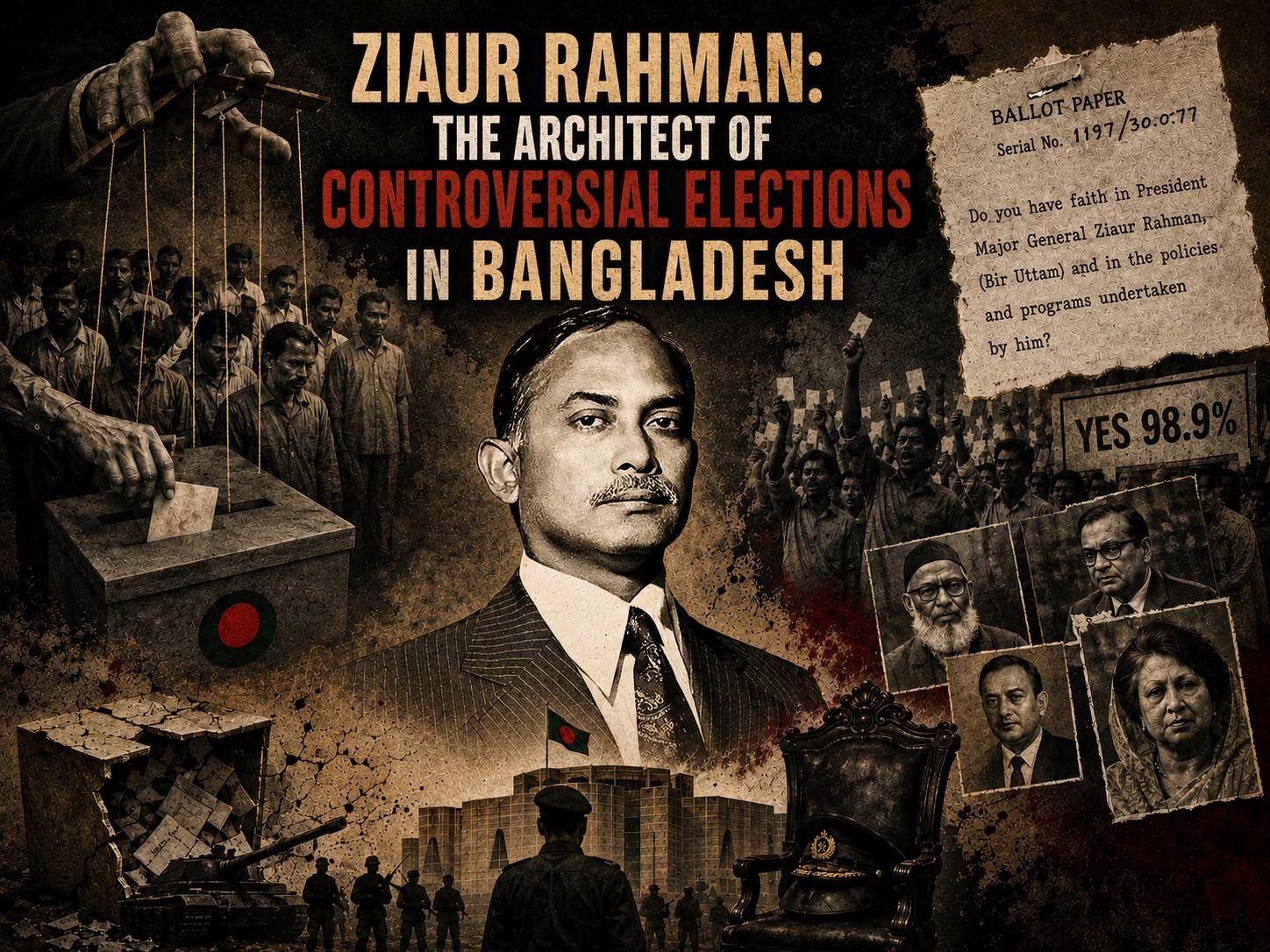
Bangladesh’s electoral system was fundamentally undermined on May 30, 1977. On that day, the country witnessed a bizarre referendum. A so-called vote of confidence was held asking voters whether they had confidence in President Major General Ziaur Rahman (Bir Uttam) and in the policies and programs adopted by him. The official result claimed that 98.9 percent voted “Yes,” with an 88.1 percent turnout. In Bangladesh’s electoral history, this vote is remembered as the infamous “Yes-No” referendum.
I would like to share the firsthand experience of one of my friends regarding that referendum. He is a freedom fighter, researcher, and journalist. On voting day, he and 13 of his friends went to cast their ballots, only to discover that votes had already been cast in their names. They protested loudly at the polling station, after which each of them was handed a ballot paper. They assumed that at least 13 “No” votes would be recorded at that center. But by evening, they learned that only three “No” votes had officially been counted there. Ziaur Rahman’s “Yes-No” referendum deeply undermined the credibility of Bangladesh’s electoral system. Even after all this, do they still have the moral standing to lecture others about democracy and elections?
Let us look back once more. On April 21, 1977, General Ziaur Rahman assumed the presidency after forcing President Abu Sadat Mohammad Sayem aside at gunpoint. Zia had already declared himself Chief Martial Law Administrator through a military decree. Later, through another decree, he declared himself President. He did not need votes to assume power. He simply seized the chair because he wanted it. At one point, he apparently felt the need to legitimize his rule, and thus organized the “Yes-No” referendum. That referendum or confidence vote was arranged solely to legalize his self-appointed presidency. It was Ziaur Rahman — the leader they continue to glorify — who inflicted one of the deepest and most shameful wounds on Bangladesh’s electoral system. What greater farce could there be than the May 30, 1977 referendum? Ironically, Ziaur Rahman himself was assassinated by a group of rebel soldiers on May 30 as well.
Author: M. Nazrul Islam, President of the All-European Awami League; Austria-based human rights activist, writer, and journalist.