

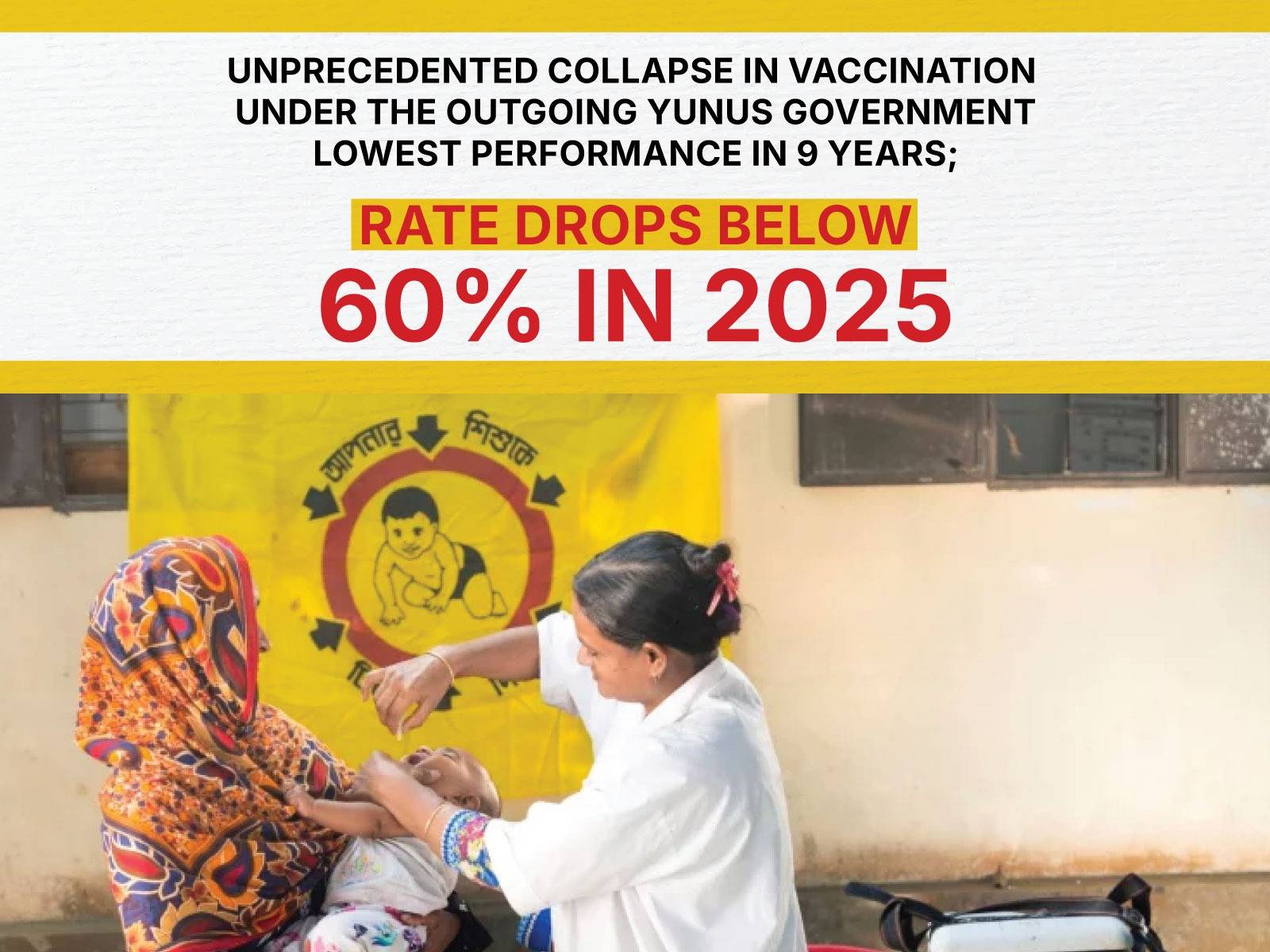
Lowest performance in 9 years; rate drops below 60% in 2025
Key highlights at a glance:
- In 2025, the vaccination rate has dropped to 59.6%.
- From 2017 to 2022, the average vaccination rate ranged between 90% and over 100%.
- Significant gaps have been observed in Measles and Rubella (MR) vaccinations.
- Experts blame inefficiency of the health adviser and lack of field-level monitoring.
- 40% of children are now at risk of life-threatening diseases.
During the tenure of the outgoing interim government led by Dr. Muhammad Yunus, severe mismanagement and lack of foresight in the health administration have led to a major setback in the country’s child health protection program. In 2025, the routine immunization (EPI) program for children has faced an unprecedented collapse—the worst in the past nine years. According to government statistics, the national average vaccination rate has alarmingly dropped to just 59.6%.
An analysis of vaccination data from the past nine years by the Directorate General of Health Services shows that from 2017 to 2022, Bangladesh was internationally recognized as a role model in immunization. The vaccination rate was 89.6% in 2017, 89.4% in 2018, and rose to 90.8% in 2019. Even during the global COVID-19 pandemic in 2020, the health sector managed to maintain a rate of 86.6%.
Bangladesh achieved its highest success in vaccination in 2021 and 2022.
The rate reached 100.6% in 2021 and climbed to a record 103.6% in 2022. However, from 2023 onward, the trend began to decline, with the rate falling to 93.6% that year. After the Yunus-led government assumed office in 2024, the rate further declined to 86.6%. The latest estimates for 2025 show a sharp drop to just 59.6%.
Data also indicate that the decline is most evident in life-saving vaccines for children such as BCG, Pentavalent-1, Pentavalent-3, and particularly Measles-Rubella (MR1 and MR2). Public health experts warn that if vaccination coverage falls below 95%, the risk of outbreaks of infectious diseases increases significantly. The current rate of 59.6% poses a serious threat to the country’s future public health.
There is also growing discontent within the health sector regarding the role of the outgoing government’s health adviser. Allegations include the removal of experienced officials in the name of reform and failure to properly monitor vaccination activities at the field level.
The statistics have also sparked strong reactions on social media. Many users claim that earlier warnings about the vaccination crisis were suppressed by government supporters or certain groups, but now official data itself reveals the fragile state and severe shortcomings of the health sector.
A senior official of the Directorate General of Health Services, speaking on condition of anonymity, said that urgent and effective measures are needed to overcome this crisis. Otherwise, diseases such as polio, measles, or tuberculosis—once under control—could re-emerge in severe forms. Members of civil society and health experts believe that the “negligence” of the outgoing government has undermined long-standing achievements in Bangladesh’s health sector. Addressing this massive gap will be the biggest challenge for the incoming administration.