

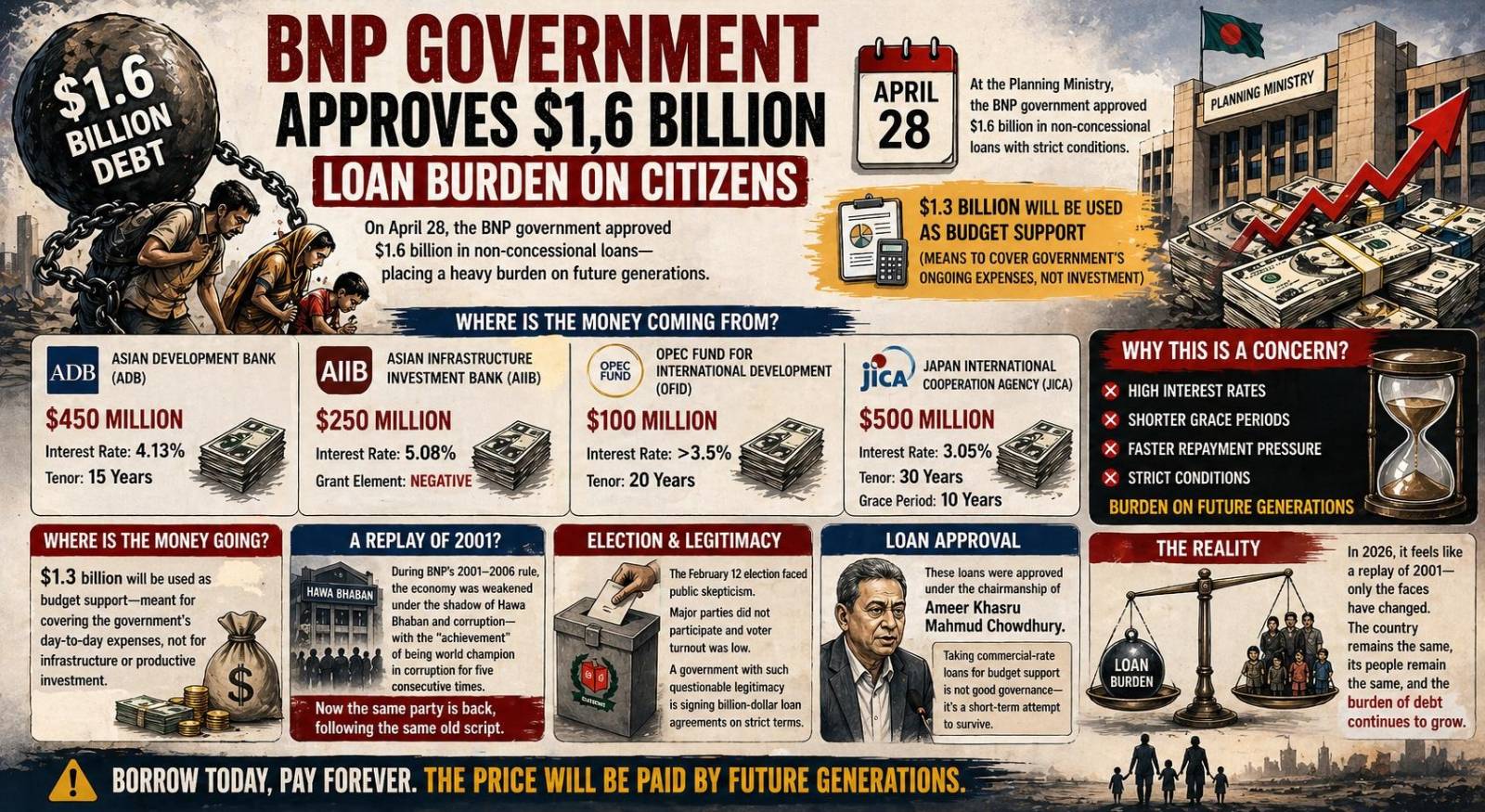
On April 28, at the Planning Ministry, the BNP government made a decision that, in simple terms, places yet another heavy burden on future generations. They approved $1.6 billion in non-concessional loans—meaning loans with strict conditions. Anyone familiar with basic finance understands that non-concessional loans come with near-market interest rates, shorter grace periods, and faster repayment pressure. In simple terms, such loans are far from comfortable for a country like Bangladesh.
Of this, $450 million is being taken from the Asian Development Bank at an interest rate of 4.13% for just 15 years. The Asian Infrastructure Investment Bank is providing $250 million at around 5.08% interest. Another $100 million is coming from OPEC Fund at over 3.5% interest. Looking at the grant element of these loans is alarming—in the case of AIIB, it is negative, meaning this is not soft financing but almost commercial borrowing.
The next question is: where is this money going? It is being said that $1.3 billion will be used as budget support. Budget support means covering the government’s ongoing expenses—not infrastructure, not productive investment. In other words, strict-condition loans are being used to run day-to-day expenses. It is hard to imagine a worse example of financial management.
The election held on February 12 is widely known to have faced public skepticism. Major political parties did not participate, and voter turnout was low. A government formed under such circumstances is now signing billion-dollar loan agreements on strict terms, potentially tying the country into long-term debt obligations for decades.
Those who remember the 2001–2006 BNP administration have not forgotten how the economy was weakened during that time. The period was marked by governance under the shadow of Hawa Bhaban and repeated global rankings in corruption. Now, the same party is once again in charge of the economy, seemingly following the same pattern—borrow heavily, spend now, and worry about the future later.
These loans were approved under the chairmanship of Ameer Khasru Mahmud Chowdhury. While the name carries weight, it is unclear whether the seriousness of the responsibility is fully understood. Taking commercial-rate loans for budget support is not a sign of good governance—it reflects a short-term attempt to manage immediate pressures with whatever resources are available.
Among the loans, JICA’s $500 million appears relatively manageable, with a 3.05% interest rate, a 30-year term, and a 10-year grace period. But what about the others? The grant element of the AIIB loan is negative. Even the Economic Relations Division’s own analysis highlighted this—yet approval was still granted.
In 2026, it feels like a replay of 2001—only the faces have changed. The country remains the same, its people remain the same, and the burden of debt continues to grow in much the same way.