

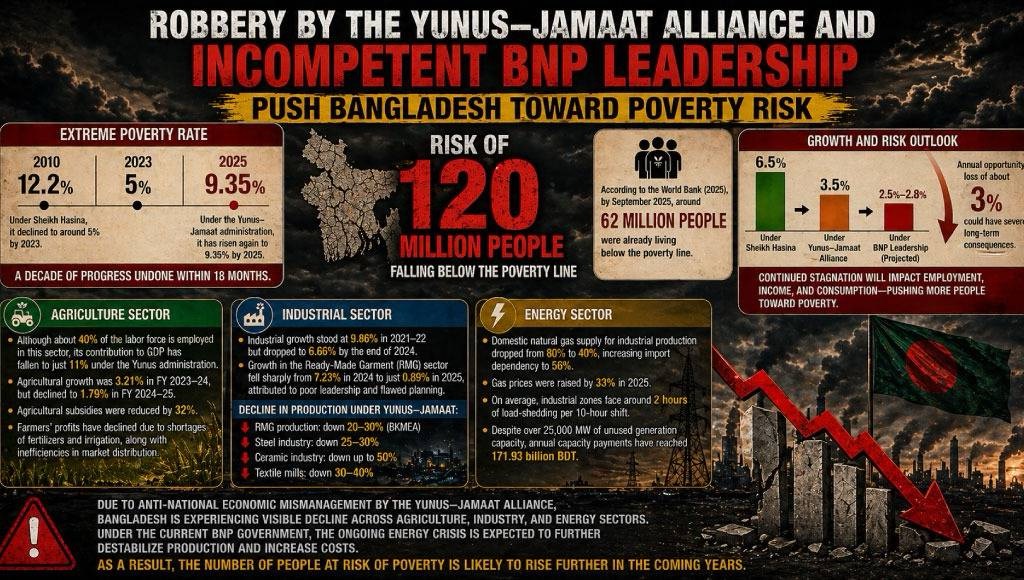
Risk of 120 Million People Falling Below the Poverty Line
In the context of recent economic trends, more than 100 million people in Bangladesh are currently at risk of falling below the poverty line. If total production declines by a further 10 percent, this number could rise to nearly 120 million.
According to data from the Power and Participation Research Center (PPRC), the extreme poverty rate stood at 12.2% in 2010. Due to planned policy measures under Sheikh Hasina, it declined to around 5% by 2023. However, under the Yunus–Jamaat administration, it has risen again to 9.35% by 2025. In other words, a decade of progress has been undone within 18 months. As a result, nearly one-third of the country’s population is now at severe risk of poverty.
According to the World Bank (2025), by September 2025, around 62 million people were already living below the poverty line—marking a significant setback in poverty reduction achievements.
Agriculture Sector:
- Although about 40% of the labor force is employed in this sector, its contribution to GDP has fallen to just 11% under the Yunus administration.
- According to BBS data, agricultural growth was 3.21% in FY 2023–24, but declined to 1.79% in FY 2024–25 under the Yunus–Jamaat government.
- Agricultural subsidies were reduced by 32%.
- Farmers’ profits have declined due to shortages of fertilizers and irrigation, along with inefficiencies in market distribution.
Industrial Sector:
- Industrial growth stood at 9.86% in 2021–22 but dropped to 6.66% by the end of 2024 under the Yunus–Jamaat administration.
- Growth in the Ready-Made Garment (RMG) sector fell sharply from 7.23% in 2024 to just 0.89% in 2025, attributed to poor leadership and flawed planning.
Decline in production under Yunus–Jamaat:
- RMG production: down 20–30% (BKMEA)
- Steel industry: down 25–30%
- Ceramic industry: down up to 50%
- Textile mills: down 30–40%
Energy Sector:
- Domestic natural gas supply for industrial production dropped from 80% to 40%, increasing import dependency to 56%.
- Gas prices were raised by 33% in 2025.
- On average, industrial zones face around 2 hours of load-shedding per 10-hour shift.
- Despite over 25,000 MW of unused generation capacity, annual capacity payments have reached 171.93 billion BDT.
Growth and Risk Outlook:
Bangladesh’s GDP growth averaged 6.5% under Sheikh Hasina but has declined to around 3.5% under the Yunus–Jamaat alliance. It is projected to fall further to 2.5–2.8% under BNP leadership. This implies an annual opportunity loss of about 3%, which could have severe long-term consequences. Continued stagnation may significantly impact employment, income, and consumption.
Due to what is described as anti-national economic mismanagement by the Yunus–Jamaat alliance, Bangladesh is experiencing visible decline across agriculture, industry, and energy sectors. Under the current BNP government, the ongoing energy crisis is expected to further destabilize production and increase costs. As a result, the number of people at risk of poverty is likely to rise further in the coming years.