

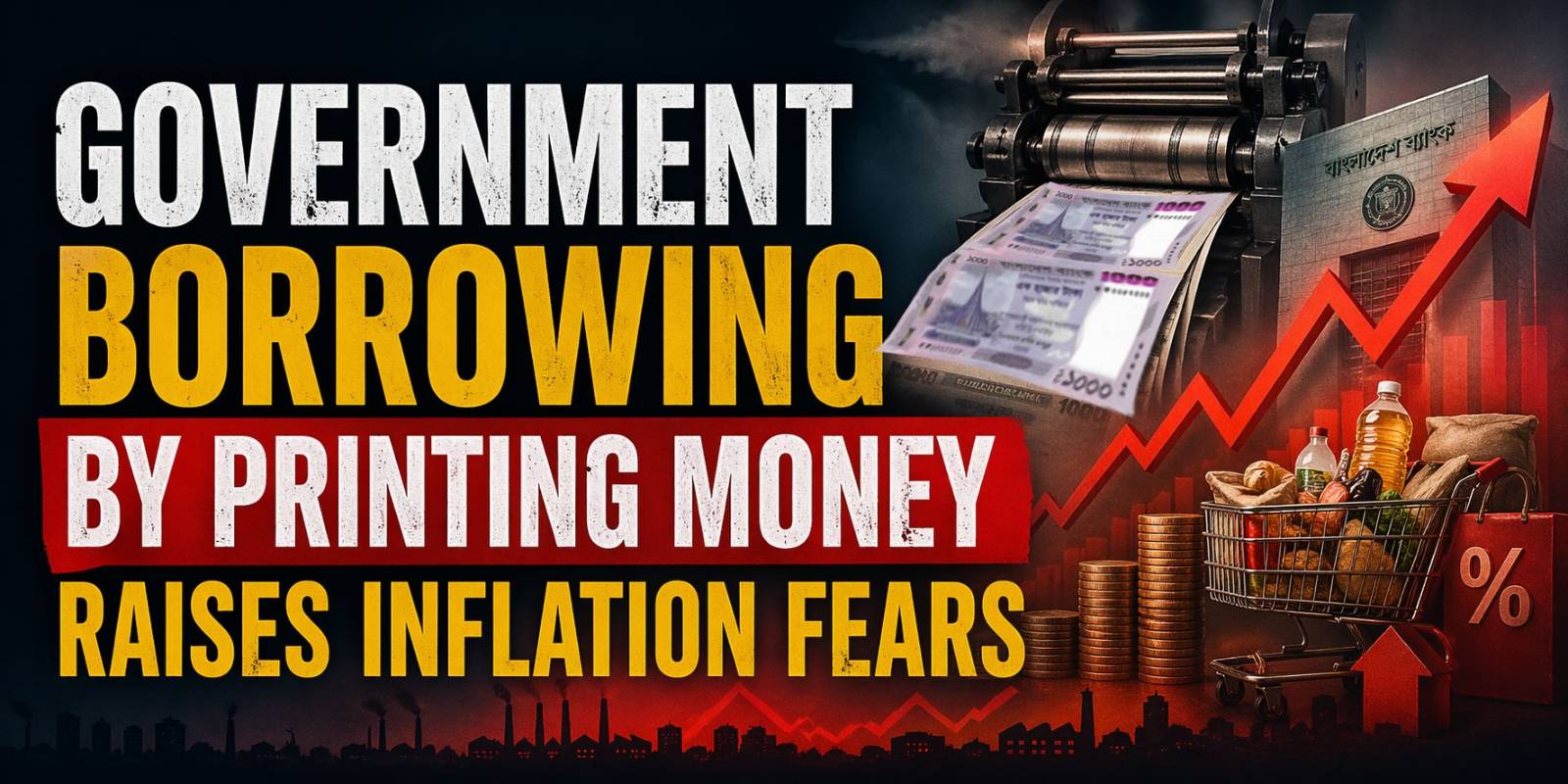
Bangladesh’s fragile macroeconomic situation is facing renewed concern, as economists warn that the government’s growing reliance on borrowing through money creation could intensify inflationary pressures.
The issue was highlighted on Thursday (23 April) at a seminar organised by the Policy Research Institute (PRI) in the capital’s Banani area. Speaking at the event, PRI’s Chief Economist Dr. Ashiqur Rahman said the government borrowed around 20,000 crore taka from Bangladesh Bank in March alone.
He described the borrowing as “high-powered money” — effectively newly printed currency — and warned that such measures, taken alongside weak revenue collection, risk fuelling inflation. The government, he said, is increasingly dependent on both high-interest borrowing from commercial banks and direct financing from the central bank to cover its fiscal deficit. Economists caution this will directly impact consumer markets, pushing prices higher.
At the same seminar, Mahbubur Rahman, President of the International Chamber of Commerce Bangladesh (ICCB), said uncertainty is weighing heavily on investment decisions. Business leaders remain hesitant due to unreliable electricity and gas supplies, which are disrupting industrial production. He added that without confidence among local investors, attracting foreign investment will be difficult. Increased government spending linked to political commitments is also contributing to inflationary pressure.
The broader economic outlook presented at the seminar paints a concerning picture. GDP growth has slowed to around 3% in the second quarter of the current fiscal year — the lowest since the pandemic period. Non-performing loans in the banking sector have surged to around 30%, while private sector credit growth has dropped to just 6%. Meanwhile, rising global energy prices, partly driven by tensions in the Middle East and instability in the Red Sea, are adding further strain to import costs.
Economists warned that printing money without structural market reforms increases the money supply without boosting real production. This creates a situation where more money chases fewer goods, leading to higher inflation. Excessive money creation can also weaken the domestic currency against the US dollar, further increasing import costs.
The burden is expected to fall most heavily on fixed-income groups, whose purchasing power declines as prices rise. Over time, this could widen income inequality, benefiting asset holders while pushing lower- and middle-income households into deeper financial hardship.