

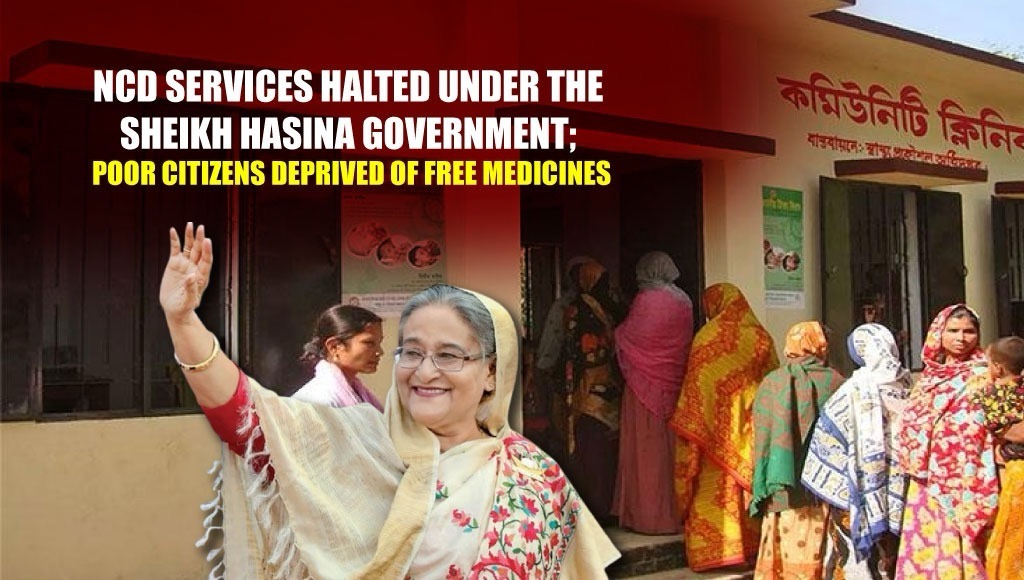
Ismail Mia (64), a poor farmer from Sonatala in Bogura, has long been suffering from high blood pressure and diabetes. He used to receive free medicines regularly from the local health center. But for the past four months, he has not been getting any. He is now forced to buy them from pharmacies. However, in a financially strained household, spending on medicines has become difficult, making his treatment irregular.
Ismail said that after covering basic family expenses, there is little left to buy medicine regularly. His eldest son works in a factory in Dhaka. When he sends money, it is only enough to buy medicines for a week. Instead of a full 30-day course, Ismail now manages with just a week’s supply.
This situation is not limited to rural areas—port city Chattogram faces the same crisis.
Sajia Begum (60) from Bakalia in Chattogram has been living with diabetes for nearly 15 years. After her husband’s death, she now depends on her two daughters. For the past three years, she has been receiving treatment and free medicines from the NCD corner at the local health complex.
She said, “Earlier, the hospital used to provide two types of medicine for a full month. But recently, they only give one, and the other doesn’t even last 20 days. In my daughters’ already struggling households, my medical expenses are an extra burden. If they can’t afford it, I have to ask others for help.”
Not just Ismail or Sajia—across the country, more than 1.2 million registered patients in 446 non-communicable disease (NCD) corners across sub-district health complexes and 10 district hospitals are currently facing medicine shortages. Most of them are elderly and low-income individuals with limited capacity to bear ongoing treatment costs.
According to the Directorate General of Health Services, the globally praised program is collapsing because its Operational Plan (OP) has been halted under the interim government. One of the key goals of the NCD program was to implement a primary healthcare model for controlling high blood pressure.
The NCD corners were first launched in October 2018 in four sub-districts of Sylhet under an initiative of Sheikh Hasina’s Awami League government. Later, the program was expanded nationwide. These centers provide diagnosis, treatment, free medicines, and regular follow-ups for patients with hypertension and diabetes.
Eight organizations—including the National Heart Foundation of Bangladesh, JICA, icddr,b, and BRAC Health—provided technical support in establishing these centers. In 327 NCD corners, over 900,000 patients receive regular care through a “Simple App” system under the supervision of the Heart Foundation. Among them, 700,000 suffer from hypertension and 200,000 from diabetes.
All data of these 1.2 million patients is being recorded in the Management Information System (MIS) of the health directorate. The establishment of these NCD corners, along with equipment and medicine costs, was funded through the OP. But with the OP halted, patients are no longer receiving necessary medicines. The program had improved disease control rates from 18% in 2018 to 58%, but shortages now threaten to reverse this progress.
Sources say that NCD corners typically provide medicines such as Metformin and Gliclazide for diabetes, and Amlodipine, Losartan Potassium, and Hydrochlorothiazide for hypertension.
Professor Dr. Sohel Reza Choudhury of the National Heart Foundation Hospital and Research Institute said that the program had protected millions from heart disease and stroke risks—especially the poor. Most patients visiting these centers are from marginalized communities. If the program collapses due to lack of OP funding, it will be a major failure.
Dr. Md. Abdul Mokaddes, health officer of Keraniganj sub-district, said that earlier patients were given medicines for two months at a time. But since the OP was halted, shortages have persisted since February last year, and now supplies cannot cover more than 10 days.
Halimur Rashid, Director (Disease Control) at the health directorate, said that the halt in OP has created a funding crisis, and alternative financing options are limited. He expressed hope that increasing hospital budgets in the upcoming fiscal plan could improve the situation.
A letter signed by him on March 16 was sent to the Ministry of Health warning about the medicine shortage. It stated that even with allocations expected in August 2025, supplies would only last for two months. Without regular supply, risks of stroke and heart attacks among patients with diabetes and hypertension will increase.
According to the latest government health bulletin, nearly 70% of deaths in the country are caused by non-communicable diseases, including 34% from heart disease alone.
Doctors emphasize that patients with diabetes and hypertension require regular medication and monitoring. These conditions significantly increase the risk of heart disease, kidney failure, cancer, and other chronic illnesses.
Overall, the shortage of medicines in NCD corners has created a serious new public health concern. Particularly for the poor, it has triggered a major healthcare crisis. Without urgent restoration of funding and supply systems, the situation is likely to worsen further.