
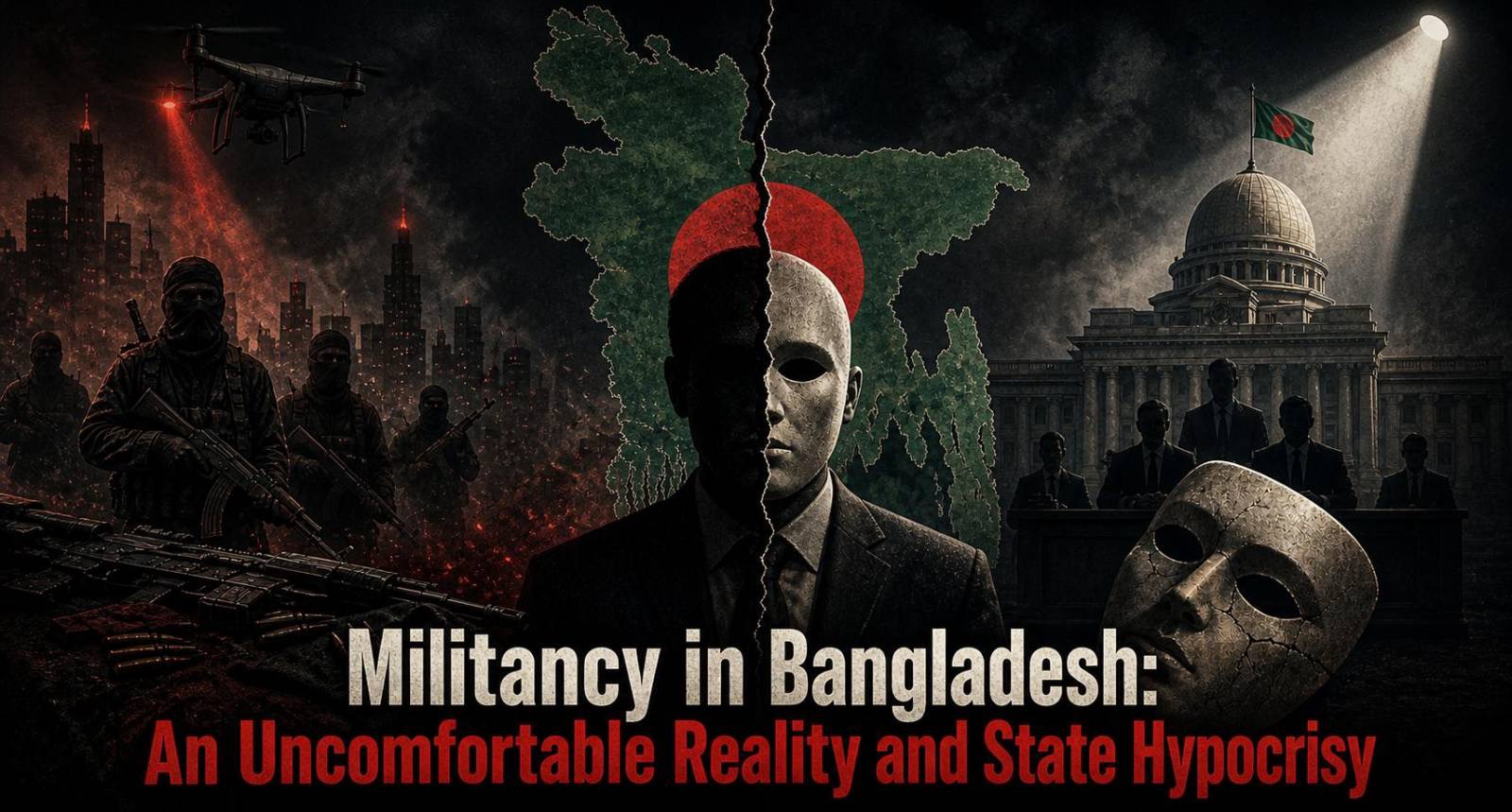
Recent developments have brought an undeniable truth to the forefront. A confidential letter from police headquarters, the arrest of four ‘Aqsa’ members from the heart of the capital along with advanced weapons and drones, and, most notably, the disappearance of a member of the air force who reportedly joined a Tehrik-i-Taliban Pakistan (TTP) camp—all point to one conclusion: militant forces remain active within Bangladesh and are now more technologically equipped and organized than ever before.
However, the behavior of the BNP-led government on this issue is proving to be dangerously counterproductive. The contradictory statements from Home Minister Salahuddin Ahmed and the Prime Minister’s Information Adviser Dr. Jahed Ur Rahman highlight a deep moral and policy bankruptcy within the government.
On one hand, the Home Minister refuses even to acknowledge the term “militancy,” stating bluntly, “I do not recognize that term… such things do not exist in Bangladesh at present.” On the other hand, the Prime Minister’s adviser admits almost the opposite: “It is a fact that militancy exists in Bangladesh… and we want to combat it.”
What message does this contradiction from two top figures of the same government send to the public? When the state itself is indecisive, it is hardly surprising that extremist groups are becoming more organized—building bombs, deploying drones, and establishing networks with international terrorist organizations like TTP. This reflects a familiar strategy of an unconstitutional force that has effectively hijacked democracy. Acknowledging militancy risks political backlash, while denying it invites international pressure. Ordinary citizens are the ones paying the price for this duplicity.
This government itself emerged from a non-participatory, farcical process. In February 2026, after boycotting major political parties, this group—allegedly nurtured within Ziaur Rahman’s military cantonment—came to power. The culture of repression within it, rooted in authoritarian practices, now appears under the guise of counterterrorism. In reality, it continues to carry the same collaborator mindset. The term “Razakar” no longer simply means “volunteer”; it symbolizes betrayal and collusion with the nation’s enemies. BNP’s past alliance with Jamaat fostered the early growth of militancy in the country, and today they find themselves entangled in the very forces they once enabled.
So, who exactly are militants?
Many people confuse terrorism with militancy, but the distinction is crucial. Consider this example: if Hizb ut-Tahrir murders someone with machetes, and members of Chhatra Dal commit a similar act, both are violent—but the motivations differ. A Chhatra Dal attacker may kill for worldly gains—money, influence, or even trivial reasons like funding drug use. It is a heinous crime, but it is terrorism. In contrast, a Hizb ut-Tahrir member may kill for perceived rewards in the afterlife. Killing in pursuit of an unproven afterlife, branding others as infidels, and embracing suicide in hopes of paradise—this is militancy. And that is what makes it more dangerous than conventional terrorism: it leaves no room for negotiation or humanitarian appeal.
The current government’s refusal to acknowledge this distinction—and its attempt to frame political violence by Chhatra Dal as mere “political activity”—is deeply opportunistic. While denying reality, international militant networks like TTP have reportedly begun to establish roots even within the armed forces. The disappearance of an air force member, internal investigations, and the presence of Bangladeshi militants on Pakistani soil stand as stark evidence against such denial.
Militants have not retreated; they have regrouped, often after securing bail. Law enforcement data shows that in the past three years, 1,231 militants have been released on bail. Among them, 114 have disappeared, and 370 accused individuals remain at large. Nine death-row militants who escaped from prison in August 2024 are still fugitives. Yet the Home Minister continues to claim, “Such things no longer exist in our current culture.”
This is the reality: a vast gap between official statements and ground-level facts. The day this government acknowledges that denial and opportunistic narratives cannot combat militancy is the day a real resistance can begin.
It is now April 2026. Each passing day shortens the lifespan of this authoritarian force. But silence is not an option. Protest is necessary—whether through the pen or through presence. This duplicity must be challenged. Because wherever militancy and communalism rise, the flame of democracy begins to flicker. This is not just a political issue—it is about the survival of the state and the safety of its people. Diplomatic maneuvering will not be enough to bury it. The time to resist is now.