
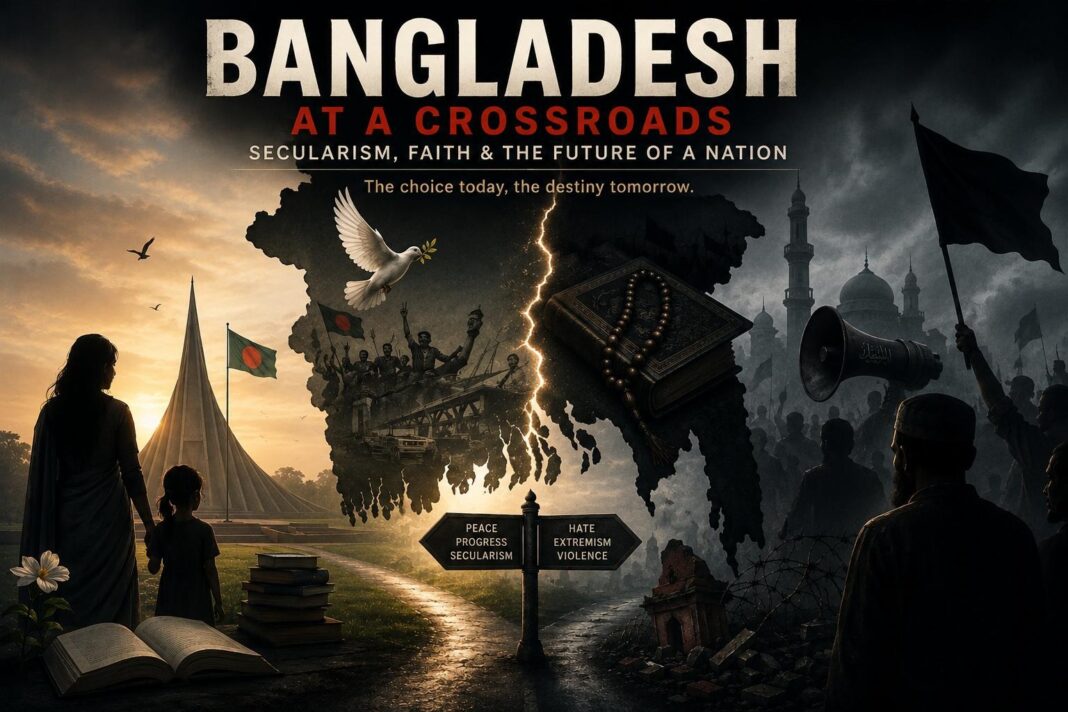

Today, talk of secularism in Bangladesh feels like an old song. The melody is familiar, the lyrics are memorized, but fewer and fewer people are willing to sing it. Even many who once sang it loudly have now lowered their voices — some out of political convenience, some out of fear, and others because they have lost faith altogether.
After an elected government was overthrown through a coup in August 2024, Bangladesh entered a political vacuum that was largely filled by the combined influence of two forces: the BNP on one side and Islamist parties on the other. The interim government led by Muhammad Yunus has maintained an uneasy but functional relationship with both. The result is that the secular character of the state is gradually becoming weaker.
A look into the history of the BNP shows that the party was born and developed under the shadow of military rule. After seizing power, Ziaur Rahman built the party through state patronage, and its ideological foundation was never clearly secular. It was during his rule that secularism was removed from the Constitution and the phrase “Bismillah” was inserted. Since then, the BNP has repeatedly formed alliances with Islamist parties, granted them political legitimacy, and compromised with them for the sake of power. The party not only allied itself with Bangladesh Jamaat-e-Islami — whose leaders were accused of participating in the 1971 genocide — but also gave them positions in the cabinet. This was not merely political necessity; it was a question of values.
What happened during the rule of Yunus following the July–August 2024 unrest was even more direct. Attacks on minority communities, vandalism of temples, and the seizure of Hindu families’ property were often portrayed as isolated incidents. But when the state fails to prosecute these crimes, when perpetrators are shielded, and when victims continue to speak of insecurity without receiving justice, it becomes impossible to dismiss them as isolated events. The killing of Dipu Das is only one name among many. Countless incidents either never reached the media or were quickly buried.
From the perspective of religious market theory, the rise of religion-based politics in Bangladesh did not happen overnight. For years, economic frustration, distrust toward a corrupt state system, and skepticism about the effectiveness of progressive politics created a vacuum. Into that vacuum stepped religious politics with a simple but powerful narrative: that all problems can be solved through the protection of religious identity, and that only they are capable of providing that protection.
The most dangerous aspect of this narrative is that it cannot truly be tested. If someone promises that a certain economic policy will increase GDP, the claim can be verified. But when people are told that everything will be fixed once “God’s law” is established, there is no measurable standard of accountability. When failure occurs, blame is simply shifted onto external enemies. Within this framework, accountability disappears entirely.
This pattern is clearly visible in the rhetoric of Bangladesh’s Islamist parties. Their cultivation of fear toward India and the portrayal of Hindus as “the other” is not merely religious emotion; it is a calculated political strategy. Creating an external enemy makes it easier to divert attention from internal failures. And when that enemy is tied to a religious identity, mobilizing supporters requires even less effort.
Looking at the Yunus government creates a particular discomfort. Internationally, Yunus is widely known as a liberal and reform-minded figure. But when the government under his leadership remains in silent understanding with religious political forces, and when state inaction is visible in cases of minority persecution, a large gap emerges between personal reputation and political reality. That gap can no longer be ignored.
Secularism in Bangladesh is not a foreign import. It is the result of a long struggle by the people of this land. One of the central foundations of the 1971 Liberation War was resistance against discrimination carried out in the name of religion. Today, as that history is gradually rewritten and the spirit of the Liberation War is dismissed as merely the political property of one party, it is important to understand that this is not simply historical revisionism. It is a conscious attack on a set of values.
In a society where dissent can be suppressed in the name of religion, where minorities can be portrayed as outsiders, and where the state either remains silent or actively assists the process, minorities are not the only eventual victims. Members of the majority who think differently, who ask questions, or who simply wish to live differently are also pushed outside the boundaries of acceptable society one by one.
Whether Bangladesh is now walking down that path is the most urgent question of all.