
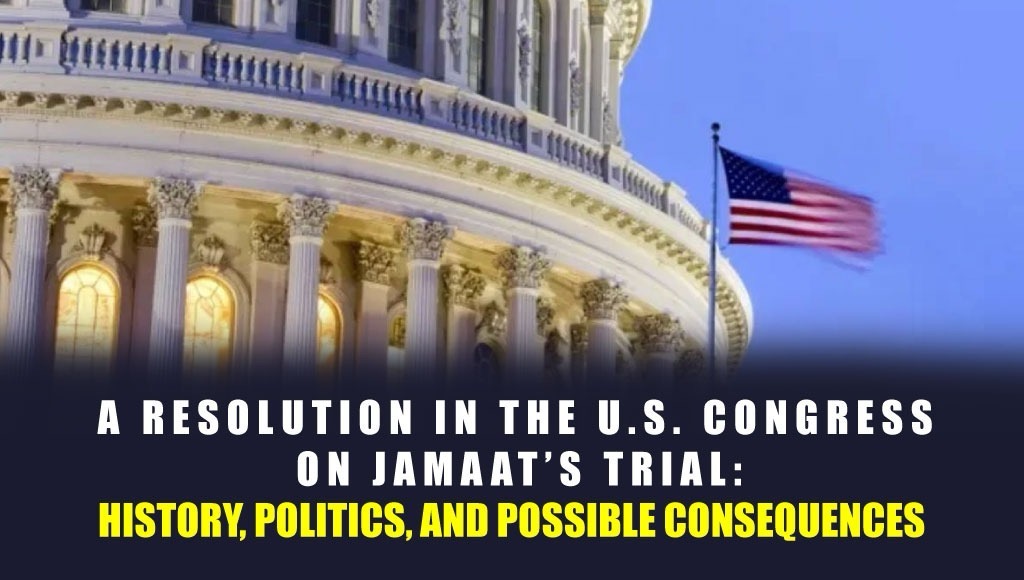
At a time when Bangladesh’s domestic politics has been relatively calm in the post-Eid atmosphere, a proposal raised in the United States Congress has sparked fresh debate. The proposal was introduced by Democratic Congressman Greg Landsman, calling for accountability of Bangladesh Jamaat-e-Islami over alleged involvement in the 1971 genocide.
This raises an important question: is it merely a symbolic political stance, or part of a broader geopolitical calculation?
Re-emergence of History: Renewed Pressure Over 1971 Accountability
Debates and judicial processes surrounding crimes against humanity during the Bangladesh Liberation War have persisted for decades. Verdicts from the International Crimes Tribunal, reports by human rights organizations, and eyewitness accounts have all brought serious allegations against some Jamaat leaders.
The proposal in the U.S. Congress essentially brings that historical accountability back into international focus. According to experts, such moves can also serve as a political means of giving international recognition to past judicial processes.
Why Now? The Timing Question
A key question is: why at this moment?
If Bangladesh Jamaat-e-Islami emerges as a strong opposition force following recent elections, renewed scrutiny over its past, human rights record, and international acceptability is not unexpected.
The United States has long shaped its diplomatic stance in South Asia around democracy, human rights, and the rule of law. So, this proposal may not be just about the past—it could also signal concerns about the present and future political landscape.
The Geopolitical Context
In South Asia, the competition for influence among the United States, India, and China is becoming increasingly visible. Bangladesh sits at a crucial point in this strategic landscape.
Analysts believe that different countries are positioning themselves in ways that may influence the nature and international alignment of Bangladesh’s political forces. This proposal can also be seen as a “signal” within that broader diplomatic game.
What Happens If the Resolution Passes?
Resolutions of this kind in the U.S. Congress are typically non-binding. Still, their impact should not be underestimated.
Possible consequences include:
1. Increased Diplomatic Pressure
The Bangladesh government could face renewed pressure over human rights and judicial processes.
2. Visa Restrictions
The U.S. has previously imposed visa policies on individuals from various countries over human rights concerns. Similar steps cannot be ruled out.
3. Impact on International Image
The global acceptability of Jamaat and related political actors may come under question.
4. Domestic Political Effects
It could deepen political polarization in Bangladesh, especially in the post-election balance of power.
Reality vs. Political Messaging
It is important to note that such proposals in the United States Congress cannot directly ban or punish any political party. However, they carry strong political messaging that can influence future policy decisions of the U.S. administration.
So, viewing this as a sudden or isolated development would be misleading. Rather, it reflects a complex interplay of history, international politics, and Bangladesh’s internal power dynamics.
In Conclusion
The proposal in the U.S. Congress regarding Jamaat’s trial is not just an isolated event. It shows that Bangladesh’s internal politics is no longer entirely internal—it has become part of a broader international arena.
To truly understand its significance, it must be viewed at the intersection of historical accountability, present-day politics, and future diplomacy.