

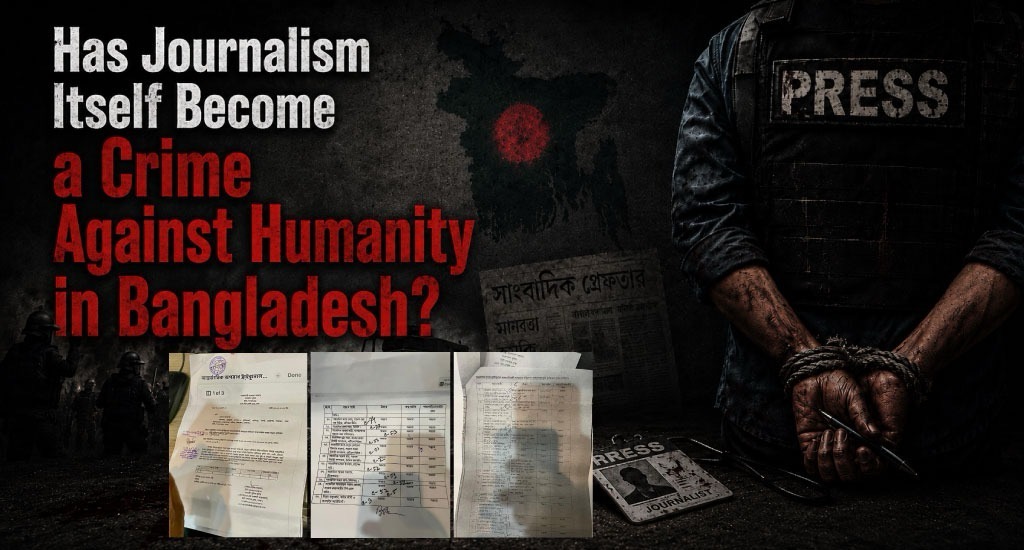
A letter has reportedly been sent from the City Special Branch of Bangladesh Police to zone officers in areas including the Dhaka Secretariat, Press Club, Gulshan, Supreme Court, Baridhara, Banani, Tejgaon, Dhaka University, Mohammadpur, Bhatara, Bilkhet, and several other locations. The letter instructs them to collect the names, designations, addresses, mobile numbers, NID numbers, and passport details of 30 journalists and send the information to a specific Gmail address. The reason given? Allegations that these individuals are under investigation for crimes against humanity by the International Crimes Tribunal.
Crimes against humanity. Do you understand the weight of those words?
In 1971, the Pakistani occupation forces and their local collaborators, the Razakar and Al-Badr militias, committed atrocities that the law defines as crimes against humanity: genocide, mass rape, arson, and torture. The International Crimes Tribunal was established to prosecute those crimes. Yet now, under the banner of that same tribunal, it is being suggested that Nayeemul Islam Khan committed crimes against humanity by practicing journalism, that Iqbal Sobhan Chowdhury committed such crimes by serving as an information adviser, that Munni Saha committed them by reading television news, or that Prabhash Amin committed them by running a newsroom. Anyone who accepts this argument without question is free to do so. But anyone applying even minimal reasoning can see what this really is.
This is a new phase of political vengeance. An old weapon with new targets.
A glance at the list of the 30 individuals makes the intention obvious. Nayeemul Islam Khan, former press secretary to the prime minister. Iqbal Sobhan Chowdhury, former information adviser. Farida Yasmin, former president of the National Press Club. Shyamal Dutta, former editor of Bhorer Kagoj and former general secretary of the National Press Club. Mozammel Haque Babu, former editor-in-chief of Ekattor TV. Nabonita Chowdhury, television presenter. Subhash Singha Roy, former editor of AB News Twentyfour. Ahmed Zobayer, former managing director of Somoy TV. Tushar Abdullah, former head of news at Somoy TV. Saiful Alam, CEO of DBC News. Naim Nizam, former editor of Bangladesh Pratidin. Abed Khan, former editor of Samakal. Prabhash Amin, former head of news at ATN News. Farzana Rupa, former chief reporter of Ekattor TV. Shakil Ahmed, former head of news at Ekattor TV. Mithila Farzana, former head of current affairs at Ekattor TV. Manjurul Islam, former editor-in-chief of DBC. Ashish Soikat, former chief news editor of Independent TV. Jahedul Hasan Pintu, former editor of DBC. Manash Ghosh, former head of news at Asian TV. Pronob Saha of DBC. Masuda Bhatti, former information commissioner of Bangladesh. Munni Saha, former executive editor of ATN News. Zahirul Islam Mamun, former executive editor of ATN News. Swadesh Roy, former executive editor of Daily Janakantha. Soma Islam of Channel i. Shyamal Sarkar of Ittefaq. Ajay Das of Samakal. Ashraful Alam Khokon, former deputy press secretary to the prime minister. Nijhum Majumdar, lawyer and online activist.
Look closely at this list. These are all nationally recognized media figures who have spent decades working in television and print journalism. People may agree or disagree with their journalism, and criticism is always fair game, but that is a separate issue. How does appearing on a talk show, writing an editorial, or running a newsroom become a crime against humanity? This government has not explained it, and it never will, because no credible explanation exists.
The real objective is simple: silence inconvenient voices. Stop the pens that raise uncomfortable questions. And if possible, throw them in prison through politically motivated cases. That is exactly what this government is doing. Dozens of journalists are already behind bars. There are no transparent answers about the charges against them, the status of their cases, or when they may be released. Now there are signs that the list is about to grow even longer.
It is also important to remember how this government came to power. In the February 12 election, the country’s major political parties were absent. Voter turnout was minimal. Polling centers remained largely empty. The ruling camp staged what many critics describe as a controlled political performance among handpicked candidates and then claimed power from it. Standing on that disputed legitimacy, the government is now moving to implicate journalists in crimes against humanity cases. This kind of shameless use of power is not new for the BNP. The party founded by Ziaur Rahman within military barracks has long carried that authoritarian instinct: speaking of democracy in public while governing with the mentality of military rule.
And Jamaat hardly needs separate explanation. The political heirs of those accused of committing actual crimes against humanity in 1971 are now allegedly using the International Crimes Tribunal as a shield against journalists. If anyone sees this as normal, the problem lies in their own sense of judgment.
When BNP and Jamaat speak on international platforms about press freedom in Bangladesh, the spectacle has now become a complete farce. Press freedom does not mean allowing only television channels and newspapers that support you to operate. Real freedom means allowing even those voices that criticize you to speak freely. Without that principle, speeches about media freedom are nothing more than political theater.
The International Crimes Tribunal remains an important institution for the people of Bangladesh. The wounds of 1971 are still carried by this nation. Using that tribunal as a political weapon against opponents damages not only these 30 journalists, but also the credibility of the tribunal itself.
But judging by the conduct of this government, such concerns are unlikely to matter. Doing whatever is necessary to stay in power appears to define its political character. Silencing journalists, imprisoning dissenting voices, and turning state institutions into political tools are not signs of democracy. They are signs of authoritarian rule.