
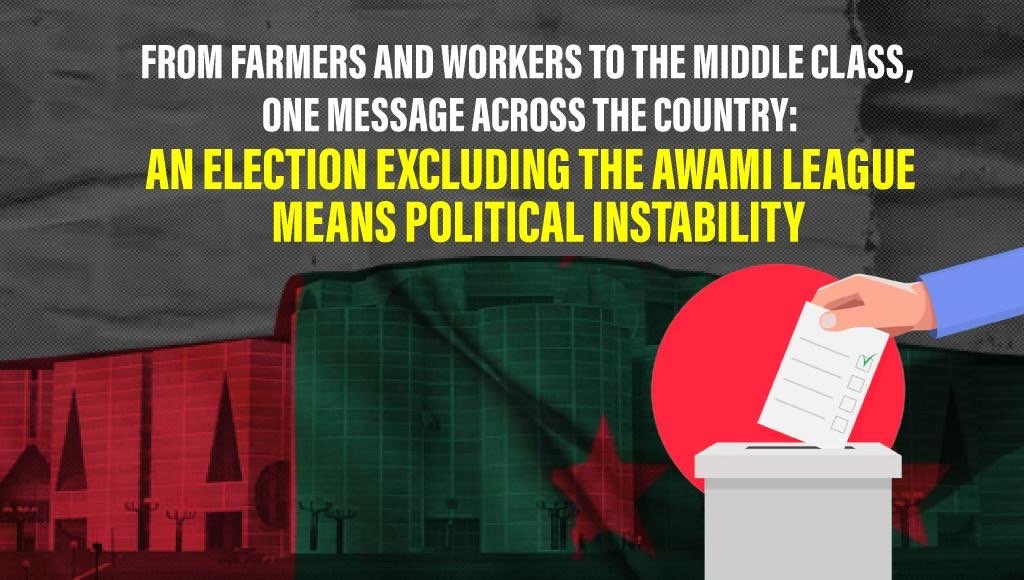

In the current political landscape of Bangladesh, one thing is becoming increasingly clear: the people will not accept any political process without a participatory election. A broad national group—from marginalized communities to the middle class—is now voicing a unified message: excluding the Awami League from the election means opening the door to uncertainty. This position is not just partisan support; it is an expression of a deep consciousness rooted in the country’s history of state stability and independence.
Rural farmers, day laborers, working-class people, and small entrepreneurs have realized from past experience that the economic security and development they received under Sheikh Hasina form the most reliable foundation of stability in their lives. For them, politics is not an abstract idea; it is directly linked to real-day services such as market prices, electricity, irrigation, roads, healthcare, and education. Therefore, they believe that any election excluding the country’s major political force could put the economy and overall peace at risk.
Recent observations show that grassroots people in various parts of the country are openly expressing that they will not accept any attempt to seize power through a one-sided or illegitimate election. Their reasoning is clear: a government formed without people’s participation can never maintain long-term legitimacy. This understanding reflects a fundamental public sentiment deeply embedded in Bangladesh’s democratic spirit.
Among those who uphold the ideals of the Liberation War, another strong conviction is at work: intentionally excluding the party that led the independence movement from the election means denying the very history of the country’s founding. In international diplomatic language, this is called “institutional dislocation”—a situation where the political structure becomes weakened if the historically central force of the state is removed. The concern of the Bangladeshi people lies exactly here—a one-sided process can push the entire state system toward instability.
Meanwhile, the working class and the middle class have taken an even firmer stance on the question of stability. In their view, political instability means job shortages, market volatility, and inflation. Hence, their message is simple but practical: “We cannot destroy the environment in which we were doing well.” Through this, they are essentially supporting the fundamental demand for a participatory election.
A similar tone is heard in the international diplomatic arena. Analysts believe that a democratic state can maintain legitimacy only when competitive multiparty elections are ensured. Therefore, any attempt to exclude the main political force is unacceptable by international standards. From this perspective, the international community is emphasizing inclusive elections to maintain political stability and economic continuity in the country.
Overall, the strong message being conveyed today by Bangladesh’s grassroots is deeply significant—
there can be no election without participation, and no election excluding the Awami League is acceptable.
This is not merely a political stance; it is the language of the people’s collective responsibility toward national stability.
In this new chapter of Bangladesh’s political reality, the people themselves are leading democracy back onto the right path—through peaceful, organized, and responsible pressure.