

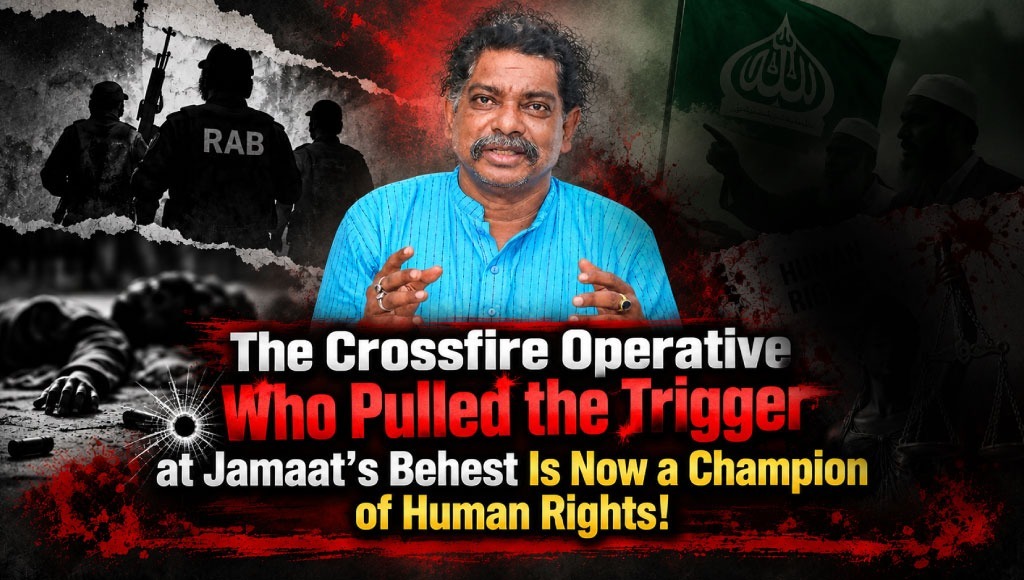

In 2026, we find ourselves confronted with a bizarre reality: the very man once associated with enforced disappearances, killings, and crossfire deaths now tries to position himself at the forefront of marches carrying the torch of human rights. The mask of dismissed Lieutenant Colonel Hasinur Rahman is no longer a mystery to anyone. Yet this was the very man who, while leading RAB-7 in Chittagong, allegedly turned an entire region into a place of terror, where people lived in fear of death. The three years from 2004 to 2006 represented the darkest chapter of his alleged abuse of power. The Bir Protik medal he received for what was portrayed as “bravery” in operations against unarmed indigenous civilians in the hills allegedly became, in his hands, a license to kill.
The streets and alleys of Chittagong still carry memories of those blood-soaked nights, and countless families are said to shudder at the mere mention of Hasinur Rahman’s name. His name is reportedly spoken in households with hatred and suppressed grief. Human rights organizations’ records, the article claims, show that 57 crossfire killings took place under RAB-7 during that period. According to the same account, 15.5 percent of all RAB killings nationwide occurred in Chittagong alone. So many people allegedly lost their lives without trial on the orders of a military officer, yet even today he walks the streets, gives speeches, and presents himself as a victim. This, the article argues, is one of the state’s greatest failures.
No one has forgotten that night in September 2004. Ten people were reportedly killed together in an area near a police station. Two days later, Ahmadul Haque Chowdhury and his bodyguard Minhaj were arrested and allegedly killed the following day in what was described as a “crossfire.” To their families, it remains clear that these were never gun battles. They were, they believe, cold-blooded killings. On November 28, Chhatra League leader Mahimuddin Mahim was arrested at the airport after returning from Dubai and was reportedly killed that same night. Just two days later, Chhatra Dal leader Iqbal Bahar Chowdhury was allegedly killed in the same manner. This sequence, the article argues, suggests that under Hasinur Rahman’s leadership, RAB-7 had effectively become a “factory of death,” where due process was unnecessary and all that was required was pulling the trigger.
The most disturbing allegation emerging from human rights reports is that these killings were driven by clear political bias. While activists and supporters of the BNP and Awami League were allegedly targeted, individuals associated with Jamaat-e-Islami were reportedly given effective protection. Human Rights Watch, according to the article, directly noted that local journalists and human rights activists in Chittagong had told the organization that RAB-7 maintained close ties with Jamaat-e-Islami. The family of Ahmadul Haque Chowdhury also reportedly stated that Jamaat members had planned the killing through RAB. In other words, the article alleges that part of the state security apparatus had effectively become an instrument of a sectarian political force, with Hasinur Rahman allegedly holding the handle of that instrument.
The olive-uniformed officer who received the Bir Protik medal for what was portrayed as “bravery” against indigenous hill communities was allegedly spreading fear from home to home in the city, backed by the shadow of political patronage. Even after being dismissed from the Army over allegations of anti-state activities and rebellious conduct, his rhetoric did not change, according to the article. Only his side changed. The man who allegedly once operated RAB’s trigger at Jamaat’s behest now pretends to be a vocal opponent of extrajudicial killings. Even after eighty-five years, this hypocrisy, the article says, has no end.
The real problem is the complete absence of accountability. Even though an international organization such as Human Rights Watch allegedly documented 57 killings with evidence, no criminal trial has been brought against Hasinur Rahman, according to the article. The families who lost their loved ones are still said to wander from street to street seeking justice. They stand for hours at the doors of courts. Yet the alleged perpetrator continues to claim innocence and walk through society with his head held high. This culture of impunity, the article argues, is the root of human rights violations in the country. Until this culture is uprooted, people like Hasinur Rahman will continue to emerge and return under one disguise or another.
The soil of Chittagong still carries the cries of those 57 families. No one hears or sees the stories hidden behind each alleged crossfire killing. Yet each story contains the anguish of a person’s final breath. It contains the sound of a family falling apart. Hasinur Rahman does not listen to those cries. Even today, the article alleges, he continues to present his past achievements with pride and, whenever given the opportunity, lectures others on morality. Such a brutal irony, it says, would be difficult to find anywhere else.
When the commander of RAB-7, whose operations allegedly made the air of Chittagong heavy with fear, was dismissed, no expression of remorse was heard from him. Nor, according to the article, was there any attempt to apologize to the families. Instead, he allegedly took the opposite path and began the process of reinventing himself. Time may cause some people to forget, but history, the article insists, will never forget these 57 killings. A man who carries both a medal for bravery and the stigma of mass killings cannot reconcile these two opposing extremes of his life.
The story of Hasinur Rahman is ultimately a story about a state apparatus in which abuse of power was not an exception but a rule. When an institution that is supposed to protect people’s lives and property instead points a gun at their heads, it becomes impossible for society to sleep peacefully. Thousands of people could not sleep during those nights in Chittagong. Many still cannot. The wounds left by losing loved ones never truly heal. The article argues that Hasinur Rahman has spent his life adding salt to those wounds through his actions. Perhaps one day he may be held accountable in a court for his alleged misdeeds, but the damage he has caused can never be repaired by any compensation.