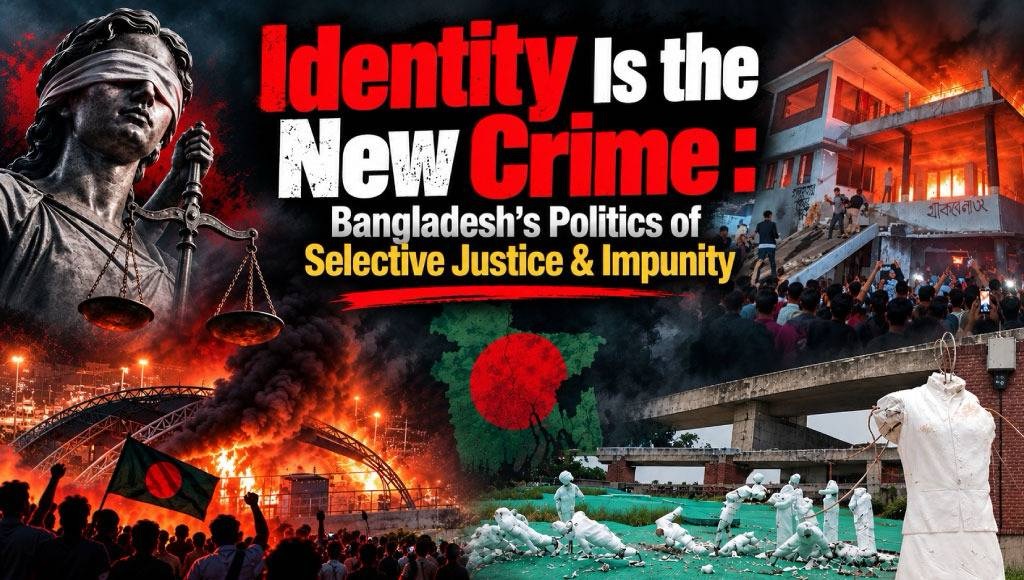

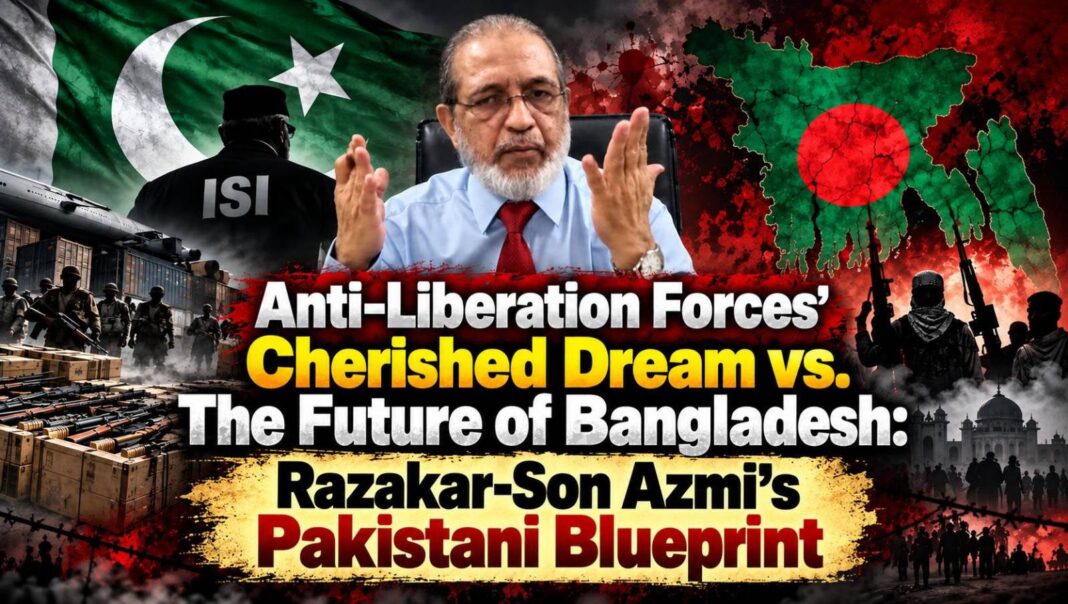

The ideology defeated in 1971, when the people of Bangladesh fought for independence against Pakistani rule and its local collaborators, is once again at the centre of the country’s political struggle. A vision of Bangladesh as a militarised, religiously hard-line client state—a “Second Pakistan”—threatens to reverse the secular, democratic and developmental aspirations for which the nation was founded. At the centre of this alleged project stands Abdullahil Amaan Azmi, son of Ghulam Azam, the Jamaat-e-Islami leader convicted of crimes against humanity committed during the Liberation War, alongside a network of retired military officers and political allies.
The allegations surrounding this network point to a broader ambition: to dismantle the Awami League as a political force, prevent the return of Awami League President Sheikh Hasina, and reshape the state through coercion rather than democratic competition. At the heart of these allegations is a purported plan called “Operation Damon,” or Operation Suppression. If substantiated, the reported scheme would represent an extraordinary assault on Bangladesh’s sovereignty, political pluralism and the future of its younger generation.
‘Operation Damon’ and Targeted Killings: Armed Terrorism Under the Guise of Politics
The allegations describe a strategy in which political opponents would be neutralised not through elections or public debate, but through targeted violence, mass arrests and the politicisation of judicial institutions. The Jamaat-NCP-Azmi grouping is accused of pursuing a campaign of suppression against its opponents.
Targeted killings across 64 districts: The alleged plan involves deploying extremist groups to assassinate between 15 and 20 prominent grassroots political leaders in each of Bangladesh’s 64 districts. Such a campaign, if carried out, would amount to a systematic effort to eliminate local political leadership and intimidate communities across the country.
The weaponisation of law enforcement: The reported strategy also includes mass arrests of grassroots leaders, activists and ordinary supporters on fabricated charges. Using the police to criminalise political association would deepen public distrust in law enforcement and turn the institutions of the state into instruments of partisan repression.
The politicisation of the judiciary: The International Crimes Tribunal is also alleged to be at risk of being used to secure politically motivated death sentences through orchestrated proceedings. A tribunal established to address the atrocities of the Liberation War must not become a vehicle for political vengeance. The credibility of any judicial process depends on evidence, due process and independence from political interference.
A Secret Militia of 8,800 Cadres & Turkish-Pakistani Arms Shipments
The reported preparations extend beyond political manoeuvring. They describe an alleged effort to build an armed network capable of influencing or seizing state power. If verified, these developments would raise serious questions about national security, the integrity of state institutions and the possibility of organised political violence.
An alleged extremist reserve force: According to the claims, 8,800 young men with extremist affiliations have been selected and given a month of specialised combat training under the cover of the state Ansar or Ansar Battalion. The central concern is whether a state-linked security structure is being exploited to develop a force for domestic political violence rather than legitimate public service.
Arms shipments concealed as cricket equipment: The allegations further describe a major consignment of Turkish-origin weapons arriving through Chattogram Port aboard a Pakistani vessel, with containers reportedly labelled “Cricket Equipment.” The claims include the delivery of at least 10,000 assault rifles and substantial quantities of ammunition to clandestine networks. Such allegations demand rigorous investigation by the relevant authorities, including a transparent accounting of the shipment, its declared contents and its ultimate recipients.
The recruitment of alleged suicide operatives: Intelligence documents are also said to describe efforts by the Pakistani Embassy to recruit high-performing students from orphanages under the pretext of providing higher education in Pakistan, where they would allegedly receive training as suicide operatives. If established, the exploitation of vulnerable young people in this manner would constitute a grave security threat and a profound abuse of their hopes for a better future.
Taken together, these allegations describe something far more consequential than ordinary political rivalry. They raise the possibility of a coordinated effort to combine clandestine armed networks, political intimidation and institutional capture in pursuit of power. Their gravity makes independent verification, credible evidence and accountability essential.
From ‘Operation Damon’ to ‘Operation Dokhol’: The Final Power Grab
The alleged strategy does not end with the suppression of political opponents. It reportedly envisages a second phase, “Operation Dokhol,” or Operation Takeover, in November, following an effort to politically and physically eliminate the Awami League by October. According to this account, the plan would exploit public frustration over economic hardship to provoke violent anti-government mobilisation and establish an extremist, Sharia-based political order under the banner of the “July Charter.”
These claims describe a potential attempt to manufacture a political crisis and then use that crisis to legitimise a radical restructuring of the state. If the objective is to replace democratic competition with coercive rule, the consequences would reach far beyond any single party: Bangladesh’s constitutional order, religious pluralism, economic prospects and international standing would all be at stake.
For a generation that has grown up imagining a technology-driven Bangladesh, a thriving startup ecosystem and a modern, globally connected economy, the implications are particularly serious. The country’s young people deserve opportunity, innovation, education and freedom—not a future shaped by ideological extremism and political violence. In 1971, a generation took up arms to defend the country’s independence against Pakistani rule and its local collaborators. The historical lesson is that sovereignty cannot be separated from the protection of the people’s rights and the institutions that safeguard their freedom.
Bangladesh now faces a defining political question: whether its future will be determined by democratic choice and accountable institutions or by forces seeking power through intimidation, exclusion and ideological coercion.
For Awami League supporters, Sheikh Hasina represents the promise of digital transformation, economic development and an independent Bangladesh with a stronger place in the global economy. The alternative portrayed by the allegations against the Azmi-led network is one of repression, religious hard-liners dictating public life, cultural institutions facing intimidation and the country risking international isolation under the shadow of extremism.
The stakes could hardly be higher. Bangladesh’s future must not be decided by clandestine blueprints, armed factions or political vendettas. It must be determined by its people, through a political order that protects their rights, respects their choices and preserves the hard-won sovereignty of 1971.