

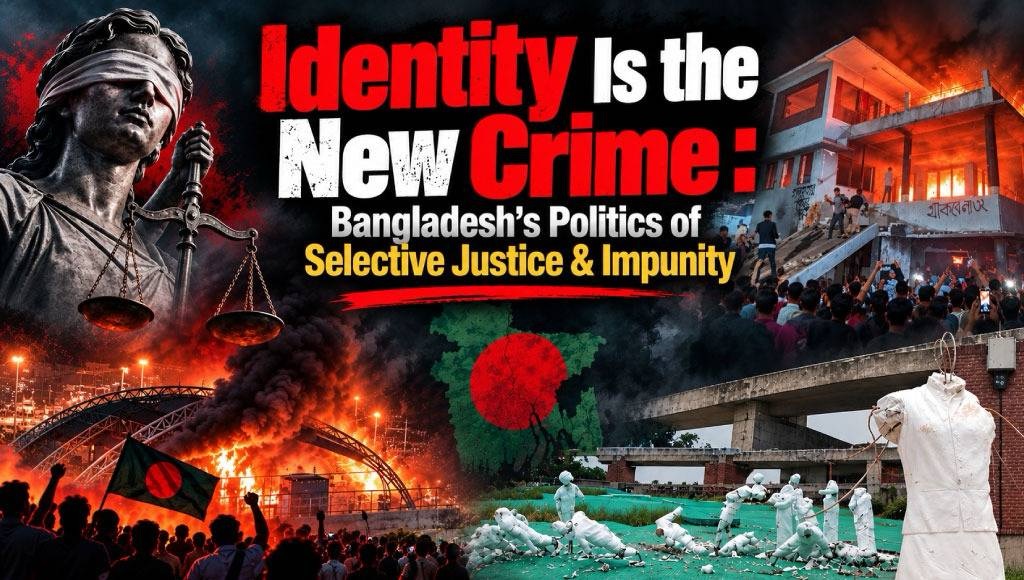

When a nation’s political transition turns into selective vengeance in the name of justice, that transition can never acquire lasting legitimacy. That is precisely what is happening in Bangladesh today, and the responsibility now rests squarely on the shoulders of the BNP-Jamaat alliance, because they have held the reins of power since February 17.
Yunus, a usurious financier backed by foreign money, militant organisations, and military support, orchestrated the July riots and overthrew an elected government through a coup. That is now history. But the present is more disturbing than the history, because the BNP-Jamaat alliance, which came to power after Yunus’s fall, has done something in the name of transitional justice that is not accountability at all. It is a form of collective punishment regime. Crimes are not being judged here. Identities are.
The basic principle of the legal framework is individual culpability. In other words, only those against whom specific allegations have been brought should be subjected to judicial proceedings. What the BNP-Jamaat alliance has done instead is group blame: criminalising an entire political identity. Simply being associated with the Awami League now means being socially “othered” and treated by the state as a suspect. This has no place in any established principle of jurisprudence. It is pure political purging.
Who gave the mandate to bring bulldozers to Dhanmondi 32? Such a demand was not even heard during the July riots. Yet it has now been established that the BNP itself supplied the bulldozers. This was not merely an act of vandalism. It was a calculated project of historical erasure, an attempt to physically wipe out a chapter of the past to win a war over the national narrative. The destruction of Liberation War monuments and the attempt to demolish Mujib’s mausoleum in Gopalganj are part of the same pattern. And in the killing of six people in Gopalganj, there has been no widely reported judicial inquiry commission. This is perhaps the clearest manifestation of impunity: the state itself has effectively granted immunity.
There has been no criminal prosecution over the beating death of Masud, a Chhatra League activist. At the same time, the educational lives of thousands of ordinary Chhatra League activists have been brought to an administrative end without any due process. Technically, this amounts to “guilt by association”, where people are punished solely based on organisational identity without their individual guilt ever being established. No principle of constitutional democracy can sustain such a practice. Yet the BNP-Jamaat alliance is selling precisely this as “reform”.
The most interesting, and perhaps the most dangerous, pattern concerns who is being targeted by this violence. The Awami League does not directly attack BNP political leaders and activists, because the BNP is an openly declared political adversary and therefore a legitimate opponent in their eyes. The targets instead include people such as Azmeri Haque Badhon and Asif Nazrul, individuals who had long maintained relatively obscure, apolitical, or bipartisan public images. Their very purpose was to be prepared over many years, with domestic and foreign backing and assistance, so that they could be used in the July riots. This was not random targeting. It was a calculated strategy aimed at destroying the neutral space itself, leaving society with no third position beyond “you are either with us or you are the enemy”.
An interview with Dhaka University professor Tanzim Uddin Khan is a striking document in this context. In that interview, he himself acknowledged the conspiratorial nature of the so-called “conscience of the nation” teacher network. Yet no investigation or accountability process has been initiated by the BNP-Jamaat alliance in response to that admission.
This brings us to perhaps the most naked example of selective justice. Dipu Chandra Das, Tofazzal, who went to Dhaka University to eat a meal, and the pir in Kushtia were not associated with the Awami League. Yet there has still been no credible investigation into their brutal killings. The implication is clear: justice is being allocated according to the identity of the victim, rather than the seriousness of the crime. This is not a justice system. It is a mechanism of political selectivity in which the victim’s identity determines whether justice will be delivered at all.
There is a concept in the transitional justice literature known as “winners’ justice”, or victor’s justice. It describes a situation in which the side that comes to power uses the judicial system as an instrument for suppressing its political opponents rather than as a means of establishing justice. The BNP-Jamaat alliance has fallen squarely into this trap, or more accurately, has chosen this path willingly. The consequence is that the millions of ordinary people who placed their faith in the July transition now feel betrayed. What they wanted was an accountable and inclusive system of governance, not a regime of revenge.
Another important point is alienation theory. When a particular population is systematically excluded from the political process and deprived of its right to due process, it has little rational incentive to return to mainstream politics. Political science refers to this as “radicalisation through exclusion”. Through the blanket criminalisation of millions of ordinary Awami League workers and supporters, they have been pushed into a position where they feel they have nothing left to lose. This psychological space is particularly dangerous because it can become the breeding ground for a long-term cycle of political violence.
If the BNP-Jamaat alliance genuinely wanted a stable and democratic Bangladesh, its priority would have been to ensure fair trials for those facing criminal charges while guaranteeing normal political rights for everyone else. Instead, it chose the opposite course. It has shown that, for them, the word “reform” is effectively a euphemism for permanently removing political opponents from the political process.
This strategy may help consolidate power in the short term. In the long term, however, it pushes the country toward a failed-state model in which vengeance replaces institutions and confrontation replaces consensus as politics’ central language.