
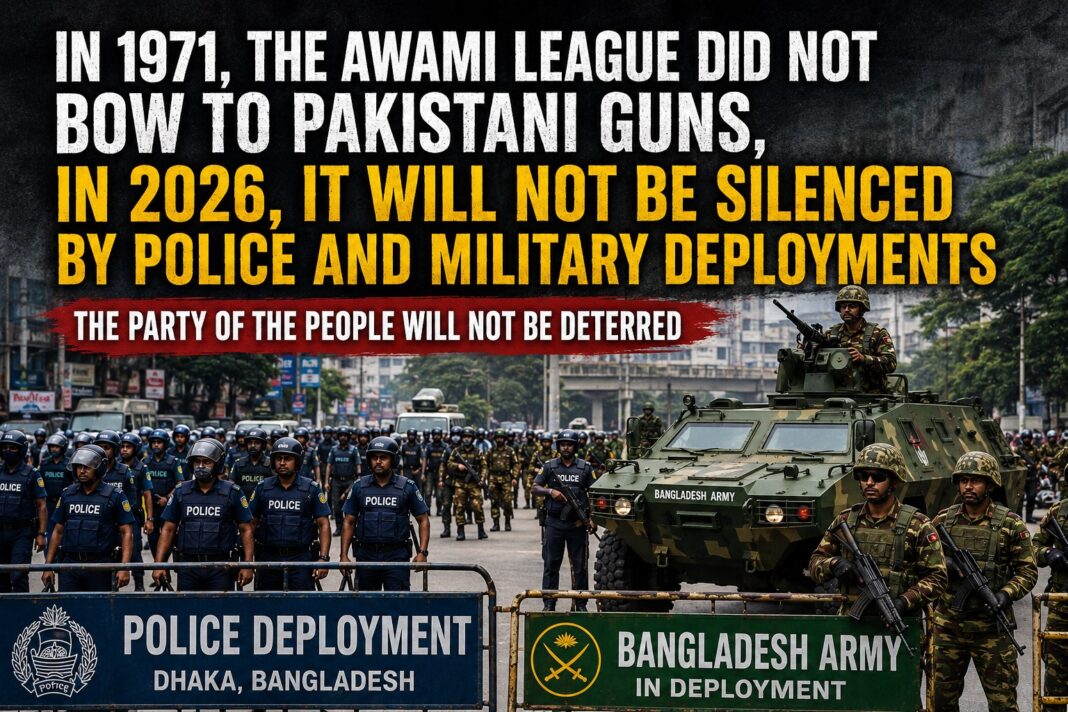

To mark the 77th founding anniversary of the Bangladesh Awami League on June 23, the government has implemented extensive security measures in the capital and other key areas across the country. More than 18,000 police personnel have been deployed, and orders have reportedly been issued to deploy the military in several districts as well.
If the Awami League has truly become politically irrelevant, then why is such a massive security operation deemed necessary for a party anniversary? The answer is simple: the Awami League is not merely the name of a political party, but a political force with deep roots and significance for many people.
The BNP government’s deployment of police and military personnel itself demonstrates that the Awami League remains a major political force in Bangladesh. Throughout its 77-year history, the party has endured bans, imprisonment, and numerous periods of political repression. Yet each time, it has re-emerged stronger despite the obstacles placed before it.
In 1971, it was under the leadership of the Awami League that Bengalis organized resistance against the repression, arrests, and denial of political rights imposed by Pakistan’s military regime. During that period, the Mujibnagar Government, formed and led by Awami League leaders, directed the Liberation War. Even BNP founder Ziaur Rahman participated in the war under the authority of that Mujibnagar Government.
Today, that same BNP is attempting to suppress the Awami League’s founding anniversary through the deployment of police and military forces. But history shows that the Bangladesh Awami League has long been regarded by its supporters as a party rooted among the people. Political movements built on public support cannot be permanently halted through repression or the use of force.