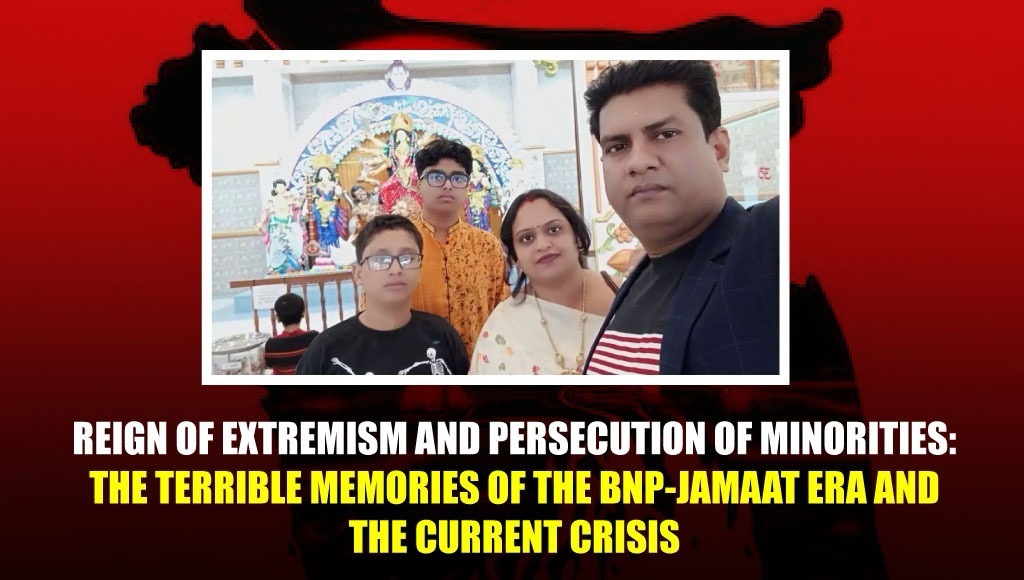



Even today, when you enter the house in Machuapara, Rangpur, it feels as though the breaths of four people still linger in the air: Ganapati Chakraborty, his wife Pritilata, their daughter Agami, and their son Priyam.
One night, all four were killed.
The first story presented after the murders was that a quarrel over yaba consumption had escalated into the killings. Ordinary people, too, were left thinking: perhaps this was simply the brutality of drug addicts.
But as the days pass, that narrative is becoming increasingly difficult to sustain.
Because a new piece of information has now emerged—one that could potentially shatter the police’s entire theory.
Drug tests conducted on the detained suspects reportedly found no trace of narcotics. Siddhartha Das and Mugdha Das, around whom the yaba theory had been constructed, showed no evidence of drugs in their systems.
So what exactly was the story being told?
A negative drug test does not, by itself, prove that they did not commit the murders. But it does fundamentally call into question the immediate motive that was presented—an argument over yaba consumption.
Without evidence, the yaba theory is now little more than an alleged constructed narrative. Whether it is being used to conceal what actually happened remains a question that demands answers.
The family had reportedly been under pressure even before the killings.
Agami Chakraborty had allegedly been threatened by Meril Suman, Parvez, Pavel, Momin Mia and Abu Humayra. The name of Ashfaq Sifat, son of Jamaat leader Mahbubur Rahman, has also surfaced in connection with the allegations.
Agami had reportedly told her friend Protha Mondal that she was considering seeking police assistance.
In other words, the threats were not completely unknown.
But the question is: Did the police do anything at the time?
Or did they simply hear the complaints and brush them aside?
And this is where another mysterious name enters the picture: Eva Rahman.
A close associate of the Chakraborty family and Priyam’s private tutor, Eva Rahman has now become the center of a thickening cloud of mystery surrounding the case.
Eva Rahman and Pritilata Chakraborty had reportedly contacted detective officer Sanatan Chakraborty. The matter subsequently reached the ears of Police Commissioner Abdul Mabud.
Questions are now also being raised about the reported closeness between Eva Rahman and Abdul Mabud.
Why did the family receive no effective security despite informing police in advance about the threats?
What communications took place between Eva Rahman, police officials and others before the murders?
Is anyone actually investigating these questions?
Or are authorities merely pretending to investigate while deliberately looking the other way?
Another major question remains unanswered: Where has Eva Rahman been since August 22?
There has been no transparent explanation regarding the whereabouts of someone who was reportedly so close to the family.
And yet, is Eva Rahman emerging as a central character in the investigation?
Or is someone preventing that from happening?
Eva Rahman is not the only name to have surfaced.
Allegations of extortion have also brought local BNP-linked figures into the spotlight.
There has been discussion of alleged involvement by individuals associated with the local BNP in demands for money connected to the construction of Ganapati Chakraborty’s house.
Allegations have also surfaced regarding the influence and pressure of Rangpur Metropolitan BNP convener Shamsuzzaman Shamu.
Dhiman Thakur and his son Pran Bhattacharya Poran, who are locally known as people close to Shamu, have also faced allegations of demanding money.
The incident in which Agami reportedly rejected a marriage proposal has emerged as another possible source of conflict.
In other words, the Chakraborty family was allegedly facing threats, political pressure, extortion attempts and personal disputes.
And yet, the police did nothing.
Why was this family left alone despite so many allegations and warning signs?
That is now the most frightening question of all.
There are also no shortage of inconsistencies surrounding the role of the police.
Different accounts have reportedly emerged regarding the timing of the murders. There have been conflicting explanations about the electricity being disconnected. There are also allegations that water at the crime scene damaged or destroyed crucial evidence.
Do the phone records, CCTV footage, mobile-phone locations, DNA evidence, fingerprints and autopsy findings actually correspond with the sequence of events described by police?
Or are they simply not being brought together?
Without an independent investigation, these questions will never receive credible answers.
And finally comes the question that no one seems willing to ask.
Four members of a religious minority family were murdered inside the same house.
Before that came threats.
There were allegations of political pressure and extortion.
And afterward came inconsistencies in the police narrative.
Is this entire picture merely a collection of unrelated incidents?
Or is there a carefully planned pattern behind it?
Has the investigation examined the possibility of involvement by militants or an organised group?
Or was that possibility deliberately ruled out from the beginning so that no one could reach the real trail?
The four murders in Rangpur are no longer simply a murder case.
They have become a living testament to alleged police negligence, political influence and the insecurity faced by religious minorities.
When an investigation treats a single narrative as established truth; when it constructs a yaba story despite drug-test results reportedly finding no narcotics; when there is no transparency surrounding a figure such as Eva Rahman—the truth cannot emerge from such an investigation.
The truth behind these four lives must be established through evidence, not assumptions.
But who stands in the way of that evidence?
Who does not want the real mystery behind these murders to come to light?
Until those questions are answered, the silence hanging over that house in Machuapara, Rangpur, will only grow heavier.
And the responsibility for breaking that silence now lies with the investigators.
But the real question is: Do they actually want to break it?