

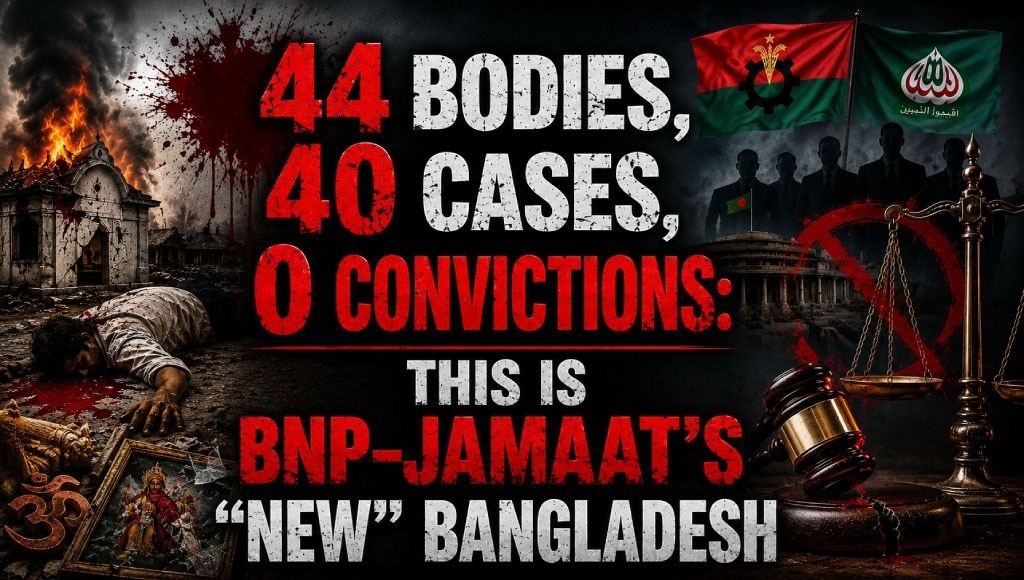
Let’s begin with the numbers, because the numbers speak for themselves. From January to June 2026, during the six months that BNP has been in power and Jamaat has served as an equal partner in Parliament, the monthly average of killings targeting minorities has increased by 33 percent. In 40 separate incidents, 44 people have been murdered. This is not a period under an opposition government. This is their own administration, whose leaders continue to speak of the “rule of law” and “justice for all.”
Now the question is: how many of these 40 murder cases have been concluded? How many of the accused have been convicted? Everyone already knows the answer: virtually none. The Bangladesh Hindu Buddhist Christian Unity Council itself says that victims are not receiving justice and that there has been no effective action against the perpetrators. When a state repeatedly fails to bring murderers to justice, it is no longer an isolated failure. It becomes policy, a form of silent state consent.
There is another statistic worth noting. While the reported number of attacks on places of worship and incidents of violence against women has declined, cases of land grabbing have increased by 43 percent. The contradiction is not difficult to understand. A decline in deadly violence cannot be presented as “progress” when land seizures are rising at the same time. Instead, it suggests that the methods of intimidation have changed, but the greed for minority-owned land and the politics of dispossession have not changed at all.
There is no need to revisit Jamaat’s history. A party whose role during the 1971 Liberation War remains deeply controversial now sits in Parliament, listening in silence whenever minority rights are discussed. And the BNP, whose 2001–2006 administration has long been documented by critics as a dark chapter in the history of minority persecution, appears, according to this text, to be demonstrating in 2026 that the nature of power has not changed, only the calendar year has.