

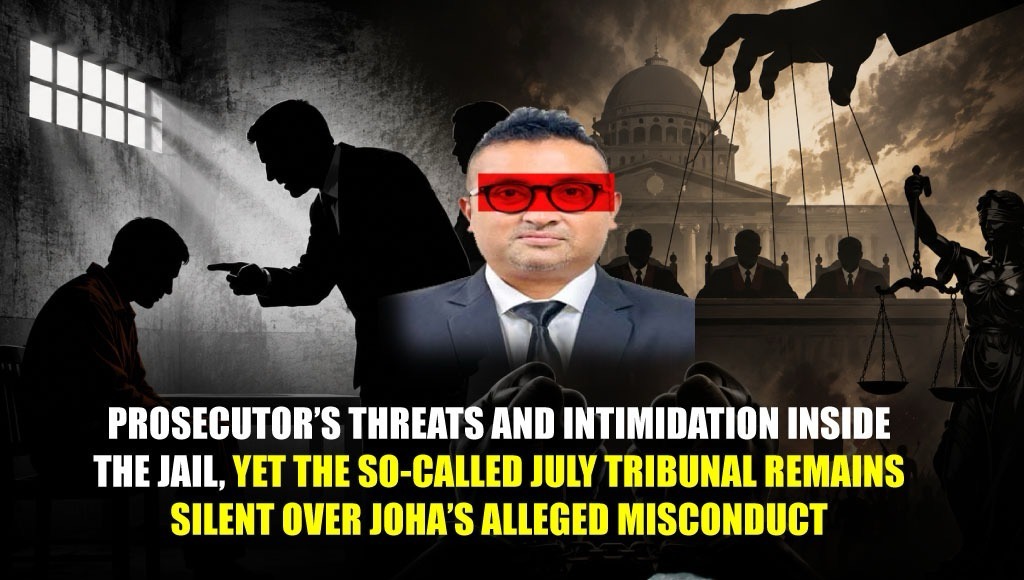
What has been unfolding in the so-called July Massacre Tribunal is not merely the complaint of a single police officer. According to the article, it is evidence of an entire system that seized state power through a coup and conspiracy and is now pursuing political revenge under the guise of justice. The testimony delivered in court by former Assistant Sub-Inspector (ASI) Chanchal Chandra Sarkar evokes comparisons to the staged trials often associated with authoritarian regimes in the developing world.
Chanchal Chandra alleges that on January 27, 2025, he was summoned to the Officer-in-Charge’s room inside the prison. After the door was closed, Prosecutor Tanvir Hasan Joha allegedly introduced himself and told him that he would have to say whatever he was instructed to say. According to Chanchal, this was not the conduct of a lawyer seeking justice but of a prosecutor attempting to pressure an accused person into making a confession. He further claims that when he refused, Joha threatened to kill him and later threatened harm to his close relatives.
The article argues that when a prosecutor, whose role is to uphold the law, is accused of issuing death threats to obtain testimony, serious questions arise regarding the fairness and impartiality of the judicial process. It contends that such conduct would be more consistent with criminal behavior than with the responsibilities of a legal officer.
The article further claims that this is not an isolated incident. It alleges that many of the July-related cases over the past two years have followed a similar pattern, with the accused often being police officers or members of the Awami League, while judges, prosecutors, and investigators are portrayed as belonging to the same political camp. The article argues that allegations against Joha reflect broader concerns about the credibility of the entire tribunal process.
Looking back, the article describes the events of 2024 as a nationwide upheaval that led to the removal of Prime Minister Sheikh Hasina’s elected government. It alleges that foreign powers, the Islamist party Jamaat-e-Islami, and the BNP played direct or indirect roles in that process. According to the article, the government formed under Muhammad Yunus subsequently established the tribunal as a tool of political retaliation. It further claims that many of the judges and prosecutors involved have political affiliations with BNP, Jamaat, or figures close to Yunus.
The article points to Chanchal Chandra’s case as an example of what it describes as a broader pattern: securing confessions first and conducting investigations afterward. It argues that the cases filed against him were fabricated and alleges that prosecutors were more interested in obtaining a predetermined confession than in examining evidence. Chanchal reportedly told the court that he did not commit the shootings for which he has been accused, but the article claims that Prosecutor Joha disregarded his statements and instead sought a confession supporting the prosecution’s narrative.
According to the allegations, Joha met Chanchal inside the prison rather than in a courtroom, accompanied by a woman whom he reportedly introduced as his future wife. The article questions the legality and propriety of such a meeting and asks under what legal authority a tribunal prosecutor would attempt to secure a confession behind closed doors inside a jail facility.
The article then asks why the tribunal has allegedly failed to take action against Joha. It argues that the tribunal was created as a political instrument and therefore has little incentive to scrutinize the actions of its own prosecutors. In this view, Joha’s alleged conduct is portrayed not as an exception but as part of the tribunal’s broader mission.
Although the Yunus administration is no longer in power and the BNP has governed since February 2026, the article claims that the same tribunal, the same prosecutors, and the same practices remain in place. It argues that this continuity demonstrates the persistence of the same political network despite the change in government.
In conclusion, the article asserts that Chanchal Chandra’s allegations reveal fundamental flaws in what it describes as a politically motivated judicial process. It argues that the accusations against Prosecutor Joha undermine claims of adherence to the rule of law and calls for the tribunal to be abolished and for legal action to be taken against those who allegedly used the judiciary as a tool of political revenge.
Source: Ajker Patrika (as cited in the original article).