

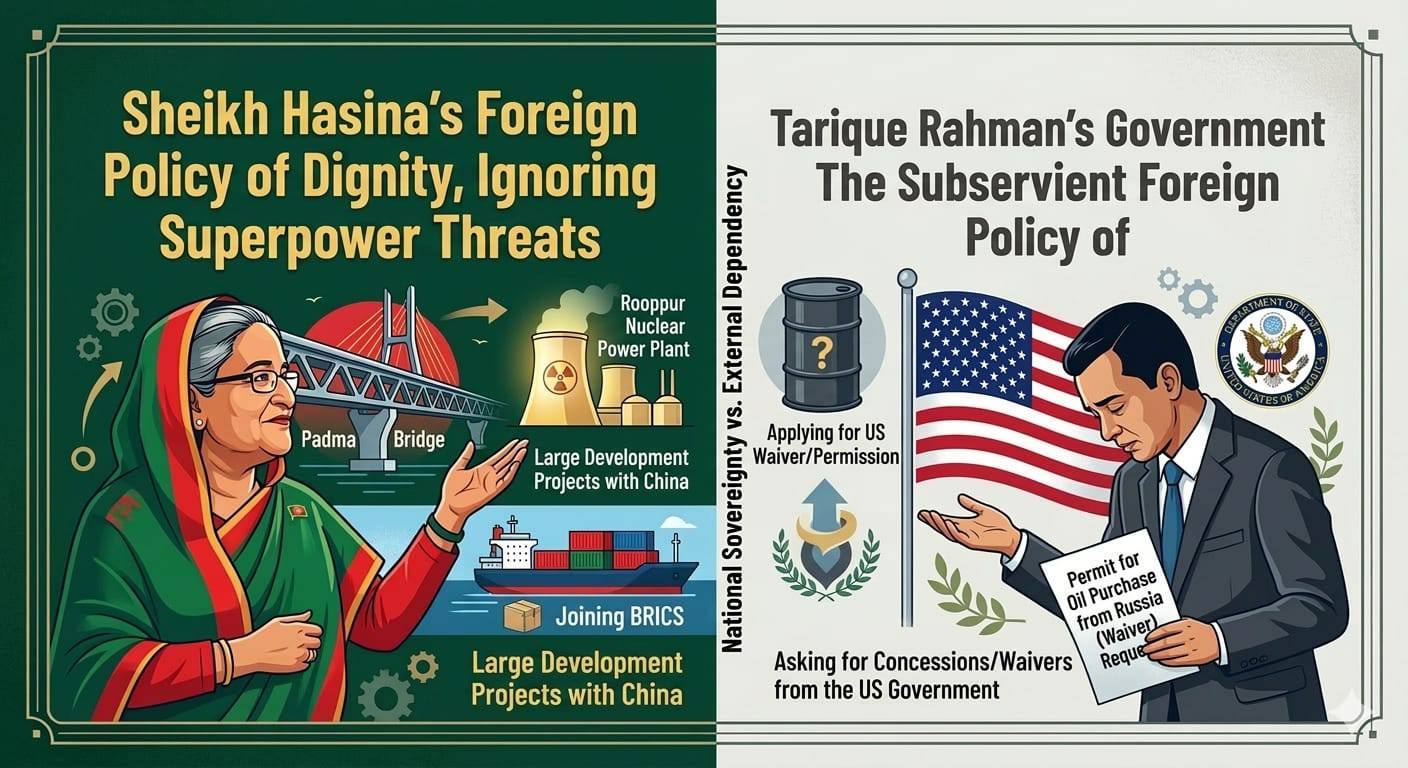
In the political history of Bangladesh, the term “subservient foreign policy” has long been used as a cheap propaganda tool by a certain political quarter against the Awami League. However, a look at the pages of history reveals that the “head-high” diplomacy initiated by Sheikh Hasina during her tenure as Prime Minister placed Bangladesh on a pedestal of true dignity in the world arena.
Today, as time stands as a mirror of truth, the difference between protecting actual national dignity and international sycophancy is becoming crystal clear. Prime Minister Sheikh Hasina proved that Bangladesh does not survive on anyone’s mercy but on its own strength. Yet, under the current government of Tarique Rahman, we are witnessing how the nation must wait for the “mercy” or “special waiver” of superpowers for every small or big decision. Is this the so-called independent foreign policy that the nation was promised?
During her time as Prime Minister, Sheikh Hasina showed her greatest courage in ensuring national energy security. The Rooppur Nuclear Power Plant is an epic chapter in the development of the Bengali nation. The core work of this project began on November 30, 2017, when Prime Minister Sheikh Hasina herself inaugurated the first unit’s concrete pouring. Currently, this mega project is in its final stages. According to recent data, experimental production from the first unit will begin by June-July 2026, and by December 2026, it will be possible to regularly supply the full capacity of 1200 MW of electricity to the national grid. After the start of the Russia-Ukraine war, when the Western world imposed strict economic sanctions on Russia, many influential states hesitated to work with them. But Sheikh Hasina placed national interest above all else.
Ignoring the frowns of the United States, she continued the project with Russia. She unequivocally declared, “No one can direct us on who we should or should not keep relations with.” In today’s volatile global energy market, the Rooppur Nuclear Power Plant is emerging as a great blessing for Bangladesh. This is the fruit of Sheikh Hasina’s fearless mindset, where she refused to bow to the pressure of any superpower.
One of the greatest achievements of Sheikh Hasina’s regime was maintaining a unique balance among global superpowers. While India’s contribution to our Great Liberation War is undeniable and the Awami League shares a historic and sincere friendship with India, Sheikh Hasina did not become entirely dependent on any single country for development. Despite the subtle dissatisfaction and unease of India, the United States, and the entire Western world, she maintained a close and cooperative relationship with China for Bangladesh’s infrastructural development. She proved how uncompromising she was regarding national interests.
Under her leadership, one miraculous mega project after another was implemented with Chinese funding and technical assistance. Projects like the Padma Bridge Rail Link (built at a cost of over $3 billion), the Bangabandhu Sheikh Mujibur Rahman (Karnaphuli) Tunnel—the first underwater tunnel in South Asia, the Payra 1320 MW Thermal Power Plant, and the Dasherkandi Sewage Treatment Plant are the direct results of Sheikh Hasina’s diplomatic prowess. When the Western world was trying to polarize global politics, Sheikh Hasina expressed her intent to join BRICS, making it clear that Bangladesh would not be a satellite state to anyone.
Today, Sheikh Hasina is not in power. Under Tarique Rahman’s government, we are witnessing a humiliating spectacle. Recently, Planning Minister Amir Khosru Mahmud Chowdhury sought a “special waiver” or permission from US Ambassador Brent T. Christensen to buy oil from Russia. While countries like India are buying oil independently by exercising their sovereign rights, the current government of Bangladesh has to plead for permission from the US State Department. During her premiership, Sheikh Hasina never made decisions on national interests by begging or seeking permission from foreign powers. Today, if we have to hold the feet of a third power even to buy oil from a trusted friend like Russia, what could be a greater example of a “subservient foreign policy”?
History will testify that Sheikh Hasina was a stateswoman who protected the dignity of the red and green flag by ignoring the threats of global bosses. She brought development, but not at the cost of sovereignty. In 2026, when the electricity from Rooppur lights up every home, people will gratefully remember that brave leader. Sheikh Hasina’s “head-high” policy was the true shield of Bangladesh, while the current subservient stance of Tarique Rahman’s government is putting our very sovereignty into question.
Author: Akib Hossain Zabir
Student: Department of Law, World University of Bangladesh.