

Before jumping in front of the train, Mir Ruhul Amin may have paused for a moment to think: where would he get 4,400 taka every week to repay a loan of 99,000 taka? A seventy-year-old farmer whose onion crop failed to fetch a price in the market, how would he manage such installments? But before any answer could be found, the train arrived and ended his life.
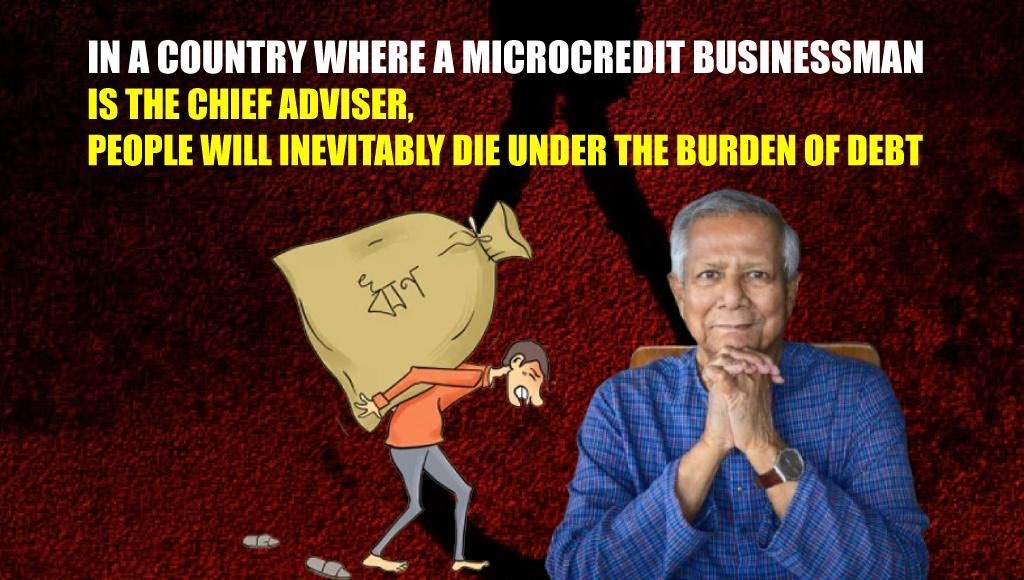
At the same time, Muhammad Yunus, who won a Nobel Prize for lending to the poor, seized power by toppling an elected government through riots backed by the military, supported by Islamist extremists, and financed from abroad. A man who built his life on the business of interest is now holding the highest executive authority in the country. If one spoke of this contradiction, would anyone even believe it?
A report by Prothom Alo reveals the condition of 24 families across five upazilas of Rajshahi, where each family has taken loans from multiple NGOs. The director of RULFAO, Afzal Hossain, called this system “target lending.” That is, NGO field workers distribute loans hurriedly and without proper verification simply to meet targets. No one checks how much debt a person already has, or what they are using the loan for. The only concern is meeting targets and collecting installments.
Jahangir Alam, assistant director of Shapla Gram Unnayan Sangstha, admitted that young officers rush loan approvals and clients hide information. But hidden inside that admission is the true face of the microcredit industry. This is not development for the poor. It is a profitable business that turns the suffering of the poor into capital.
So the question is: when the very architect of this system runs the country, how will the problem be solved? The answer is simple. It will not. Because this is his business model. Grameen Bank and countless NGOs operate by keeping the poor trapped in a continuous cycle of debt. One loan is repaid by taking another. And so it goes on.
In Bausa village of Rajshahi, out of 650 families, 450 are indebted. That single statistic is enough to show that microcredit is not a solution. It is a disease that is consuming society. And the carrier of that disease is now in control of the state.
The foreign financing behind the violence of July 2024 that toppled the government is no longer a secret. The United States, European countries, and international organizations that had long expanded their influence in Bangladesh through NGOs were behind this change. Islamist militant groups carried out the street violence, the military provided support, and finally the microcredit businessman was installed in power.
Now Rashidul Islam sits at a tea stall and says, “I’m somehow getting by. Where I’ll go next, even I don’t know.” Inside that sentence lies the pain of millions who don’t know where they will go or how they will survive. Their weekly installment is 11,000 taka, but they have no fixed income.
When Belayet Pramanik says, “I pay whatever I manage to scrape together,” it becomes clear that these people are not free. They are slaves to installments, slaves to NGOs, slaves to a system with no escape.
Akbar Hossain hanged himself in his betel garden because he didn’t get a fair price for his crop, but his 400,000-taka loan installments did not stop. Shamsuddin wrote in his suicide note, “Don’t pay interest, don’t pay installments.” Minarul Islam gambled away his loan money, then killed his wife and two children and took his own life. These deaths are not individual failures. They are the product of a rotten system.
And the most absurd part is that Monira Khatun, deputy director of the district social services office, says they have received no complaints. People are dying, fleeing their homes, but no complaints are reaching government offices. Of course not. In a country where the chief adviser is a moneylender, where would the indebted go to complain?
This entire system has been built over decades. NGO culture has become so dominant that NGOs now perform many functions of the state: education, health, agriculture. Everywhere, NGOs. And at the heart of it all is lending. Under the name of empowerment, the poor are being turned into permanent debt slaves.
Yunus’s theory was that giving loans without collateral would turn the poor into entrepreneurs. The reality is that most people incur losses, and to cover those losses they take more loans. It is a vicious cycle. And the creator of that cycle is now running the country.
The military that assisted this illegal seizure of power knew exactly what it was doing. The Islamist groups that took to the streets knew whom they were working for. The foreign powers that financed it knew whom they were installing. This was not an accident. It was a carefully planned operation, and ordinary people are its victims.
What is happening in the villages of Rajshahi today is not just Rajshahi’s problem. It is the country’s future. When a moneylender runs a country, the people will inevitably be trapped in the web of debt. And as long as this illegal government remains in power, there will be many more like Mir Ruhul Amin who jump under trains, many more like Shamsuddin who hang themselves, and many more like Minarul Islam who die along with their families.