
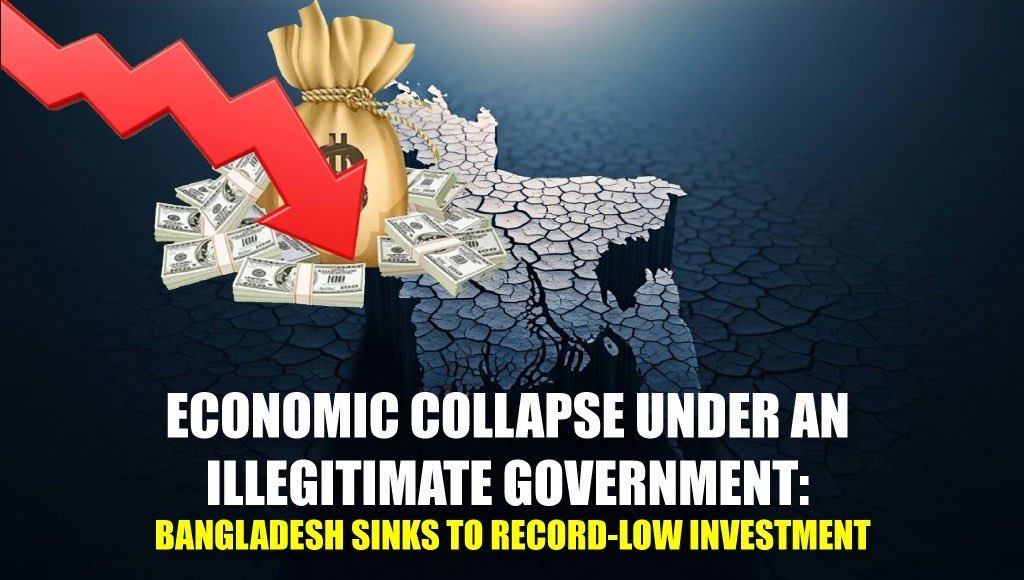

A recent report by the Centre for Policy Dialogue (CPD) reveals a deeply alarming reality: Bangladesh is facing one of its most severe economic downturns in decades. The findings point to the lowest Annual Development Programme (ADP) implementation in ten years, historically low private investment, foreign investment at rock bottom, and persistently high inflation.
Yet the most critical cause of this collapse remains largely unspoken in official economic discourse. The root of the crisis lies in the violent events of July 2024, when an elected government was forcibly removed and replaced by an undemocratic power structure led by Muhammad Yunus. The economic consequences of that political rupture are now unfolding with devastating clarity.
How Political Illegitimacy Triggered Economic Breakdown
The current interim government, which came to power outside constitutional processes, has presided over a rapid erosion of economic confidence. Prices of essential goods such as rice, onions, and cooking oil continue to rise, placing unbearable pressure on households. But the most serious damage has been inflicted on Bangladesh’s long-term economic potential.
Both domestic and foreign investors prioritize stability, predictability, and the rule of law. When a democratically elected government is overthrown and replaced by an unelected authority, investment confidence collapses. CPD’s report confirms that private investment in Bangladesh has fallen to a historic low, reflecting widespread uncertainty about policy continuity, legal enforcement, and institutional reliability.
Why Foreign Investment Has Collapsed in Bangladesh
Foreign investment is even more sensitive to political risk. International investors now see Bangladesh as a country where power was seized with military backing, where political legitimacy is absent, and where militant influence and foreign interference are widely alleged. Under such conditions, capital inevitably withdraws.
As foreign investment dries up, job creation stalls, unemployment rises, and purchasing power declines. This cycle is now clearly visible across the economy. Without investment, factories are not built, businesses do not expand, and young people are left without opportunities.
ADP Failure Signals a Halt in Development
The sharp decline in ADP implementation reflects the paralysis of state-led development. Government projects linked to infrastructure, employment, and public services have slowed or stopped altogether. Thousands of livelihoods that depended on these projects are now at risk.
Managing a national economy requires institutional legitimacy, policy coherence, and accountability. Under an unelected administration, decision-making lacks credibility, and economic governance becomes fragmented. The result is stagnation rather than reform.
Revenue Collection Crisis Under an Unelected Authority
The CPD report suggests expanding the tax base and improving revenue collection. But a fundamental question remains unanswered: why would citizens feel compelled to pay taxes to a government they did not elect?
Tax compliance depends on trust and legitimacy. When a government operates outside democratic consent, that trust erodes. This reality has translated into weak revenue performance, further constraining public spending and economic recovery.
Food Inflation, Hoarding, and the Collapse of Rule of Law
Food inflation remains one of the most painful aspects of the crisis. Despite falling global rice prices, domestic prices in Bangladesh remain high. While CPD highlights hoarding, middlemen, and supply-chain disruptions, the deeper issue is the breakdown of rule of law.
In periods of political instability, hoarders and black-market operators thrive. Under the current administration, enforcement has been weak and inconsistent. Without legitimacy, the state lacks both authority and credibility to take decisive action against market manipulation.
Banking Sector Crisis and the Impossibility of Reform
Bangladesh’s banking sector problems predate the current crisis, but under a democratically elected government, institutional reform remains possible. Under an illegitimate regime, such reform becomes nearly impossible.
A government that itself operates outside constitutional boundaries cannot credibly reform institutions built on constitutional authority. As a result, the banking crisis deepens, credit access tightens, and businesses struggle to survive.
Youth Unemployment and the Loss of Bangladesh’s Future
Bangladesh’s greatest strength has long been its young population. Yet today, that demographic advantage is being squandered. With investment at historic lows, job creation has stalled. New factories are not opening, and existing businesses are downsizing.
Young people are increasingly disillusioned. Many are seeking opportunities abroad, accelerating brain drain and weakening the country’s future economic prospects. An economy without jobs for its youth is an economy without a future.
Militancy, Foreign Influence, and Investor Fear
Allegations of foreign funding and militant involvement in the July 2024 unrest have further damaged Bangladesh’s international image. Organized violence on that scale, many argue, could not have occurred without trained groups and external support.
The perception that militant groups are now operating with greater freedom poses a direct threat to both national security and economic stability. No serious investor will commit capital to a country perceived as politically unstable and vulnerable to extremism.
The Military’s Role and the Weakening of Democratic Institutions
In democratic systems, the military is expected to remain politically neutral. The events of July 2024, however, raised serious questions about that neutrality. The failure to protect constitutional order and the apparent support for an illegal transfer of power have weakened democratic institutions.
This erosion of institutional balance has had a direct economic impact. Economic stability cannot exist without political stability, and political stability cannot exist without respect for democratic norms.
A Crisis That Is Economic, Political, and Moral
As economic indicators continue to deteriorate, ordinary citizens bear the cost. Prices rise, jobs disappear, businesses fail, and access to credit shrinks. The optimism that once surrounded Bangladesh’s development trajectory has given way to uncertainty and despair.
The data presented in CPD’s report point to more than an economic downturn. This is a political and moral crisis. When democracy is dismantled, the economy inevitably collapses. Politics and economics are inseparable.
Bangladesh was once regarded as an emerging economy in South Asia. Today, that progress is being reversed. Investor confidence is fading, institutions are weakening, and the country’s international standing is deteriorating. The consequences of the illegal July 2024 power seizure are now undeniable—and the economy is paying the price.