
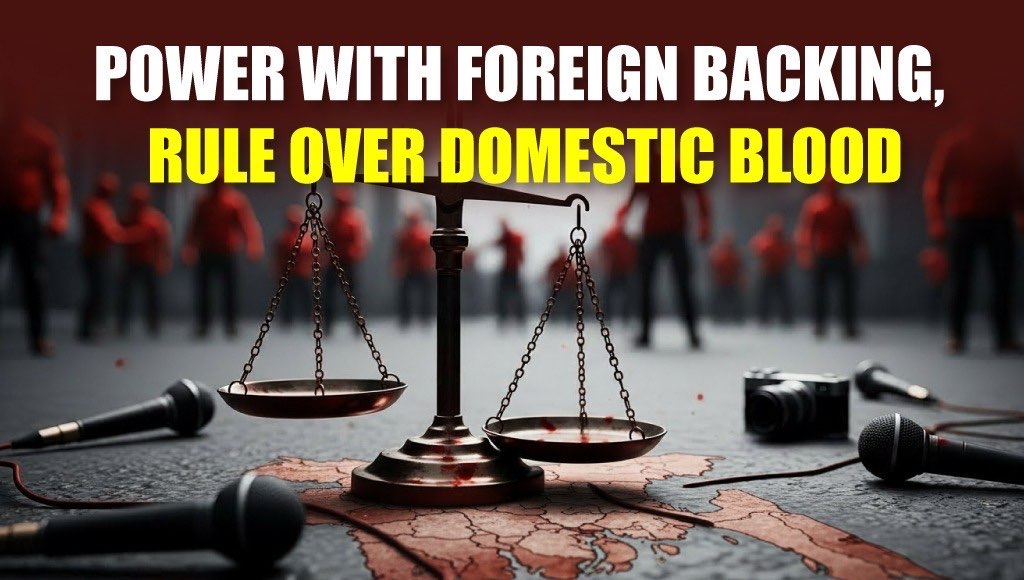

Last year alone, there were nearly 3,750 murder cases. An average of 72 criminal incidents every day. One hundred and thirty-three people were killed in political violence. One hundred and sixty-eight people were beaten to death in the name of mob justice. There were 318 attacks on journalists. This is the real picture of Bangladesh under Yunus’s so-called “reform government.” A government that came to power promising the rule of law has today left no trace of law at all.
When an elected government was overthrown through riots and bloodshed last July, many believed change might come. But what change actually came? In place of an elected government now sits a group of people who have neither a popular mandate nor any experience of governing. What they do have is the blessing of foreign masters and the silent support of religious extremists.
Yunus himself is a money-lending businessman who built his enterprise by extracting high interest from the poor in the name of microcredit. Does winning a Nobel Prize automatically make someone a competent administrator? Is running a country the same as running a microfinance institution? Yunus and his team have completely failed to fulfill the responsibilities they took on. Not only have they failed, but they have also made things worse.
Even in the July riots, there were signs of foreign funding. Whose interests were served by destabilizing Bangladesh is no longer a mystery. To Western powers, Bangladesh is a square on a geopolitical chessboard. They want a government that will remain obedient to their interests. And in this project, they have found allies in Islamic extremist groups that have always opposed democratic processes.
The role of the military is also deeply questionable. In a democracy, the armed forces exist to protect borders and ensure national security, not to interfere in politics. Yet history shows that whenever the military has intervened in Bangladeshi politics, the country has regressed. Democracy has been damaged. People’s rights have been curtailed.
Look at the situation now. Police claim law and order is under control, but reality on the ground is the opposite. People are being shot dead in broad daylight. Criminals roam freely under political protection. Even filing a police complaint does not protect lives. Offenders are not arrested because they operate under political patronage.
Human rights organizations paint an even darker picture. More than 7,000 people have been injured in political violence. People are being beaten to death in the name of mob justice. Deaths in police custody and killings disguised as “crossfire” continue. Violence against women and children has increased. Journalists are attacked to prevent the truth from coming out. Is this the “reform” people were promised?
Since Yunus and his team came to power, political revenge has intensified. Those associated with the previous government are being persecuted. Awami League leaders and activists are under attack. Within the BNP there are internal clashes over dominance and committee positions. Jamaat and Islamist militant groups are finding space to rise again. The entire country feels like a battlefield.
A businessman is shot dead in Jessore. A Jubo Dal leader is shot in Chattogram. A man is beaten to death in Narsingdi. And there is no accountability. The killers are not caught because they know power stands behind them. They know nothing will happen to them under this illegal regime.
The economic situation is equally dire. Unemployment is rising. Prices are out of control. Labor unrest is growing. Workers are dying in factory accidents. But the government shows no concern. They are busy entrenching their own power and preparing a farce in the name of elections.
The home affairs adviser says “all efforts are being made.” But where are the results? Murders happen daily, people live in fear, and he says efforts are ongoing. Is this responsibility? Is this accountability?
Most shameful of all is that this government has no legitimacy. It did not come to power through the people’s vote. It came through conspiracy and bloodshed. An elected government was removed through a military-backed coup, aided by foreign powers, Islamic extremists, and the armed forces. This was not a popular uprising. It was a planned coup.
Democracy is not just elections. It means rule of law, human rights, and freedom of expression. None of that survives under this government. A country where people are killed every day, where women and children are unsafe, where journalists are silenced, cannot be called democratic. This is a police state where no one dares to question those in power.
Yunus and his team know they have no popular support. That is why they are afraid. And to hide that fear, they rely on repression. Opposition voices are silenced. Those who ask questions are persecuted. This is the hallmark of authoritarian rule.
People are now realizing they were deceived. What was done in the name of reform was actually a seizure of power. What was done in the name of democracy was actually a coup. And what is happening in the name of public welfare is looting and chaos.
History shows that military rule has never benefited Bangladesh. Indirect military rule is no different. And when that rule is backed by foreign interests, Islamist militancy, and a money-lending businessman, the consequences are even more destructive.
What the country needs now is real democracy, a legitimate government, and the rule of law. But expecting these from the Yunus government is futile. They are themselves illegitimate. How can they establish legitimacy? They came through a coup. How can they establish democracy?
Bangladesh is paying the price every day for this illegal regime. The soil is turning red with blood. And Yunus sits comfortably in his chair, planning how to please his foreign patrons. That is the reality. That is Bangladesh today.