
Bangladesh is moving toward an electoral framework in which there is a growing risk that the country’s largest political party, the Awami League, will effectively be excluded from the electoral process. Political analysts warn that this could disenfranchise nearly 60 percent of the electorate. Any election held under such circumstances would not only suffer from a crisis of legitimacy, but would also directly contradict India’s long-standing position in favor of a free, fair, and inclusive democratic process in Bangladesh.
According to diplomatic and security analysts, this issue is not merely an internal political matter for Bangladesh. Rather, it is deeply connected to India’s national security, border stability, and regional geopolitics.
Political stability in Bangladesh directly affects India’s security environment, particularly along India’s eastern and northeastern borders. What happens in Bangladesh, therefore, is not just a bilateral concern; it is also a critical factor for overall stability in South Asia.
India has long regarded free, fair, and inclusive elections in Bangladesh as the foundation of political legitimacy and sustainable bilateral relations. New Delhi’s strategic assessment is that inclusive democratic systems reduce the risks of extremism, instability, and foreign interference.
However, analysts believe that the electoral roadmap announced by the interim government led by Dr. Muhammad Yunus runs counter to this perspective. Excluding the Awami League from elections would effectively sideline the country’s largest vote bank, destroying a competitive environment and calling the election’s credibility into question. This could have direct consequences for regional stability and India’s long-term security interests.
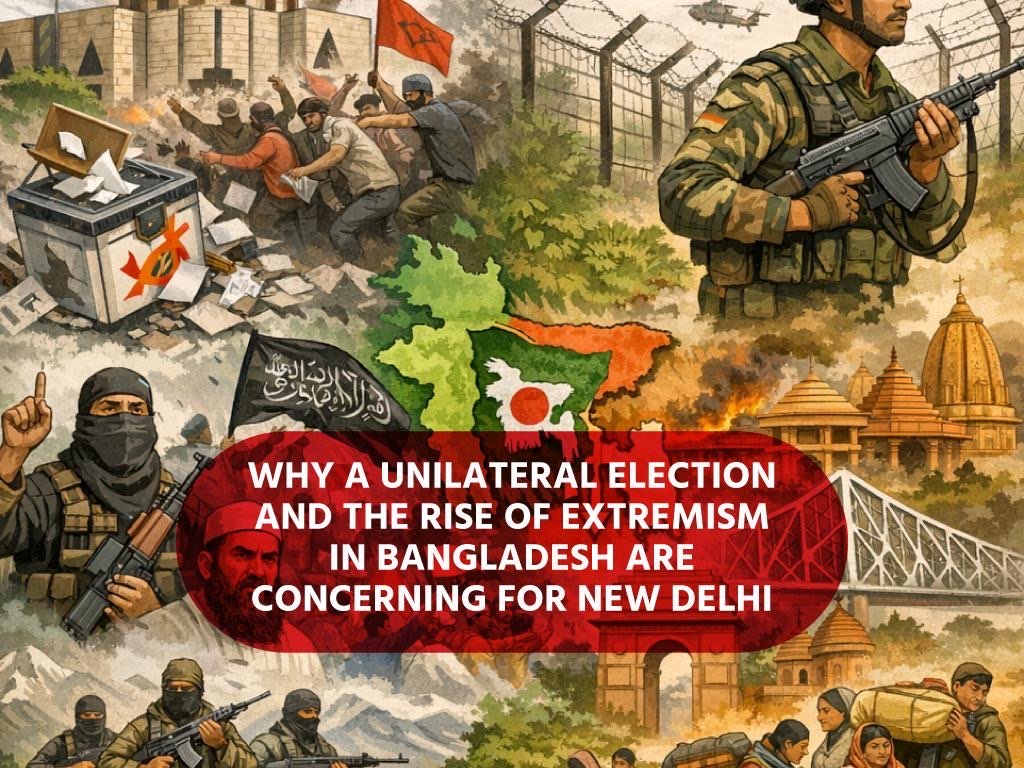
The vacuum created by excluding the Awami League from the political process is not benefiting only domestic political actors. It has also created a major opportunity for anti-India and pro-Pakistan Islamist extremist groups.
Long-marginalized Islamist extremist organizations are now becoming active in open politics. Their rhetoric clearly reflects hostility toward India and signals strategic closeness with Pakistan.
Jamaat-e-Islami and its student wing, Islami Chhatra Shibir, have been given space to re-enter mainstream politics. This is believed to be expanding their organizational influence among youth and lowering barriers to extremist recruitment.
Extremist Activities in Bangladesh and Their Implications for India
Resurgence of Hizb ut-Tahrir
The banned extremist organization Hizb ut-Tahrir has resumed open propaganda activities. Directly targeting India, it is calling for extremist Islamic rule and attempting to build new networks by exploiting the political transition period.
Pakistan-Based Militant Links
Security reports have revealed activity by individuals linked to Pakistan-based Lashkar-e-Taiba. Some militant commanders have even publicly claimed they are seeking ways to use Bangladesh as a corridor for operations against India.
Anti-India Political Narratives
Certain political parties and commentators close to the interim government are accusing India of destabilizing Bangladesh. Such rhetoric is stoking nationalist sentiment and fueling anti-India attitudes among the public.
Pakistan’s Strategic Activism
Military and diplomatic engagement between Bangladesh and Pakistan has increased. Frequent visits by Pakistani military officials indicate a potential strategic shift.
Analysts argue that, taken together, these developments are creating a multidimensional security risk, including:
• An increased risk of cross-border militant attacks
• Weakening of Bangladesh’s institutional capacity to counter extremism
• Rising political costs for future India–Bangladesh bilateral cooperation
Political instability is also creating serious risks for Bangladesh’s religious minorities—Hindus, Christians, and Ahmadi Muslims. Past experience shows that in such situations, extremist groups may engage in planned violence and forced displacement.
The consequences could spill over into India as well, through increased refugee pressure and heightened risks of communal instability in border regions.
Experts warn that if Islamist and pro-Pakistan forces come to power through an exclusionary or manipulated election:
• Border instability would intensify, bilateral cooperation on counterterrorism would collapse, and Pakistan would gain opportunities to use Bangladeshi territory to disrupt security in India’s eastern and northeastern regions.
In this context, India can no longer afford to view the situation as an “internal matter.” New Delhi should intensify diplomatic engagement, coordinate with like-minded regional and international partners, and take a clear stand in support of free, fair, and inclusive elections.
Bangladesh’s stability is inseparably linked to India’s national security. Allowing an exclusionary election to proceed unchecked would be a long-term strategic mistake for India. To prevent democratic erosion, stop the consolidation of extremist forces, and avoid regional instability, India must take effective and decisive action now.