
In recent times, an unsettling reality has begun to surface in Bangladeshi politics: a calculated attempt to package anti-India rhetoric as “nationalism.” This tendency is no longer confined to differences of political opinion; it now stands in direct confrontation with national interest, historical truth, and lived reality. Among those whose names repeatedly emerge at the forefront of this narrative are NCP leader Hasanat and Mastermind Mahfuz, an adviser to the Yunus government.
The wave of violence that swept across the country during the anti-government movement of 2024—attacks on police, loss of lives, and arson at state installations—continues to haunt public memory with unanswered questions. Although judicial processes have yet to conclusively determine responsibility, a significant section of political analysts and civil society believes that the movement’s strategic planning, incendiary language, and confrontational politics were influenced by certain individuals who later appeared to evade accountability. Against this backdrop, the current statements and positions of Hasanat, Mahfuz, and Sarjis demand renewed scrutiny in the light of public interest.
The concern deepens when their rhetoric begins to echo Pakistan’s historical narrative. This insistence on branding India as the sole “enemy” denies the multidimensional reality of Bangladesh. It ceases to be mere free expression and instead transforms into a political stance that collides head-on with the national interest.
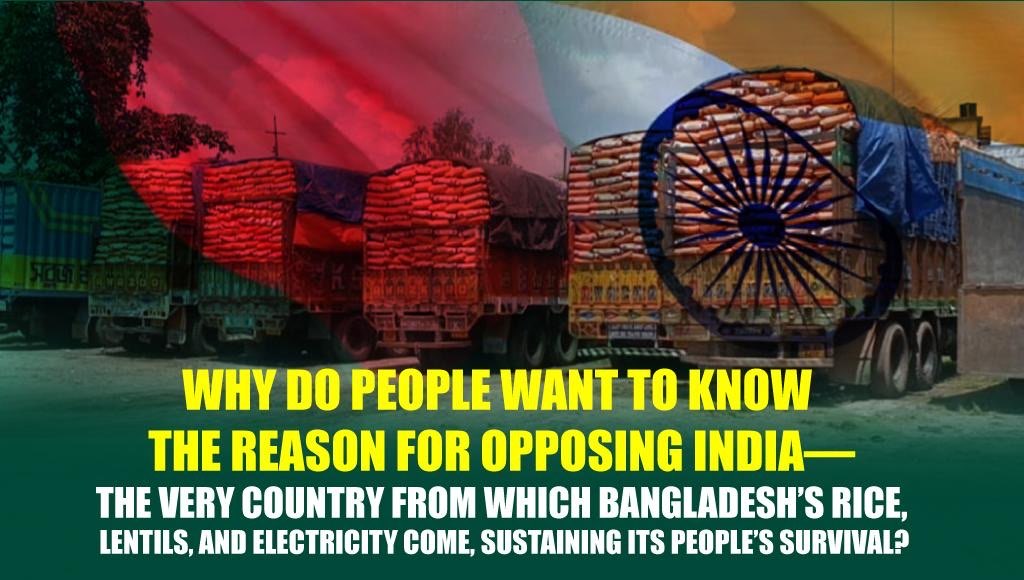
The reality is stark and unforgiving. The daily lives of Bangladesh’s people are inseparably linked to supplies of food, fuel, and electricity. A substantial portion of rice, lentils, edible oil, and power comes from India. In moments of crisis, it is this supply chain that stabilizes markets, keeps industries running, and sustains ordinary lives. Knowing this reality, if one still chooses to stoke anti-India hostility, a grave question arises: whose interests does this politics truly serve?
An even deeper truth lies in history. During the great Liberation War of 1971, India provided refuge to ten million Bangladeshi refugees—an unparalleled humanitarian example in the subcontinent’s history. Without the active participation of the Indian allied forces, the defeat of the Pakistani occupying army would not have been possible. This is not a matter of political opinion; it is an acknowledged historical fact. To deny this truth is to cast doubt on the very foundations of the Liberation War.
And yet, the question persists: why are some newly emerged, so-called political leaders repeatedly eager to inflame anti-India sentiment? Why do they seek to repackage Pakistan’s defeated, unfinished narrative in a new form? Is this ideological confusion—or a deliberate choice of conflict-driven politics?
Bangladesh’s independence was not achieved through emotional slogans alone. It was won through blood, sacrifice, international support, and strategic alliances. Those who attempt to practice politics by denying that history and ignoring present realities are not merely opposing India—they are pushing Bangladesh’s statehood and future toward peril.
That is why people ask today: why this blind hatred against India—the country from which our rice, lentils, and electricity come; the country that once sheltered refugees and stood as an ally to secure victory? Without an honest answer to this question, politics that uses anti-India sentiment as a ladder to power will ultimately prove dangerous—not for India, but for the state of Bangladesh itself.