
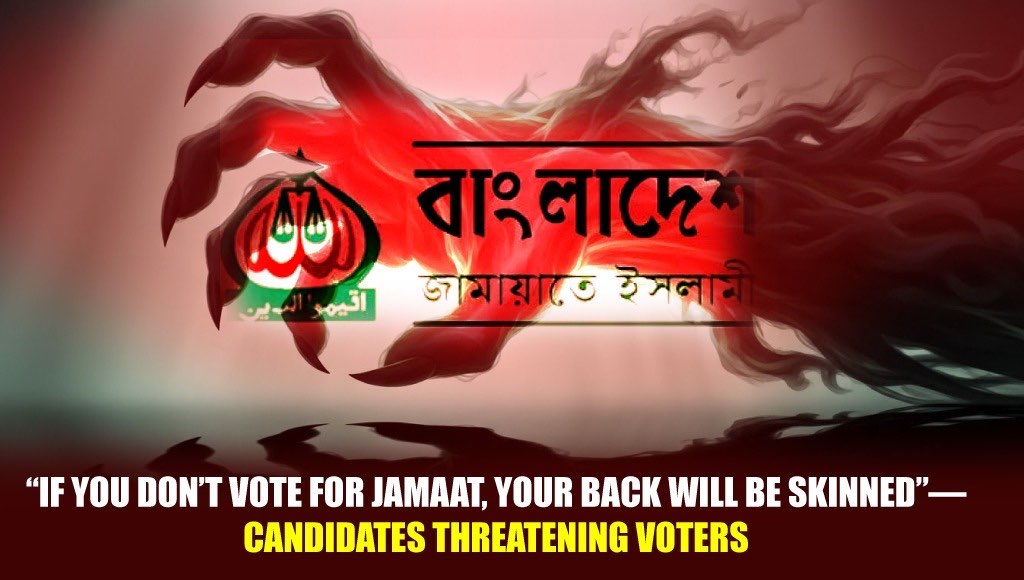
Violence, intimidation, and repression in Bangladeshi politics are nothing new; but the recent incidents occurring across different regions of the country have taken public concern to a new level. Many local voters have alleged that several candidates from Jamaat-e-Islami and their active supporters are openly threatening people to secure votes. Complainants say:
“If you don’t vote for Jamaat, your back will be skinned.”
This horrific and inhumane threat not only violates basic electoral norms but also strikes directly at democratic values.
The fundamental right to vote—where the state is supposed to ensure citizens’ safety and grant them the freedom to express their opinion—is now under threat in various ways. Regardless of the political party, when pressure is exerted on people in the name of seeking votes, it is no longer campaigning; it becomes political terrorism. And when such terrorism is combined with religious identity, group-based pressure, or organized force, it shakes the very foundations of society.
In many areas it has been observed that voters are being intimidated late at night, with groups going door to door. In markets or in front of mosques, ordinary people are being stopped and interrogated—“Whom will you vote for?” If anyone resists, their names are being noted separately. Such an environment is creating deep fear and a culture of intimidation among ordinary voters.
Voters’ own words reflect a sense of helplessness:
“Whom we vote for is no longer our decision; it’s as if someone else is deciding it for us. We’re even afraid to express our own opinions.”
The foundation of democracy is the people’s freedom of opinion and their right to vote. But when threats, violent behavior, and coercion are used to extract votes, democracy becomes wounded. Intimidating voters to confiscate their vote does not just corrupt the election—it strips citizens of their dignity.
This situation not only fosters political instability; it destroys the moral framework of society as well. Once a politics of fear takes hold, it leads to long-term violence, division, and distrust in the state. Elections then cease to be a festival of public participation and instead become a ruthless competition for seizing power.
Therefore, such allegations of severe threats and violence in the electoral field cannot be taken lightly. It is the responsibility of the law enforcement agencies and the administration to maintain neutrality, investigate every complaint, ensure public safety, and restore voters’ confidence.
Democracy survives only when people can express themselves without fear. And elections are meaningful only when voters know:
“My vote is my right; no one can extract it by threatening to skin my back.”