

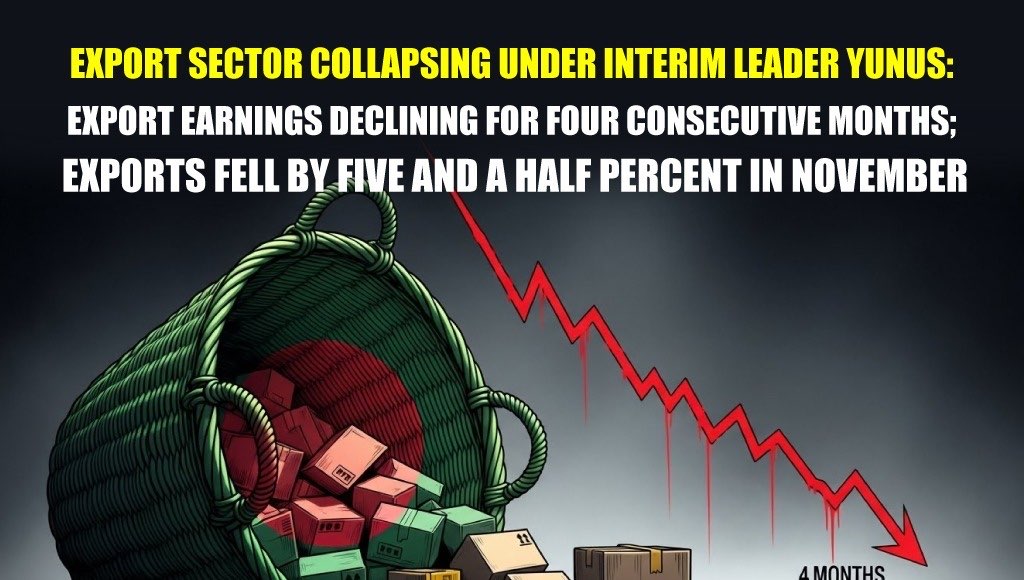
The alarming statistic of Bangladesh’s export earnings declining for the fourth consecutive month indicates a deep crisis for the country’s economy. In November, export income stood at only USD 3.89 billion, which is 5.54 percent lower than the same month last year. This continuous decline is not just a numbers game—it is a reality tied to the livelihoods of millions of people and the country’s future.
The forces behind the bloody riots that spread across the country in July are now in charge of running the nation. The manner in which an elected government was removed to seize power is now clearly reflected in economic indicators. The deep crisis into which Muhammad Yunus and his interim administration have pushed the country can no longer be concealed.
A decline in export earnings doesn’t just mean fewer dollars. It means uncertainty for the jobs of millions of garment workers. It means small and medium entrepreneurs involved in export are collapsing. It means foreign exchange reserves shrinking. Difficulty in paying import bills. In short, there is the fear that the wheels of the entire economy may grind to a halt.
It is no longer a secret that those who created the anarchy in July had foreign funding behind them. The connection of Islamic militant groups and the support of a faction within the military in removing a legitimate government is a shameful chapter in the country’s constitutional history. But even more frightening is the aftermath of this illegal power grab—ordinary people are feeling its effects every single day.
Mr. Yunus is a Nobel laureate and internationally recognized as the pioneer of microcredit. But is running an NGO the same as running a country? The theory of alleviating poverty through microcredit and managing a country’s complex economic system are two entirely different things. Whatever successes he has had in the world of microfinance, that does not automatically qualify someone to run an institution as complex as a nation.
There may be various reasons behind the decline in export earnings for four consecutive months. Global market slowdown, increased competition, reduced demand. But the biggest reason is the instability and uncertainty created inside the country. Investors are now unsure whether their money is safe. Buyers are reconsidering whether to purchase goods from Bangladesh. And domestic entrepreneurs are confused—policies are unpredictable, decisions change overnight.
Whatever the allegations against the government that was removed, at least the economic indicators were stable then. Export earnings were rising, growth was healthy, and investment was coming in. But now? Now every indicator is deteriorating. And those who created this situation are looking for excuses. They cite global circumstances. They blame the corruption of the previous government. But they refuse to take responsibility themselves.
The truth is that a country’s economy does not collapse overnight. But when there is political instability, when there are questions of legitimacy, when policymaking lacks clarity, everything gradually begins to fall apart. The decline in export earnings is just one sign. A greater crisis awaits if this trend continues.
Take the ready-made garments sector, for example. This sector is the backbone of Bangladesh’s economy. Millions of families depend on it. But after the July unrest, many factories shut down. Workers were laid off. Orders were canceled. Foreign buyers are seeking alternative sources. Vietnam, Cambodia, India—these countries are capturing Bangladesh’s market. And we are watching helplessly.
To those who supported this interim government—was this what you wanted? Was the goal to destroy the country’s economy? Or was power-grabbing the only objective? A fall in export earnings doesn’t just mean less income for the government; it means ordinary people’s livelihoods are threatened. The worker who supports a family through factory work is now losing his job. The small-business owner is going bankrupt.
Yunus, referred to by some as a “moneylender charging high interest,” has a microcredit model that is not beyond controversy. There have long been allegations that high-interest loans trap the poor in deeper debt. Many studies have shown that microcredit does not actually reduce poverty; rather, it traps people in cycles of debt. And now he is pushing the entire country into a large economic trap.
Foreign funding cannot be denied either. What is the intention of the countries and organizations that supported this illegal takeover? Do they truly want Bangladesh’s democracy and development? Or are their own interests at play in the region? Keeping Bangladesh weak may benefit some. A strong, self-reliant Bangladesh may be inconvenient for many.
The support of a section of the military is also significant. The military is a respected institution, but when it becomes entangled in politics, the nation suffers. History offers numerous examples of military interventions setting countries back—damaging democracy, the economy, and development. Bangladesh now seems to be heading down that path.
[Export sector collapsing under interim leader Yunus: Export earnings declining for four consecutive months; exports fell by five and a half percent in November]
The foundation of an economy is trust and stability. When investors, businessmen, and ordinary people have confidence in the future, the economy grows. But Bangladesh currently lacks that trust and stability. New uncertainties are emerging every day. Decisions made today are reversed tomorrow. There is no clear direction. No long-term planning.
Falling export earnings are just one symptom—the real problem lies deeper. The crisis of political legitimacy, lack of administrative competence, unclear policymaking—all of these have combined to create a dire situation. And the victims are ordinary people. Those who work hard every day, who dream of moving the country forward, are now the ones suffering the most.
The economy of the country is now on the verge of complete collapse. Export earnings are falling, investment is shrinking, jobs are disappearing, and prices are rising. People’s standard of living is worsening by the day. And those who have taken responsibility show no accountability. They are only trying to cling to power. The country and its people seem worthless to them.
How far a country can fall is now a matter of observation. The fourth consecutive month of declining export earnings is merely a sign that an even greater disaster is approaching. But those in charge show no concern. They are busy consolidating their power. The future of the country does not matter to them.