
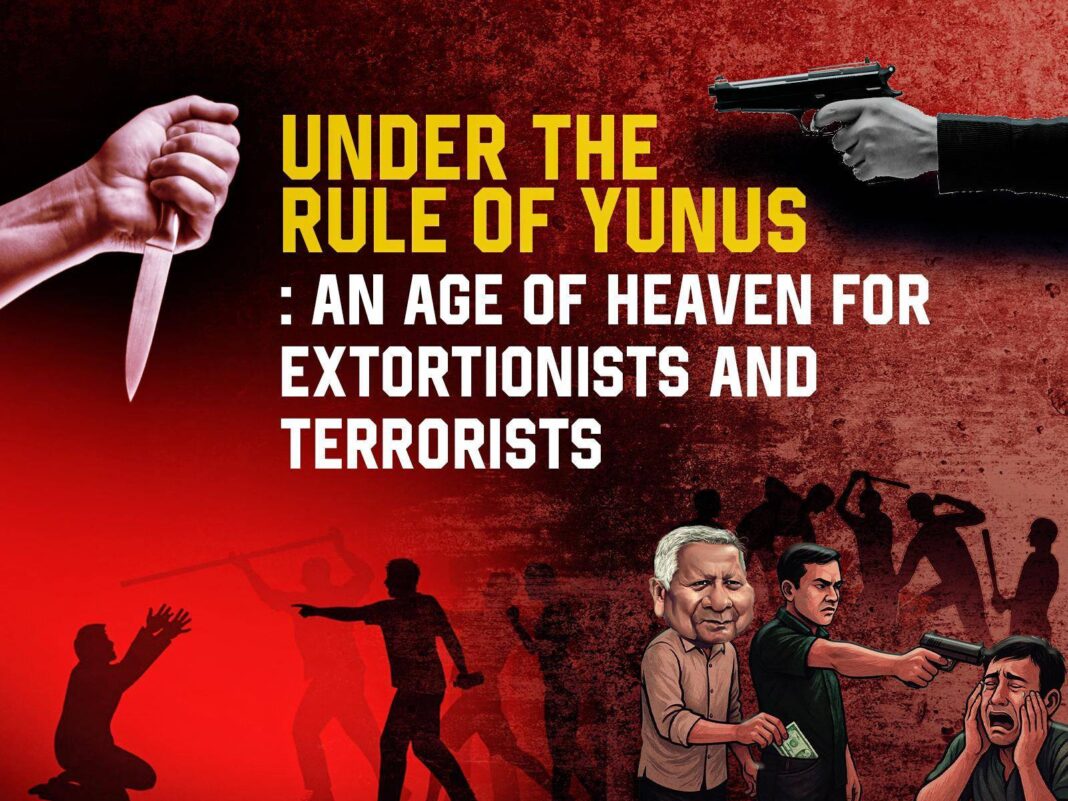

If you don’t pay five crore taka in extortion, you are shot in the leg. If you don’t pay one crore taka, your family is threatened with murder. Shopkeepers are forced to pay five hundred taka daily. Truck drivers are extorted on every road. This is the “New Bangladesh” of Yunus–BNP–Jamaat.
The country that was promised as a dream but turned into a river of blood in July is now witnessing extortion spreading faster than any epidemic. And the germs of this epidemic are being spread by the political cadres of BNP–Jamaat, who are now openly collecting money from businessmen in broad daylight.
The Awami League was in power for sixteen years. During that time, the economy grew, per-capita income increased, and export earnings tripled. BNP–Jamaat used to claim that the Awami League was involved in extortion. But in those sixteen years, did anyone ever demand one crore taka in extortion from any director of the Chittagong Chamber? Did any businessman in Pallabi get shot in the leg? Did the family of Khandaker Delwar Hossain ever have to pay extortion?
The answer is no—because then the state machinery was active, the law-enforcement agencies were effective, and the people who commit extortion were not in power.
Who are the people in power now? The BNP–Jamaat alliance, whose history is entirely filled with terrorism and extortion. During Khaleda Zia’s rule, Hawa Bhaban was the headquarters of extortion. Everyone knows about the crores of taka collected from businessmen under the name of Tarique Rahman. That is when he became widely known as “Chanda Tarique” (Tarique the Extortionist).
From 2001 to 2006, when BNP–Jamaat were in power, it was a golden era for terrorists. Then Bangla Bhai and Shaykh Abdur Rahman’s militants openly killed people with bombs. Police would not go after them because they enjoyed government protection.
Who is Yunus? A usurious moneylender who made crores by placing crushing interest burdens on poor people. His Grameen Bank has been controversial for decades. The interest rates taken from poor women would shame even a traditional moneylender.
This very person is now the chief adviser of the country, presenting himself as its savior. Yet under his supervision, extortion has reached an unprecedented level in the nation’s history.
Police lists show more than 2,500 extortionists are active in the capital. Nationwide, more than fifty thousand. Most of them are new, and almost all have political affiliations. Which party? BNP–Jamaat.
When police say “people with political affiliations are involved in extortion,” whom are they referring to? The Awami League is banned; their leaders and activists are in hiding. So who is collecting extortion money on the streets?
The answer is obvious: BNP–Jamaat workers.
From the transport sector alone, 2.5 crore taka is being collected daily in Dhaka. That’s 60–80 crore per month. More than 1,000 crore per year. Where is this money going? Into political party coffers.
This is what is called a criminal economy—now embedded within the governance structure.
Yunus’s economic adviser, Salehuddin Ahmed, has himself admitted that reaching compromise on extortion is easy. If one group leaves, another group comes. This means the government knows extortion is happening but cannot stop it.
Why can’t they? Because the extortionists are the base of this government.
Businessmen from the Bangladesh Reconditioned Vehicles Importers and Dealers Association held a human chain. They say bombs are thrown at car showrooms, and threats follow if extortion money isn’t paid. Even after filing general diaries with the police, nothing happens. No one is arrested.
Why? Because those doing it are backed by the ruling party.
A top criminal named Sajjad Ali demanded one crore taka from a woman entrepreneur in Chittagong and threatened to kill her family if she didn’t pay. Who is this Sajjad Ali? From which party? Who is giving him such power? Everyone knows the answer.
A former director of the Chittagong Chamber has said he has been defamed on social media for eight months—because he refused to pay extortion.
An exporter contributing to the economy is being defamed simply because he didn’t pay. This is Yunus’s system of governance.
An even more ironic fact: the daughter-in-law of late BNP Secretary General Khandaker Delwar Hossain has also had to pay extortion. She filed a general diary at a police station. This means even BNP’s own people are not safe.
There is no discipline among extortionists now. Whoever can, however they can, is collecting money in the name of BNP, in the name of Jamaat, or using the names of top leaders. Militant groups are also taking advantage of this. Militants who were freed during the July riots are now involved in extortion. They are using this money to rebuild organizations and buy weapons.
The July riots had foreign funding behind them. Everyone knows this now. Which country, which organization provided the money should have been investigated.
But did the Yunus government investigate? No. Because investigating would reveal their own involvement. It would prove that foreign powers funded the ousting of an elected government. And with that money, the BNP–Jamaat alliance unleashed terrorists on the streets under the name of students and the public.
Those same terrorists are now extortionists.
Over the past fourteen months, more than a hundred people have been killed in extortion-related incidents. Twenty in the capital alone. This is not ordinary crime. It is a well-organized criminal network rooted in politics and the state apparatus.
The DMP commissioner says they are preparing a list of extortionists. But is making a list enough? Where are the arrests? Where are the punishments?
The Yunus government does not actually want to stop extortion. Because the extortionists are their political foundation. If BNP–Jamaat workers stop extortion, their income stops. If their income stops, party funds dry up.
And without funds, how will their politics survive?
Therefore the Yunus government will not stop extortion. They cannot stop it. Because extortion is the foundation of their political economy.
Let us recall again what economic adviser Salehuddin Ahmed said: political compromise is difficult, but compromise in extortion is easy.
What does this mean?
It means the Yunus government accepts that extortion has become a permanent system. One group leaves, another replaces it—but the method remains the same. And the government has a stake in this system. Otherwise, how could the economic adviser speak so indifferently?
Now the question is: how will extortion be stopped?
The answer is simple. As long as the BNP–Jamaat alliance remains in power, extortion will continue. Because extortion is the core of their politics. They came to power through riots, killings, and terrorism. And they will remain in power by the same methods—extortion, murder, terrorism.
This is the language of their politics. And Yunus? He is just a mask. The real game is being played by BNP–Jamaat.
There is no rule of law in the country now. Police are ineffective. The administration is paralyzed. Political cadres are above the law. The public faces extreme uncertainty. Businessmen are closing shops out of fear. Transport owners cannot run their vehicles. Workers are losing jobs.
The economy is collapsing.
And for all this, the Yunus–BNP–Jamaat alliance is responsible.
Those who came to power in the name of democracy have now turned the country into a state of anarchy.