

Bangladesh is no longer an independent state. Those who describe what happened in July ’24 as a “student movement” are either fools or partners in a conspiracy. When an elected government is overthrown through armed riots and a loan-shark tycoon is installed in power, and when US media like The Washington Post begin lavishly praising Jamaat-e-Islami, it becomes obvious whose money and whose instructions were behind this entire drama.
To Muhammad Yunus and his American patrons, Bangladesh’s independence, sovereignty, and the people’s right to vote mean nothing. Their sole objective is to block China’s growing influence in the region, using Bangladesh as Washington’s hired mercenary. In the Washington Post article published in support of Jamaat, a US diplomat openly stated: “We want to have them as friends.”
Who are “they”? Jamaat-e-Islami—the organization that stood shoulder to shoulder with the Pakistani army in massacring the people of Bangladesh in 1971. The same organization whose leaders were hanged one by one for war crimes. Now Washington wants to make that organization its “friend.” What greater insult could there be to Bangladesh’s Liberation War?
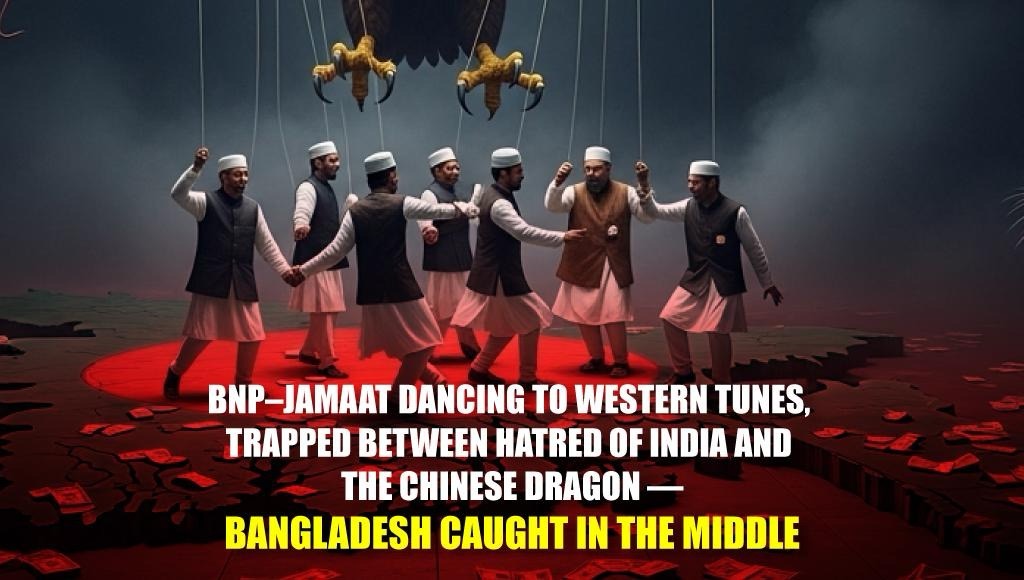
BNP and Jamaat have always been servants of American interests. Ever since Ziaur Rahman seized power through a military coup, he and his party sought refuge in America’s lap. After independence, when Bangladesh adopted a clear foreign policy by signing a friendship treaty with India, Ziaur Rahman reversed that policy and tilted toward Pakistan and the United States as soon as he came to power. This tendency only intensified during Khaleda Zia’s tenure. For BNP, Washington’s directives have always mattered more than national interests.
The question now being raised is why India appears to be changing its position. Jaishankar attended Khaleda Zia’s funeral, and a condolence motion was passed in the Rajya Sabha. Seeing this, many assume India is shifting its Bangladesh policy. But the diplomatic calculations behind this must be understood. India has realized that what is unfolding in Bangladesh is backed by American support, and that complete isolation in this context would be harmful to India itself. That is why India is trying to maintain contact with all political forces. This does not mean, however, that India is supporting forces like Jamaat or BNP.
The reality is that India is Bangladesh’s proven friend. In 1971, when the Pakistani army and their local collaborators—Razakars, Al-Badr, and Al-Shams—were massacring the people of Bangladesh, India stepped forward. India sheltered ten million refugees and bore the responsibility of their care. It trained the freedom fighters, supplied weapons, and ultimately entered the war directly. Since independence, India’s contribution to Bangladesh’s development cannot be denied—trade, connectivity, power, infrastructure—India has supported Bangladesh in every sector. Yet the Yunus clique is now trying to cling to power by spewing anti-India rhetoric.
If one understands Bangladesh’s geopolitical position, the catastrophic nature of this self-destructive policy becomes clear. Bangladesh is surrounded by India on three sides. How can Bangladesh survive by antagonizing India and engaging in anti-India activities? If border tensions rise, trade is halted, and connectivity collapses, ordinary Bangladeshis will suffer the most. But Yunus and his American patrons do not care about these concerns. Their goal is to create instability in the region and exploit that instability to contain China.
That Washington Post report was not mere journalism. Publishing such a pro-Jamaat piece in an American newspaper three weeks before the election sends a clear signal from Washington that it wants Jamaat-e-Islami to play a role in Bangladesh’s future politics. In diplomatic language, this is a declaration. Jamaat leaders themselves are publicly saying they are receiving Washington’s support. This means the United States is now directly intervening in Bangladesh’s politics—and no longer feels the need to hide it.
Marcia Bernicat herself admitted in 2018 that Bangladeshi political leaders regularly visited the US ambassador’s residence to lobby for political favors. She called it a “wrong practice.” But the question is: who created this practice? BNP and Jamaat. They were the ones who looked to America for every political decision. The same picture is now re-emerging. Every step in forming the Yunus government is being taken under Washington’s guidance.
Most alarming is the fact that Bangladesh is now being used as a battleground for proxy wars among global powers. The United States wants to contain China, India wants to secure its own safety, and Pakistan wants to restore its old influence in Bangladesh. Caught in this tug-of-war, Bangladesh is losing its independent foreign policy and its sovereignty. The now-proven foreign funding behind the July riots is part of this conspiracy. Where did this money come from? Who provided it? Why? Answering these questions reveals the full picture.
It is no longer a secret that a section of Bangladesh’s military was involved in this conspiracy. An elected government cannot be overthrown without military support. When armed riots were raging in the streets, what was the army doing? They were not merely standing aside—they silently helped this conspiracy succeed. These officers have forgotten that their oath is to the Constitution, not to any foreign power.
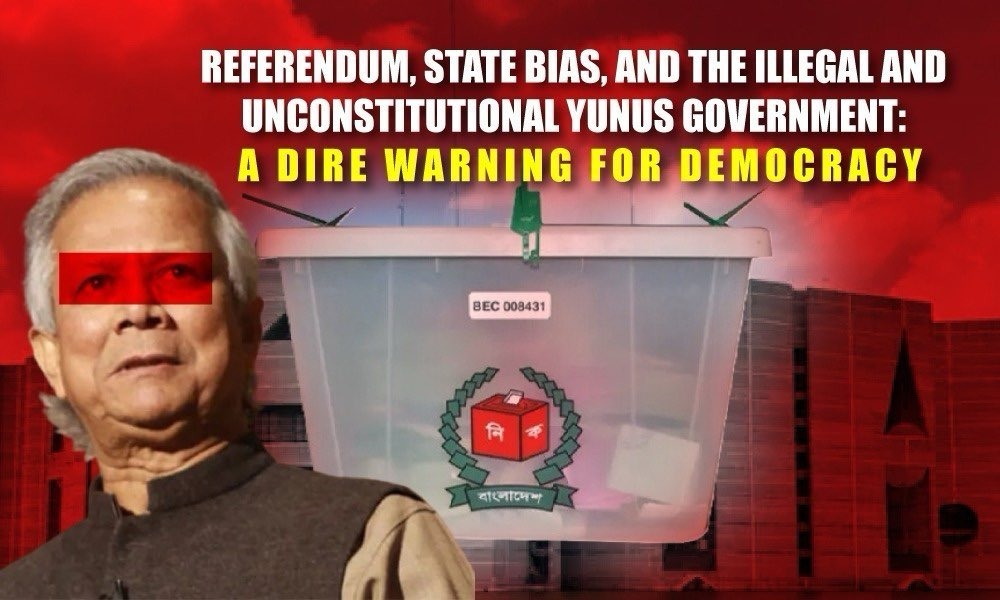
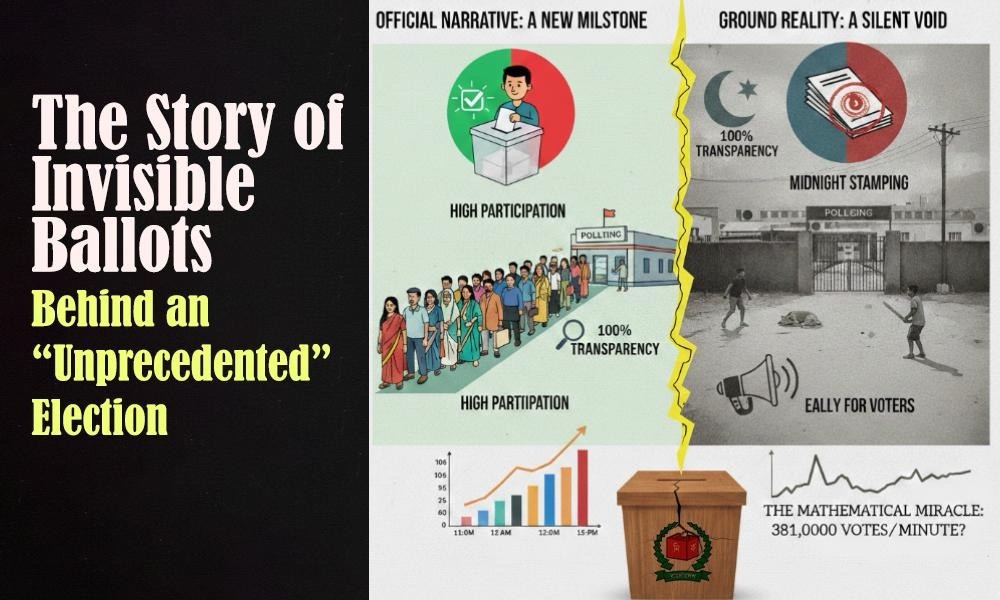
The current government has no constitutional legitimacy. The people did not vote for them; they did not come to power through an election. Yet they remain in power solely due to foreign backing. What this government is doing now is turning Bangladesh into a playground for great-power politics. Under the guise of elections, a farce is being staged in which Jamaat and BNP are being positioned as the main players. Their past record makes it clear what Bangladesh would face if they returned to power: corruption, terrorism, militancy, and communal violence as everyday realities.
The people of Bangladesh must understand that the country stands at a crossroads. Either we survive as an independent, sovereign state, or we become a vassal state of a superpower. Yunus and his associates are pushing Bangladesh toward the latter path—and BNP-Jamaat are their biggest collaborators.