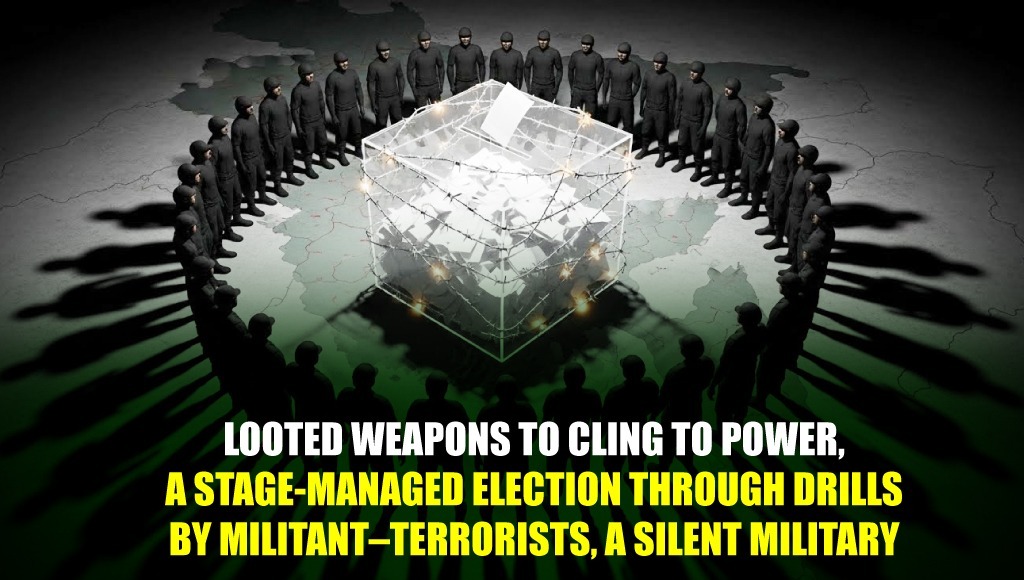

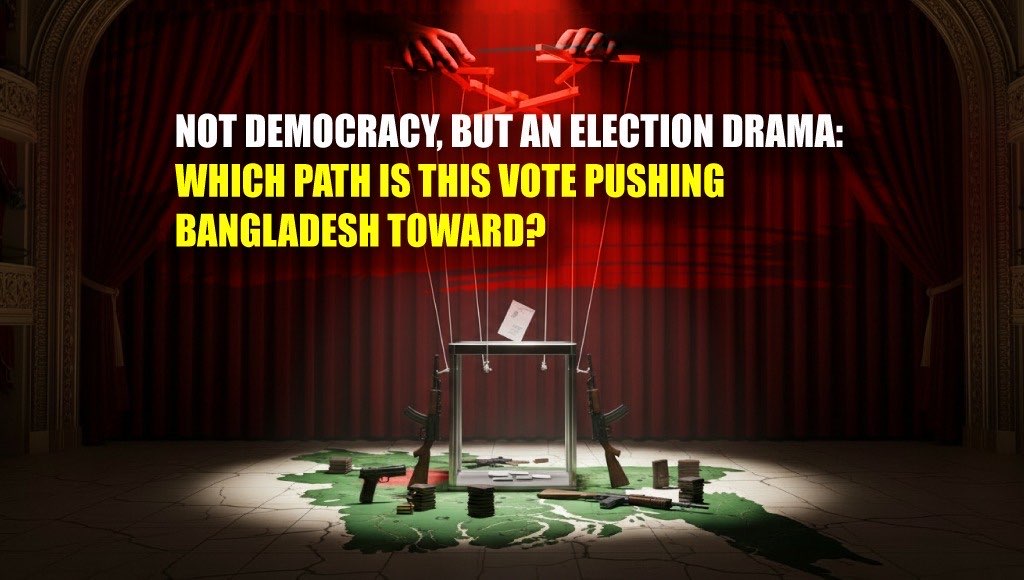

The election scheduled to be held in Bangladesh on 12 February 2026 is increasingly turning into a questionable political spectacle. It is no longer merely a constitutional process—today it has become an international controversy, a moral crisis, and above all, a symbol of democratic failure.
The core question now is simple: Is this a genuine election, or a strategy to manufacture legitimacy under the guise of voting?
- Elections Are About Environment, Not Just a Date
An election is not defined merely by fixing a date. An election requires an environment where:
Opposition parties can speak freely
The media remains independent
Citizens can vote without fear
The administration acts neutrally
Security forces behave impartially
At present, none of these five basic conditions are being met.
Recent observations by Human Rights Watch state that political rights, freedom of expression, and civic space in Bangladesh are shrinking—directly undermining electoral freedom. A vote cast under fear can never be a free vote.
- What Kind of Election Excludes the Main Political Force?
The most troubling reality of this election is that the country’s largest political force, the Awami League, is effectively absent from the electoral field.
International media and research institutions are unequivocal:
“No election can be called free, fair, or inclusive if the principal political party is excluded.”
This is not merely a party issue—it is a matter of voter representation. If a significant portion of voters is left without representation, whose parliament is this?
- International Concern: Bangladesh Is No Longer an Internal Matter
This election is no longer Bangladesh’s internal affair—it is now under global scrutiny.
Examples include:
🔹 The European Union has deployed observers but has not guaranteed the credibility of the results—only surveillance.
🔹 International civil society organizations are demanding the release of political prisoners and fresh elections.
🔹 Global democracy indices are steadily pushing Bangladesh into the category of “hybrid” or “partially authoritarian” regimes.
This is diplomatic language. In plain terms, it means: the world does not trust Bangladesh.
- Insecurity + Repression = Free Voting Impossible
Pre-election violence, arrests, intimidation, and politically motivated cases poison the electoral environment.
Media outlets such as Associated Press, Reuters, and Al Jazeera repeatedly ask:
Can people in Bangladesh vote safely?
So far, no one has been able to answer that question.
- Why This Election Is a “Decorative Democracy”
A new term is gaining currency worldwide: Decorative Democracy—something that looks like democracy on the outside but is hollow within.
In this election:
✔ There will be ballots
✔ There will be polling booths
✔ There will be results
But—
❌ No level playing field
❌ No fear-free environment
❌ No foundation of trust
❌ No political inclusion
This is not a democratic model—it is a counterfeit version of democracy.
- History Is Clear: Such Elections Weaken the State
Across the world, history shows:
Fake elections → international isolation
Fake elections → economic uncertainty
Fake elections → social division
Fake elections → prolonged instability
Is Bangladesh heading down that path?
This Is Not a Political Question, but a National One
This election is not just about power—it is about the future structure of the Bangladeshi state itself.
If elections are turned into theater today, the next generation will no longer believe in ballots. They will believe in streets, confrontation, and chaos.
Democracy does not collapse in a single day.
It is slowly suffocated to death.
This election is one chapter of that suffocation.