

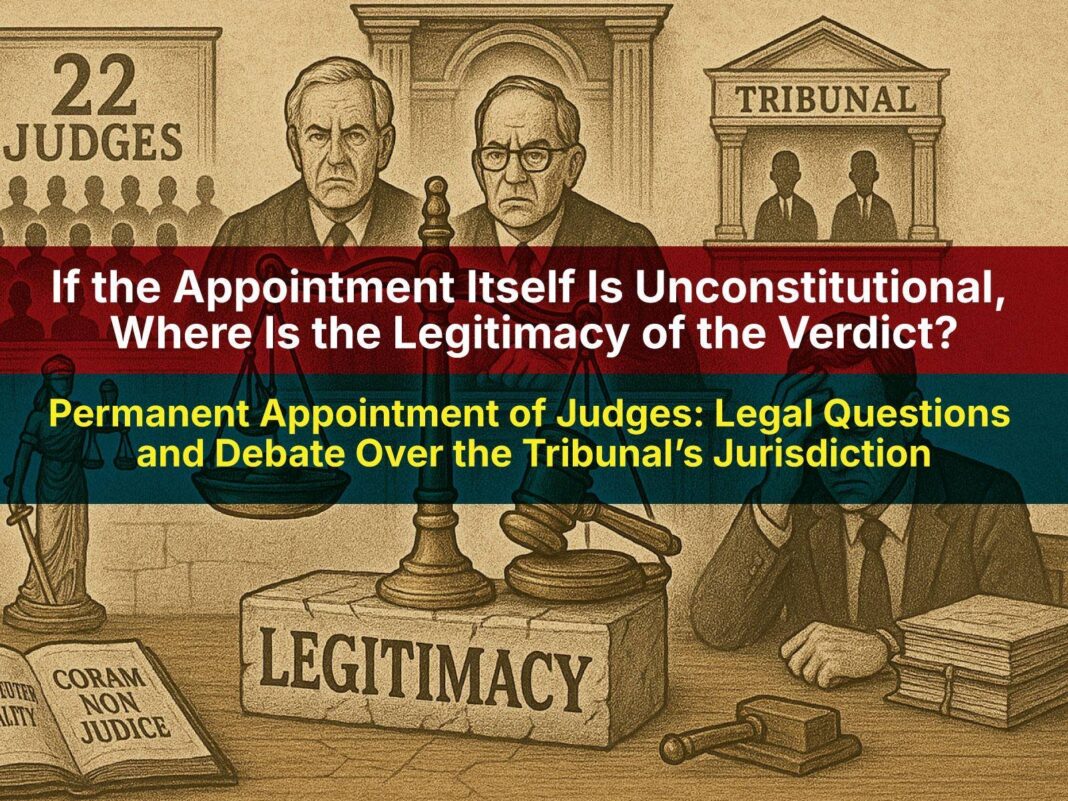

A new debate has emerged within the legal community centering on the permanent appointment of 22 additional judges to the High Court Division after just one year of service. Critics argue that this appointment process raises constitutional questions regarding the jurisdiction of two judges serving on the International Crimes Tribunal, potentially throwing the future of ongoing cases into uncertainty.
A group of lawyers has expressed concern by referring to the Latin maxim “Coram non judice.” The phrase means a verdict delivered by a judge who has no legal authority or jurisdiction to hear the matter. Such verdicts are considered legally void from the very beginning (void ab initio).
At the heart of the discussion is the appointment of the 22 individuals who were appointed as additional judges one year ago. According to Article 98 of the Constitution, the President may appoint qualified persons as additional judges of the Supreme Court for a period of two years. If their performance during this period is deemed satisfactory, the President may then appoint them as permanent judges.
However, these 22 additional judges have recently been made permanent after only one year of service. Critics question what special merit or historic judgments justified their early confirmation before the completion of their two-year term.
The most critical aspect of this debate concerns the panel of judges at the International Crimes Tribunal. Among the newly permanent judges, two—Justice Golam Mortuza Mojumder (Chairman) and Justice Md. Shafiul Alam Mahmood (Member)—are currently serving on the Tribunal. Shortly after their appointment as additional judges of the High Court a year ago, they were assigned to the Tribunal.
According to some legal experts, this is where constitutional and legal complications arise. They argue that Section 6 of the International Crimes (Tribunals) Act, 1973 specifies that Tribunal judges must be appointed under Articles 94 and 95 of the Constitution—provisions that apply to permanent judges of the Supreme Court.
In their view, individuals holding the position of “additional judge” under Article 98 cannot serve as judges of the Tribunal, especially not in the position of Chairman. This, they say, is not only a violation of the law but also unconstitutional. On this basis, the appointments of Justice Golam Mortuza Mojumder and Justice Md. Shafiul Alam Mahmood to the Tribunal were legally invalid from the beginning.
Critics further argue that making them permanent judges now cannot retroactively legitimize their earlier actions. At the time they presided over Tribunal proceedings, their designation was “additional judge,” which does not meet the requirements laid out in the Tribunal Act.
As a result of this legal controversy, questions have been raised about the validity of the Tribunal’s previously delivered judgments and ongoing trials. If the court accepts the argument that their appointments were unconstitutional, their verdicts may fall under the principle of “Coram non judice,” potentially triggering a major judicial crisis.