
The country’s agriculture is now facing a severe dual crisis—fertiliser on one side, irrigation on the other. While the government claims everything is under control, the reality on the ground tells a completely different story. This contradiction is no longer just a concern—it is fueling public anger. Because crops cannot be grown on paper claims of success; this is a reality the government appears to be deliberately ignoring.
The ongoing IRRI-Boro season—the backbone of national food production—is when farmers depend most on fertiliser and irrigation. Yet at this critical time, they are being hit simultaneously by an artificial fertiliser shortage, uncontrolled price hikes, and a fuel crisis affecting irrigation. The government insists there is sufficient stock. But the question remains: if supplies are adequate, why are farmers being forced to buy fertiliser at higher prices?
Why are dealers openly forming syndicates to control the market, while the administration remains a passive observer?
Recent reports in national newspapers reveal that farmers are being forced to pay above the fixed prices for urea and DAP fertilisers. In some areas, even after standing in line overnight, they cannot obtain fertiliser. Farmers in several northern districts have alleged that dealers are hoarding supplies to create artificial shortages. Yet there is no visible enforcement action or punitive measures against these allegations. This suggests that the syndicate is not only active but may also be indirectly tolerated.
The government has no clear answers to these questions. Instead, it is increasingly pointing to the Middle East conflict as a justification—creating a culture of avoiding responsibility. While global conditions undoubtedly have an impact, using them as a shield to hide domestic corruption, mismanagement, and inefficiency reflects clear irresponsibility.
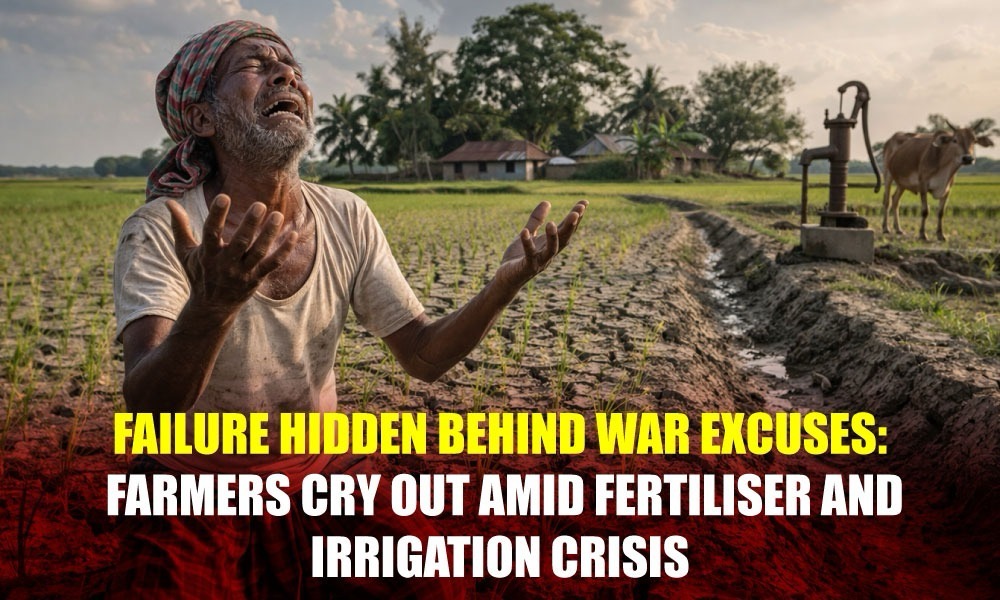
Farmers’ accounts are even more stark—no diesel, no irrigation, no timely water. In some areas, pump owners are forced to halt irrigation due to lack of fuel. Elsewhere, people must wait hours in line for small amounts of fuel. Reports indicate that in certain regions, farmland is drying and cracking, as farmers are unable to continue cultivation due to lack of irrigation. If the government still insists this is “not a crisis,” it reflects not just incompetence but a dangerous and deliberate denial of reality.
Even more concerning is the contradiction in policy: while claiming sufficient fertiliser reserves, the government has halted production at state-owned fertiliser factories citing fuel rationing. The shutdown of Shahjalal Fertiliser Factory signals that authorities themselves anticipate a major fuel and fertiliser shortage ahead. This raises a critical question—why was there no advance preparation despite such forecasts? Or was the situation allowed to deteriorate intentionally to benefit syndicates?
A major structural weakness in Bangladesh’s agriculture is its reliance on imports. Fertiliser production depends on gas, much of which is also import-dependent. Despite years of promises to reduce this dependency, there has been no visible progress. Alternative sources, domestic production capacity, and energy security remain largely confined to paper plans.
This also raises another important question—were no steps taken in the past? In reality, during the tenure of Sheikh Hasina, several forward-looking initiatives were undertaken to strengthen the agricultural sector. These included increased subsidies, digital monitoring of fertiliser distribution, expansion of electricity-based irrigation, and plans to modernise fertiliser factories. Incentive packages and accessible agricultural credit also helped boost production in many cases.
However, in the current situation, not only has that continuity not been maintained, but previous gains are now at risk due to policy slackness and lack of coordination. Weak planning, poor oversight, and lack of political will have deepened the crisis.
The result is now clear—a global shock is directly impacting the agricultural sector, while the government continues to rely on reassurances rather than action. But farmers do not need promises—they need timely fertiliser, irrigation, and fair prices.
The greatest concern now is food security. Nearly 60% of Boro cultivation depends on diesel-powered irrigation. If irrigation is disrupted, production will fall—that is basic economics. A drop in production will inevitably drive up food prices, placing additional pressure on ordinary citizens.
In this situation, the government had three clear responsibilities:
- Ensure strict monitoring of the fertiliser market and break syndicates
- Guarantee fuel supply for agricultural irrigation and increase subsidies if needed
- Activate alternative import sources and boost domestic production
But in reality, none of these steps have been effectively implemented. Instead, indecision, administrative inaction, and tacit support for syndicates have further complicated the crisis.
The biggest failure in governance becomes evident when a state fails to prepare for an impending crisis. The current fertiliser and irrigation crisis is a direct result of short-sightedness, mismanagement, and a politics of shifting responsibility.
There is still time to acknowledge reality—to listen to farmers on the ground. Not just statements, but visible and decisive action is needed. Otherwise, this crisis will not remain confined to farmers alone—it will escalate into a deep food and economic crisis, the responsibility for which cannot be avoided.