
Muhammad Yunus’s desperate power grab disguised as reform; illegal, exclusionary, and a direct assault on the 1972 Constitution.
In a brazen act of constitutional sabotage, Bangladesh’s President Mohammed Shahabuddin issued the “July National Charter (Constitutional Reform) Implementation Order” on November 13, 2025, a move that reeks of desperation and illegitimacy. This so-called order, masquerading as a pathway to reform, is nothing short of an illegal power grab designed to entrench the unelected interim regime led by Muhammad Yunus and undermine the very foundations of Bangladesh’s democracy. As a staunch defender of the 1972 Constitution, forged in the blood of our liberation war under the leadership of Bangabandhu Sheikh Mujibur Rahman and upheld by the Awami League, this decree represents not progress, but a profound betrayal. It mocks the sovereign will of the people, sidesteps parliamentary processes, and serves as a shield for those who seized power through chaos rather than consensus.
Will Bangladesh’s Massive Democratic Experiment Work?
The July Charter, with its 84 reform proposals, including 48 constitutional amendments, was signed by a mere 25 parties on October 17, 2025, in a ceremony that excluded the voices of millions. Presented as a “national consensus,” it was rammed through a controversial referendum alongside the February 12, 2026, elections, where it garnered a dubious 60% approval amid reports of low turnout in traditional strongholds and allegations of manipulation.
Bangladesh Referendum: The July Charter Explained
But approval ratings cannot launder illegality. This order, issued by a president who owes his position to the ousted Awami League government but now dances to the tune of its adversaries, exposes the fragility of Bangladesh’s post-uprising political order. It is a slap in the face to the principles of separation of powers and parliamentary sovereignty, principles that the Awami League has championed for decades against authoritarian drifts.
As Bangladesh grapples with this constitutional crisis, the international community must recognize this not as reform, but as regression, a calculated effort to rewrite history and silence dissent. The Awami League, despite being unjustly banned from electoral participation, stands as the guardian of true democratic values. This op-ed unmasks the deceit, demands accountability, and calls for a return to constitutional fidelity.
The Illegal Foundation of the Presidential Order
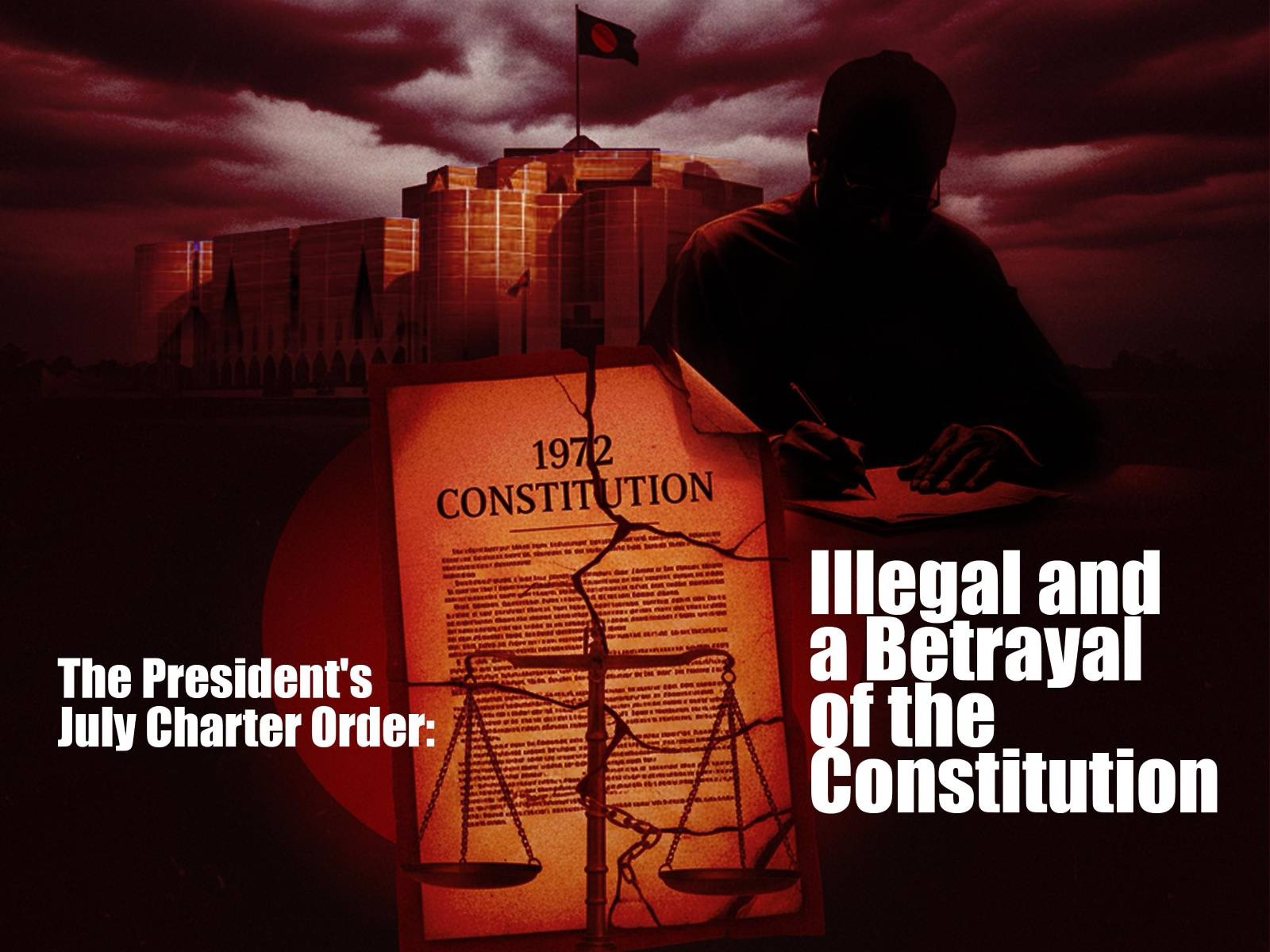
The President’s July Charter Order is built on a foundation of sand, legally void and constitutionally offensive. In a parliamentary democracy like Bangladesh’s, the president holds ceremonial powers, not the authority to mandate sweeping constitutional reforms through administrative fiat unilaterally.
President’s July Charter Order Declared “Illegal,” Accused of Violating the Constitution
As Barrister Jyotirmoy Barua aptly argued, this is merely a “presidential administrative order” with no basis in law, clashing directly with the parliamentary form of government. “The president has no jurisdiction to issue such a constitutional order,” Barua emphasized, questioning how administrative edicts can alter the supreme law of the land.
This overreach is evident in the order’s mechanics. It mandates the formation of a “Constitutional Reform Council” comprising elected MPs, who must take a second oath to implement reforms within 180 days. Such a dual oath is not just redundant; it is treacherous, forcing representatives to pledge allegiance to a parallel structure outside the existing constitutional framework. This creates a “direct conflict” with the Constitution, as legal experts have noted, rendering the entire process null and void.
The July Implementation Charter has been accused of defying the supremacy of the constitution
The interim government under Yunus, which orchestrated this farce, spent over a year convening commissions and dialogues, culminating in the Charter’s 84 proposals. Yet, these were legitimized not through parliamentary debate but via presidential decree, a clear circumvention of Article 142 of the Constitution, which requires two-thirds parliamentary approval for amendments. The Awami League has rightly decried this as an “illegal” maneuver, pointing out that the referendum itself was a “so-called” exercise staged by an unelected regime. With the Awami League banned under dubious anti-terrorism laws, the process excluded the party that represents millions, turning reform into exclusion.
Why Bangladesh’s Referendum is a Gamble
Post-election, the order’s flaws are glaring. The Bangladesh Nationalist Party (BNP), with its 212 MPs, boycotted the second oath, exposing the council’s lack of quorum, requiring at least 60 members, but was backed by only 77 from Jamaat-e-Islami and allies. This majority boycott underscores the order’s unworkability and illegitimacy. Even the BNP, which initially endorsed a “yes” vote, filed notes of dissent on key proposals like the upper house, revealing fractures in the so-called consensus. The president’s action is not leadership; it is lawlessness, betraying the oath he took under the very Constitution he now subverts.
A Calculated Deception to Shield the Usurpers
Beneath the veneer of “national renewal,” the July Charter Order is a cynical ploy to protect Muhammad Yunus and his interim cabal from accountability. The Awami League has unmasked this as a “calculated deception,” designed not for Bangladesh’s benefit but to insulate Yunus from scrutiny over his governance failures. “The July Charter was never about Bangladesh. It was about Muhammad Yunus’s survival,” the party declared, accusing him of orchestrating a “smokescreen” to dodge responsibility amid mounting criticism.
Bangladesh: Awami League slams July Charter as ‘calculated deception’ to protect Yunus
Yunus, the Nobel laureate turned unelected ruler, has presided over 18 months of chaos: breakdown in law and order, targeted attacks on minorities (including Hindus, traditional Awami League supporters), and an ineffectual police force. The Charter, with its promises of term limits, judicial independence, and women’s representation, is a facade to project international legitimacy while entrenching exclusion. By handpicking elites and NGO figures for commissions, Yunus silenced dissent, ensuring no real challenge to his authority. The Awami League lambasted this: “Behind closed doors, the Charter was a self-serving plan, not a national blueprint.”
The signing ceremony on October 17, 2025, was a sham, attended by no major parties like the National Citizen Party, exposing its “fabricated lie” of representation. Only 30% of parties signed, with the majority rejecting it, yet it was forced through presidential order. This deception extends to the referendum, a binary choice on complex issues amid limited public understanding and allegations of rigging. The Awami League warns that elections under this regime would extend the fraud: “The same actors, the same playbook, the same outcome, Bangladesh’s people left voiceless.”
July Charter Sparks Constitutional Controversy: Only 30% of Parties Sign, Majority Reject
This is not reform; it is rigging the system to perpetuate the post-uprising power grab. Yunus and his allies, including Jamaat-e-Islami, now the main opposition with its history of bans and extremism, betray the secular, democratic ethos the Awami League fought for. The order shields them from justice for the violence and instability they’ve unleashed.
Betrayal of the Bangladeshi People and Democratic Principles
The July Charter Order is a profound betrayal of the Bangladeshi people, reducing democracy to a staged spectacle while sidelining the majority. By banning the Awami League, the party that led the 1971 liberation and governed for 15 years until the 2024 uprising, the interim regime ensured the Charter’s “consensus” was anything but. This exclusion narrows participatory breadth, as critics note, leading to “enduring contestation” over the new order’s authority.
The referendum, held amid clashes and low turnout (nearly 60% overall, but depressed in Awami strongholds), was a farce. Voters drew the banned Awami League’s boat symbol on ballots in protest, signaling rejection of this imposed “reform.” The Charter’s disagreements, in the upper house, oversight bodies, and more, reveal competing philosophies, not unity. Jamaat’s push for implementation contrasts with BNP’s hesitance, fracturing the coalition.
This betrayal extends to minorities and civil liberties. Under Yunus, attacks on Hindus (14 million strong) escalated, eroding trust. The order’s push for “checks on executive power” rings hollow when the regime itself operates without mandate. The Awami League’s criticism is spot-on: “The July Charter exposed the real mindset of this unelected elite, a belief that democracy can be staged.” By legitimizing the 2024 uprising as a “second independence,” it erases the true liberation war’s legacy, a direct affront to Awami values.
International observers must see through this. The order threatens stability, risking a return to one-party rule under new guises. It betrays not just the Constitution but the people’s aspiration for genuine democracy.
The Threat to Bangladesh’s Constitutional Legacy
At its core, the July Charter Order threatens the sacred 1972 Constitution, a document born from the Awami League’s struggle against oppression. Proposals for a bicameral legislature, proportional representation, and enhanced presidential powers risk diluting parliamentary sovereignty and opening doors to authoritarianism. This is no mere tweak; it’s a wholesale rewrite under the guise of preventing “autocracy,” ironically imposed by an autocratic interim setup.
The Awami League, as the architect of modern Bangladesh, views this as an erasure of history. The Charter’s constitutional recognition of the 2024 uprising diminishes the 1971 war, a betrayal of Bangabandhu’s vision. Legal petitions have sought to declare it illegal, highlighting contradictions with the existing framework. Without broad acceptance, this legacy is at risk, fostering division rather than durability.
Restoring Constitutional Integrity: A Call to Action
The President’s July Charter Order must be repudiated as the illegal, treacherous act it is. Bangladesh deserves better than this betrayal, a return to the 1972 Constitution’s principles, free from unelected meddlers like Yunus. The Awami League, despite persecution, remains the beacon of secular democracy. International media and allies must pressure for lifting the ban, ensuring fair processes, and holding usurpers accountable.
Let this be a wake-up call: Reject the deception, defend the Constitution, and reclaim Bangladesh’s democratic soul. The people will not forgive this betrayal.