

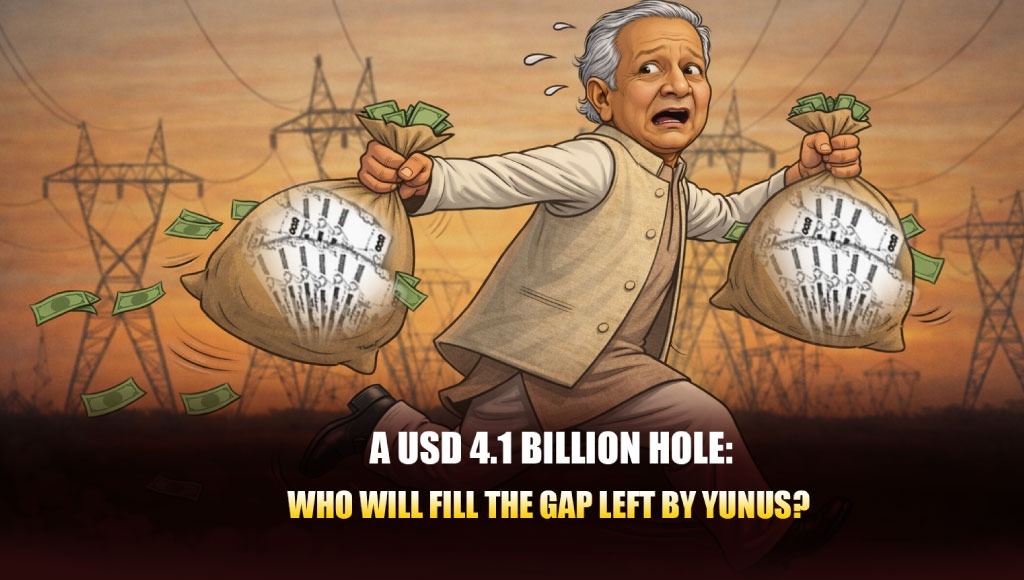
What the Yunus administration has left behind in Bangladesh’s power sector can scarcely be described as anything less than a serious failure.
According to figures from the Bangladesh Power Development Board, outstanding dues to domestic and foreign companies now stand at around USD 4.1 billion. Oil-based power plants have reportedly gone unpaid for seven to eight months — meaning no bills have been cleared since July 2025.
During this period, the Yunus government was fully in office, publicly emphasising reform, while liabilities in the power sector continued to accumulate.
The question now is whether this reflects administrative incapacity, indifference, or a deliberate policy choice.
Former adviser Fawzul Kabir Khan has said there was no intention behind the non-payment, attributing the situation to a shortage of funds. Critics argue, however, that managing such constraints is itself a core responsibility of government. After more than a year and a half in power, leaving the electricity sector in deeper crisis has raised concerns about governance and accountability.
Private power producers have also questioned whether the interim administration knowingly allowed the situation to deteriorate. Since July, bill payments were halted, letters of credit reportedly faced restrictions, fuel reserves declined, and financial bottlenecks persisted — a pattern that has fuelled suspicion.
Energy expert Ijaz Hossain has said the interim government did not fully import fuel and failed to account for industrial demand. Coal-fired power plants, designed to operate at around 85 percent capacity, reportedly ran at only 55 percent. Analysts say the missing capacity reflects shortcomings in planning and financing.
The BNP-led government now finds itself confronting what one minister has described as “disaster management.” Authorities must ensure uninterrupted electricity during Ramadan, the irrigation season, and the summer months, when demand may reach 18,000 megawatts. Yet the treasury is under strain, arrears remain substantial, fuel reserves are declining, and banks are reportedly reluctant to open new letters of credit.
According to estimates cited by Ijaz Hossain, Bangladesh requires roughly USD 25 billion annually to sustain its power and energy sector. Observers argue that the previous administration failed to adopt a long-term strategy to reduce debt or fully utilise production capacity.
Political transitions often bring competing narratives. In this case, however, officials say the figures are clear: from July to February — a period of seven months — not a single payment was made, according to the Power Development Board itself.
How much of the damage can now be mitigated remains to be seen. But critics argue that the condition in which the power sector was left suggests it was never treated as a priority.