

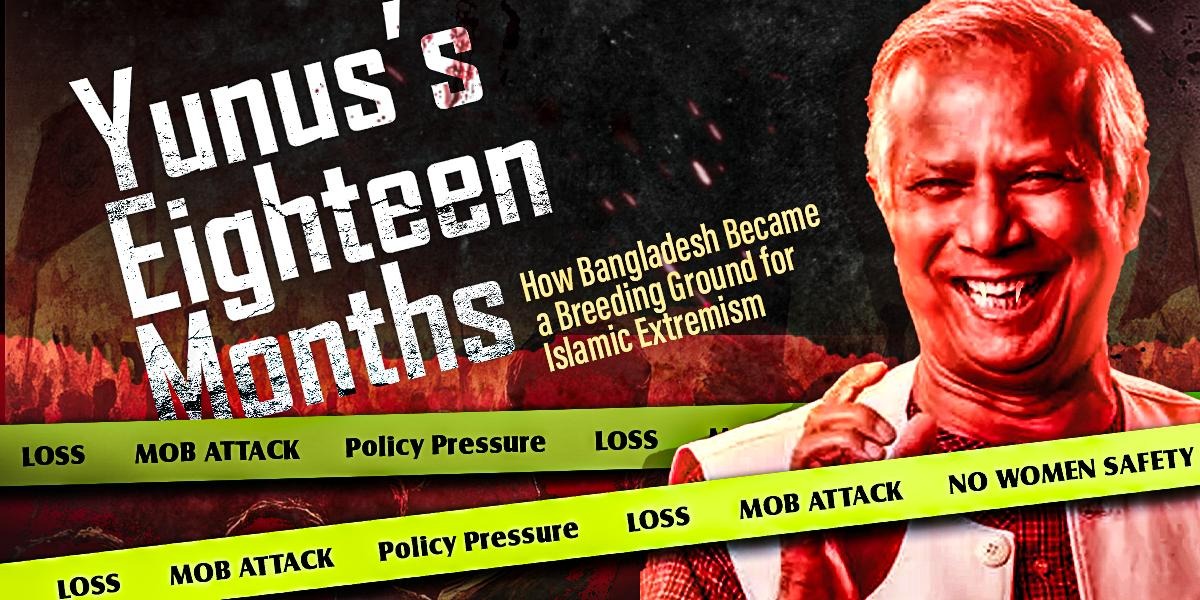
When the BBC Bengali went to interview Mufti Jasimuddin Rahmani after his release, he said, “ABT never existed.” Rajib Haider’s family watched that interview. The man whose handwritten directives led to their son being hacked to death was now on television claiming the organization itself had never existed. Keep that image in mind. Then read the rest.
Mufti Jasimuddin Rahmani was released on August 26, 2024. Muhammad Yunus had taken power on August 8 — just eighteen days earlier. Rahmani was the chief of Ansarullah Bangla Team (ABT), an al-Qaeda–inspired group that, over the past decade, systematically hacked to death bloggers, writers, and publishers in Bangladesh. Later, RSIS reported that after his release, ABT began rebuilding networks and procuring semi-automatic rifles. What did the government say then? Nothing. What did it do? Nothing.
If you call this merely an administrative mistake, then explain the December 2024 decision: appointing Nasimul Ghani, a founding member of Hizb ut-Tahrir, as Bangladesh’s Home Secretary. Hizb ut-Tahrir is an organization that declares democracy haram, calls parliament a den of evil, and advocates for the establishment of a caliphate. A founding member of that group is now the country’s top bureaucrat overseeing law and order. Did Yunus not know? Of course he knew. This is not an error; it is policy.
ORF Bangla published a report that is hard to believe at first reading. Ghulam Sarwar Rahat, the second-in-command of the banned Jamaat-ul-Mujahideen Bangladesh (JMB), was reportedly seen accompanying Muhammad Yunus during a visit to the “Aynaghar.” JMB, the organization that carried out coordinated nationwide bomb blasts in 2005, has been officially banned. Yet its former second-in-command was seen walking alongside the head of government. That single incident is significant enough; everything else pales beside it.
Then comes the Pakistan chapter. In January 2025, the Director General of Inter-Services Intelligence (ISI), Major General Shahid Amir Afsar, visited Bangladesh and toured highly sensitive areas near the Indian border — with the Yunus government’s approval. Since August 5, five high-level Pakistani military delegations have visited. For the first time since 1971, direct trade with Pakistan has resumed. Indian intelligence agencies have reportedly confirmed that Lashkar-e-Taiba, Jaish-e-Mohammed, and Harkat-ul-Jihad-al-Islami are reactivating old networks inside Bangladesh. Analysts at ORF have warned that some actors may be attempting to reshape the Bangladesh Army along a Pakistan model. Fifty years after Bangladesh won independence in blood, Pakistan’s intelligence chief is again touring its borders.
On December 26, 2025, an explosion occurred at Ummul Qura International Madrasa in Keraniganj. Investigators reportedly recovered TATP explosives — the same type used by Islamic State (ISIS) in attacks across European cities — along with 394 liters of liquid chemicals, 27 kilograms of powder, nine ready-made bombs, hydrogen peroxide, nitric acid, handcuffs, and 17 jihadist books. Dhaka police said there were plans for coordinated attacks on multiple temples in the capital. Because it was a Friday and students were absent, a catastrophe may have been averted. But the question remains: how long had this factory been operating — weeks, months? If a government cannot detect a bomb factory in its own capital, what does its claim of “zero tolerance” truly mean?
Just eight days earlier, on the night of December 18, after news spread of Sharif Osman Hadi’s death, an organized mob chanting “Naraye Takbir” set fire to the offices of Prothom Alo and The Daily Star. DW Bengali, BBC Bengali, and Al Jazeera described it as an “Islamist mob attack.” When 28 individuals were arrested, links reportedly emerged to Islami Chhatra Shibir — the student wing of Jamaat, whose ban this government had lifted just four months earlier. Meanwhile, the United Nations reported that 135 journalists had been arrested since August 5. Militants burn media offices; journalists are arrested. What would you call that?
Each time the Yunus government has spoken, it has claimed “zero tolerance.” Yet rarely has this country seen such a gulf between rhetoric and reality. More than 300 terrorism suspects are now out on bail. An al-Qaeda–inspired leader says his organization never existed. A bomb factory operates in the capital undetected. Shibir activists torch media houses; the government promises investigation. DW Bengali has openly asked whether extremist forces are receiving state patronage. The answer is increasingly self-evident.
Both RSIS and ORF independently report that al-Qaeda’s AQIS media arm welcomed the fall of Sheikh Hasina and called for establishing an Islamic state in Bangladesh. ISIS, in its magazine Al-Naba, has portrayed Bangladesh as a center of Islamic revival. Two of the world’s most notorious extremist organizations are openly celebrating developments in Bangladesh. ORF further warns of possible coordination between JMB and Hefazat. If armed militancy and organized political Islamism converge under one umbrella, it would mark an unprecedented chapter in Bangladesh’s history.
The United Kingdom, France, Germany, Italy, Canada, Norway, Sweden, Denmark, Netherlands, and Switzerland jointly condemned the December media attacks. UN Special Rapporteur Irene Khan stated that the interim government must be held accountable. Human Rights Watch observed that while Hasina adopted one extreme approach, Yunus appears to have adopted the opposite — both harmful, both costly for ordinary citizens. The world is watching, speaking, condemning. Yunus insists everything is fine.
This article is not written in favor of any political party, nor against one. Information from DW Bengali, BBC Bengali, Prothom Alo, The Daily Star, HRW, RSIS, ORF, and the United Nations points to a single picture: Islamic militancy is resurging in Bangladesh. And this resurgence is unfolding before the state’s eyes — in some cases, allegedly with its facilitation. The public has the right to know these facts. That is why this piece is written. As journalists, that is our responsibility.