
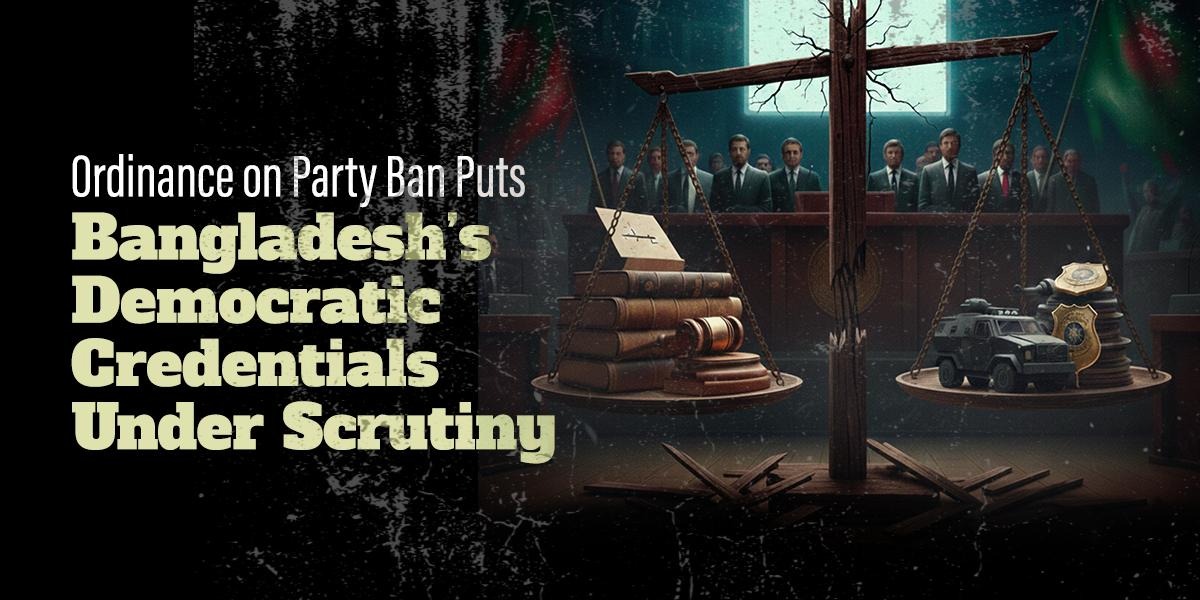
As Bangladesh’s newly elected government led by the Bangladesh Nationalist Party (BNP) assumes office, it confronts a significant constitutional and political question: whether to uphold or reverse a controversial ordinance introduced under the previous interim administration that enabled the banning of political parties.
On 10 May 2025, the interim government amended the Anti-Terrorism Act 2009 through a presidential ordinance. Using the newly expanded powers, it moved to ban all activities of the Bangladesh Awami League. As a result, the party lost its registration with the Election Commission and was unable to contest the subsequent parliamentary election.
The measure was enacted in the absence of a sitting parliament. Under Article 93 of the Constitution of Bangladesh, ordinances promulgated by the president must be placed before parliament and approved within 30 days of its first sitting in order to remain in force. The newly convened legislature must now decide whether to ratify or allow the ordinance to lapse.
A Constitutional Crossroads
Supporters of repeal argue that allowing the executive branch to ban or suspend political parties risks undermining democratic pluralism. They say such powers, once normalised, could be used by future governments against a range of political opponents.
Comparative constitutional practice in democratic systems generally treats the dissolution of political parties as an exceptional step. It is typically justified only where there is judicially established evidence linking an organisation to terrorism, violent extremism or actions that threaten the constitutional order. Critics of the ban contend that no such judicial determination has been made in this instance.
Questions of Due Process
Another concern raised by legal analysts relates to the scope of the amendment itself. The ordinance allows for the “temporary” suspension of political parties but does not clearly define time limits, procedural safeguards or mechanisms for independent judicial oversight. Observers warn that this could result in de facto long-term bans without full legal scrutiny.
The amendment also introduced provisions criminalising various forms of support for a banned organisation, including expressions on social media. Human rights advocates argue that such measures may have a chilling effect on political expression and civic participation.
Collective Responsibility Debate
International legal standards generally emphasise individual criminal responsibility rather than collective punishment. Critics argue that banning an entire political party for alleged wrongdoing by specific individuals risks conflating personal liability with organisational existence — a step they say could set a troubling precedent.
BNP’s Stated Position
Senior figures within the BNP, including its acting chairman Tarique Rahman and secretary general Mirza Fakhrul Islam Alamgir, have previously stated that they do not support the banning of political parties as a matter of principle. Observers note that the party’s response to the ordinance will now test whether those statements translate into legislative action.
A Signal for the Future
If parliament declines to ratify the ordinance, it would effectively nullify the amendment, signalling a move toward broader political inclusion and constitutional normalcy. If retained, however, the provision would remain part of the legal framework — potentially available to future governments confronting political rivals.
The decision is likely to shape perceptions of Bangladesh’s democratic trajectory at a moment when questions of political participation, institutional independence and the rule of law remain central to public debate.