

Election Truly Free and Fair?
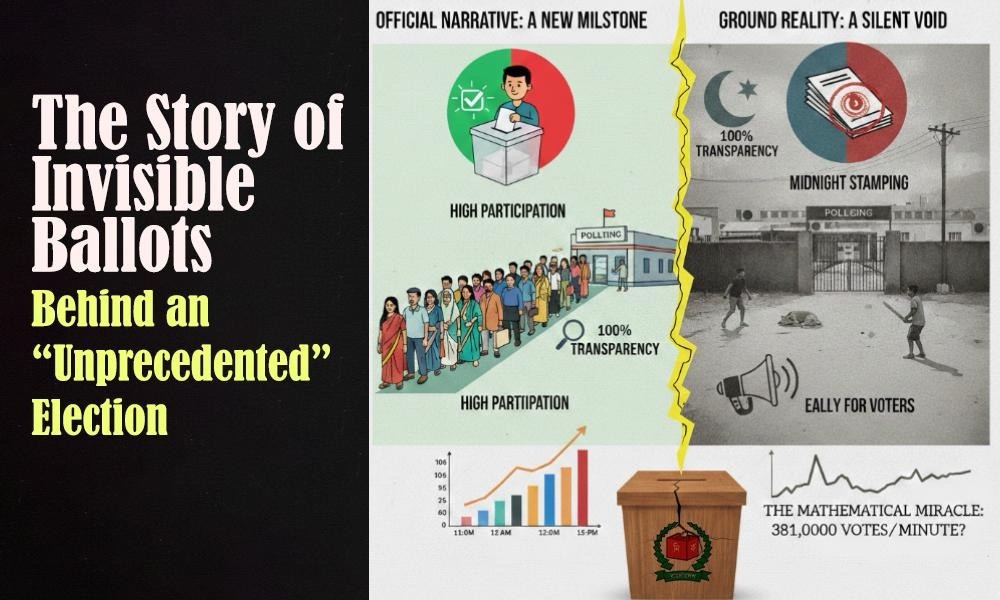
The question of fairness and credibility surrounding Bangladesh’s 13th National Parliamentary Election is no longer confined to political debate. In its post-election observation, Transparency International Bangladesh (TIB) has published statistics that directly challenge the very foundation of the electoral process. When viewed collectively, the data make it clear that the vote was not merely non-competitive in many areas—it effectively turned into a controlled process.
According to TIB, voters were obstructed from entering polling centers in 46.4 percent of cases. In other words, in nearly one out of every two centers, the opportunity to exercise voting rights was curtailed from the outset. Additionally, allegations of ballot stuffing surfaced in 21.4 percent of centers, raising serious doubts about the authenticity of voter turnout figures. In 14.3 percent of cases, ballots were reportedly stamped even before voting officially began.
These irregularities were accompanied by allegations of direct coercion and control. TIB’s observations indicate that in 35.7 percent of cases, voters were forced to cast their ballots for specific symbols. Booth capturing was documented in 14.3 percent of centers, and in the same proportion, opposition polling agents were prevented from entering. As a result, in many areas, the electoral contest effectively became one-sided.
The role of the administration and law enforcement agencies—entrusted with safeguarding electoral integrity—also comes under scrutiny in these statistics. TIB reports that in 21.4 percent of cases, authorities remained inactive in preventing irregularities. Furthermore, in 10.7 percent of cases, there were allegations of non-cooperation by law enforcement and, at the same rate, biased conduct by returning officers and other officials. In other words, irregularities not only occurred but were often left unaddressed.
Another critical dimension of electoral transparency—information flow and media access—also appears to have been restricted. According to TIB, 4G and 3G networks were shut down in 7.1 percent of cases, and journalists were obstructed from gathering information at polling centers at the same rate. This limited the public’s access to on-the-ground realities.
Instability did not subside even after vote counting. Allegations of fraud during counting emerged in 7.1 percent of cases, and 125 post-election violent incidents were documented. This continuity suggests that the process failed to gain broad acceptance not only on election day but even after results were declared.
Against this backdrop of widespread irregularities, particular attention has been drawn to several constituencies along the West Bengal–Bangladesh border, where parties such as Jamaat-e-Islami Bangladesh experienced electoral gains or increased influence. Given that TIB’s own statistics call the electoral process into question, it is difficult to ignore the connection between that process and these political shifts.
Taken together, TIB’s findings present a stark picture. Voting rights were widely obstructed, allegations of ballot stuffing and pre-stamped ballots were recurrent, administrative neutrality was questioned, and information flow was restricted. Judging the 13th National Parliamentary Election solely by its results leaves the picture incomplete.
The unforgiving language of statistics brings one central question to the forefront:
Was this truly a free and fair election—or merely a formal procedure?