
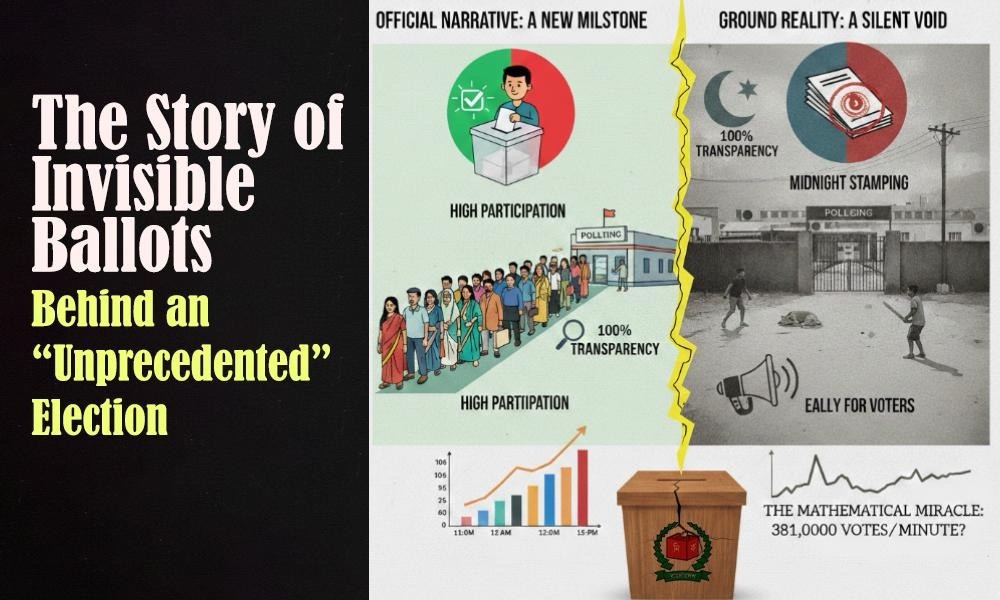

At yesterday’s press conference, the Chief Adviser’s press wing described the recent election as the “best” and “unprecedented” in Bangladesh’s history. Listening to the polished language, one might think it marked a new milestone of participation, transparency, and public trust.
But realities on the ground tell a different story. That story includes empty polling stations, ballots stamped in advance, votes cast by someone other than the actual voter, and an uncomfortable administrative silence.
A Day of Voterless Democracy
Morning turned into afternoon, afternoon into evening—yet in many centers there were not just no lines, but barely any voters at all. Election officials leaned back in their chairs chatting, scrolling on their phones, or passing time over tea.
In some places, dogs lay peacefully in front of polling stations while teenagers played cricket nearby. Instead of the usual intensity of election day, there was an unusual stillness.
The question arises: how can an election without voters be called “unprecedented”?
When the Secret Ballot Becomes an Open Stage
Video footage from various centers shows that even the minimum standards of booth secrecy were not maintained. Ballots were stamped openly.
There were no voters in line, yet ballot boxes gradually filled. This contradiction has fueled controversy. When elections move forward not by voters’ hands but by the speed of stamped seals, the credibility of the outcome inevitably comes into question.
The Night Before: The Beginning of Invisible Votes
The most serious allegation is that ballot stamping began the evening before polling day, after Maghrib prayers, at certain centers.
According to local observers, the process of ensuring “safe results” was completed under cover of darkness—turning election day into a mere formality.
One Person’s Vote, Another’s Finger
Voters were absent—yet votes were recorded. How?
Allegations suggest that votes were cast by individuals other than the legitimate voters. Whether due to lax identity verification or deliberate negligence, such actions severely undermine electoral fairness.
Ballot Box Security: On Paper or in Practice?
Reports have emerged from some areas of ballot box snatching, center takeovers, and forcible control. While these incidents are described as limited, even a single occurrence raises serious concerns about the robustness of security measures.
Crowded Booths with Agents
Election rules specify a fixed number of agents per candidate. However, complaints suggest that in many booths multiple unauthorized agents were present—potentially creating psychological pressure on voters and casting doubt on the freedom of the vote.
Law Enforcement: Active or Observers?
Questions have also been raised about the role of law enforcement agencies assigned to oversee the election.
In some centers, their passive presence—where allegations of irregularities were visible but no apparent action was taken—has been described by critics as symbolic not of neutrality, but of indifference.
Calls to Vote Over Mosque Loudspeakers
One of the most unusual allegations is that mosque loudspeakers in neighborhoods were used to call on voters to come to polling stations.
Such scenes are rare in Bangladesh’s electoral history. They not only indicate low voter turnout but also raise questions about the effectiveness of election management.
Official Narrative vs. Ground Reality
On one side: press conference statistics, expressions of satisfaction, and the label “unprecedented.”
On the other: empty polling stations, pre-stamped ballots, and administrative laxity.
This dual reality now sits at the center of public debate.
Democracy derives its strength not merely from results, but from process. If voters do not show up and ballots are already filled, an election may be administratively completed—but politically it risks losing legitimacy.
Conclusion: Questions Remain
Was this truly the best election in history—or one of the most controversial?
Without independent investigation, transparent disclosure of information, and an environment of political trust, the answer will remain elusive.
Because in the end, democracy survives not in ballot boxes—but in voter confidence.
And once that confidence cracks, even the word “unprecedented” can become synonymous with controversy.